PART 1 OF 7 · ACCURATE AI VISIBILITY
Accuracy Is the Only AI Visibility That Counts

Accurate AI Visibility, Part 1 of 7
Get described correctly first. Make it easy to find second.
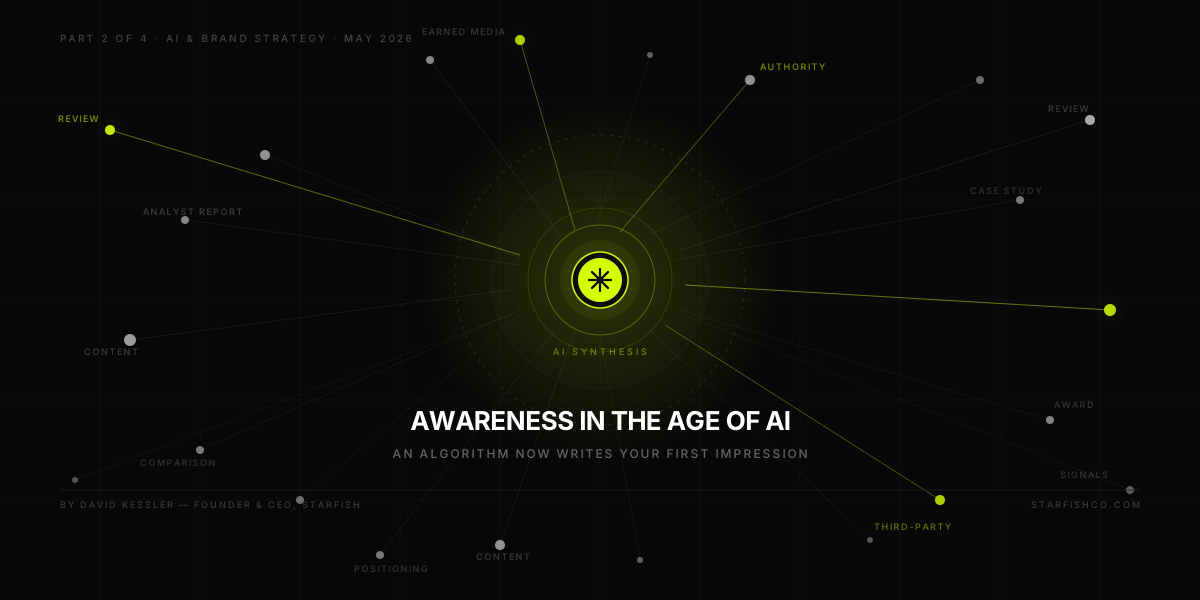
Before a buyer ever reaches your site, they now ask a machine who to consider and choose. They type your category into ChatGPT, Claude, Gemini, or Google’s AI Mode, and the system answers in one confident paragraph. It names a few brands. It describes each in a sentence. It cites some sources and ignores others. You don’t see that answer, you don’t get told when it changes, and too often it is assembled from sources nobody inside the company ever wrote.
That answer is your brand’s first impression now. And in 2027, getting it right belongs at the top of the CMO’s desk. The first thing AI Brand Strategy insists on is the thing most teams get backward: accuracy comes before visibility. Get described correctly first. Make it easy to find second. Reverse that order, and you don’t just waste the effort. You make the problem worse.
AI Brand Strategy is the work of making AI answers about your brand accurate first, then visible. It governs what AI systems say about you, where they get it, and what to correct, so people and machines encounter the same accurate story. The result it produces is AI Brand Visibility, which always means accurate visibility, never presence alone. That definition sits alongside our other writing on how brand consistency became non-negotiable; this piece is about the order the work has to follow.
The instinct everyone has is wrong
When marketers discover AI is misrepresenting them, the reflex is to chase visibility. Get mentioned more. Rank higher. Appear in more answers. It feels like progress. It’s the opposite. The work lands with whoever owns search, whose scoreboard is traffic and clicks, so the goal quietly shifts from being described correctly to being mentioned at all.
Here’s why that backfires. These systems assemble what they say about you from what they’ve read and seen repeated. Push harder on visibility while the description is still wrong, and you don’t fix the answer. You amplify it. You teach the models a louder version of the wrong story, across more surfaces, with more sources echoing it. A partial effort isn’t neutral. It’s worse than not starting at all.
You wouldn’t build on a cracked foundation. Think of it this way: visibility is the house. Accuracy is the ground it stands on.
The wrong answer hardens, and the clock is running
Every month a description circulates unchallenged, it costs more to correct. These systems assemble what they say from what’s been written and repeated, and the longer a version goes uncorrected, the more sources pick it up, the more answers repeat it, and the more the model trusts it. What starts as a careless line on a third-party directory becomes, within months, the consensus the machine defends. We have written about why an inaccurate AI description gets harder to fix over time.
This is already mainstream, not a future problem. Buyers are already using generative AI to research vendors and products. The job has landed. The decision that remains is whether you govern that answer on purpose.
What accurate actually means
Accuracy here isn’t an aspiration. It’s specific. It means the facts about your brand (what you’re called, what you do, what you’re best at, who you serve) survive being summarized by a machine and come out intact. It means that when an engine is asked to describe you, it reaches for language you authored, not language a review aggregator guessed.
Getting there is a sequence. Settle what you’re called and what you’re best at. Write it down as a single governed source of truth. Get that language into the sources these systems actually read. Then make it easier to find. That foundation holds even as the engines keep changing underneath you, because you’ve fixed the input, not chased the output.
This is not an SEO or AEO tactic with a new name. Findability is a downstream step. Why the AEO playbook will not save you is the existing argument; Part 2 of this series takes the distinction further.
The takeaway for CMOs
AI is going to answer for your brand whether you govern it or not. The decision left to you is whether you govern that answer so it is accurate before it is loud. Start with a baseline, not a budget. Find out what the machines say about you today, correct it at the source, and let visibility compound on a foundation that is actually true. The free AI Brand Visibility Assessment shows whether AI answers describe your brand clearly and correctly, because the answer has to be accurate before it is visible. In 2027, the brands that win this are the ones that refused to confuse being seen with being right.
Related reading: the three ways AI gets your brand wrong, and what AI Brand Visibility actually means when the answer is accurate first, then visible.
Starfish is a Branding and Creative Agency that builds brands with the soul to move people and the coherence to govern AI. Its expertise in Brand Experience is what enables it to lead in AI Brand Strategy.
Frequently Asked Questions
Read MoreRead Less
Why does accuracy come before visibility in AI search?
Because AI systems build their answers from repetition. If the description of your brand is wrong, increasing your visibility simply spreads the wrong version across more answers and more sources. Correcting the description first means every gain in visibility reinforces something true.
Isn’t getting mentioned more by AI a good thing?
Only if what’s being said is right. Being named more often while being described incorrectly scales the error. Mentions are a vanity signal. An accurate, well-sourced description is the asset.
How do I find out what AI says about my brand today?
Run a structured set of prompts across every major AI engine, and map how you’re described, which sources each answer draws from, and how much of each answer comes from your own site. How to audit what AI says about your brand walks through that method. The free AI Brand Visibility Assessment shows whether AI answers describe your brand clearly and correctly, because the answer has to be accurate before it is visible.
How long does an inaccurate AI description take to fix?
It depends on how long it has circulated and how many sources repeat it. The cost rises over time, because descriptions harden as they age. The earliest correction is always the cheapest.