Why Marketing Fails Without Brand Conviction
Most marketing campaigns don’t fail because of poor execution. They fail because the brand behind them doesn’t truly believe in what it’s saying. You can have the most sophisticated targeting, the most polished creative, and the biggest budget, but without genuine conviction at the core of your messaging, audiences will sense something is off.
This is one of the most overlooked problems in modern marketing. Brands invest heavily in tactics while neglecting the foundational belief system that makes those tactics resonate. The result is forgettable campaigns, weak audience connections, and wasted spend.
In this analysis, we’ll break down exactly why conviction is the missing ingredient in so many marketing strategies. You’ll learn how to identify the warning signs of conviction-free messaging, understand the psychological reasons why audiences respond to authentic brand belief, and discover practical ways to rebuild your marketing around a stronger, more credible foundation. Whether you’re refining an existing brand or diagnosing why your current efforts aren’t landing, this breakdown will give you a sharper, more honest perspective on what effective marketing actually requires.
The Marketing Illusion: Tactics Without a Foundation
There is a quiet crisis running beneath the surface of modern marketing, and the numbers expose it plainly. According to Venngage’s 2026 design and marketing trends survey, 43% of marketers identify keeping AI outputs on-brand as their single greatest challenge, outranking concerns about content quality, prompting complexity, and tool adoption. That statistic is not a technology problem. It is a strategy problem, and it points to something far more systemic: most organizations have never clearly defined what their brand actually stands for in the first place.
The proliferation of AI-generated content has created a paradox at the heart of marketing. Execution has never been faster, cheaper, or more abundant. Nearly 94% of marketers are already using or planning to use AI in their content workflows in 2026, producing blogs, emails, social assets, and visual media at volumes previously unimaginable. Yet brand differentiation has never been harder to achieve. When every organization has access to the same tools, the same platforms, and the same playbooks, the resulting output converges toward sameness. Generic content saturates every channel. Audiences grow fatigued. Trust erodes. As one analysis of the rise of corporate marketing illusion observed, volume has become a substitute for strategy, and noise has replaced conviction.
The root cause is structural. Most organizations treat marketing as an output layer: a revolving sequence of campaigns, content calendars, paid media activations, and channel-specific tactics. Each piece is optimized in isolation, rarely interrogated as the expression of a coherent organizational belief system. Brand guidelines exist as PDF documents rather than decision filters. Voice and tone frameworks gather dust while AI tools generate at scale without meaningful governance. The result is fragmentation dressed up as productivity.
The organizations demonstrating the strongest brand performance in 2026 are not winning by outspending their markets on media. They are out-believing their competitors at the brand level, building marketing on a foundation of clearly articulated identity, consistent conviction, and deliberate coherence across every touchpoint. The core argument is straightforward: marketing without conviction is noise. And the only sustainable foundation beneath effective marketing is a brand identity defined not by what an organization does, but by what it uncompromisingly believes.
What Marketing Actually Is and What Most Organizations Get Wrong
Marketing, at its most reductive, gets treated as a synonym for promotion: the ads you run, the emails you send, the social posts you schedule. This conflation is understandable, but it is also one of the most costly misunderstandings in business strategy. The true function of marketing is the translation of brand meaning into audience action, converting what an organization believes and stands for into consideration, preference, purchase, and loyalty. Promotion and distribution are tools within that function, not the function itself. When organizations treat the tools as the strategy, they build on sand.
The Execution-Expression Divide
The most consequential distinction in marketing practice is the gap between marketing-as-execution and marketing-as-expression. Execution-oriented marketing chases attention: it optimizes click-through rates, tests headlines, and measures impressions. These activities have genuine value, but they operate on borrowed time. Expression-oriented marketing builds mental availability, distinctiveness, and trust; the kind of equity that makes every future campaign more efficient and every customer relationship more resilient. Research from NielsenIQ indicates that brand strength accounts for roughly 30% of revenue across categories, a figure that reflects the compounding logic of expression over pure execution. Short-term tactics rent demand; brand equity invests in it.
This distinction matters even more in 2026, when more than 80% of marketers are using AI tools for content and media production. The result is a market flooded with competent but interchangeable outputs. According to research on how marketing and advertising differ in function and purpose, marketing’s role extends far beyond advertising into the alignment of product, experience, pricing, and communication around a coherent value proposition. Organizations that understand this will use AI to scale expression. Those that do not will use it to amplify noise.
The Cost of Skipping the Foundation
Brand positioning, messaging architecture, and narrative coherence are prerequisites for effective marketing, not outputs of a successful campaign. Without them, tactics lack direction. Campaigns contradict each other across touchpoints. Teams default to volume because they have no filter for quality. The result is a cycle of perpetual reinvention: new campaigns that generate short-term spikes but accumulate no durable brand value. Businesses without a documented brand strategy report stagnant or declining ROI significantly more often than those with one, a gap that widens as competitive environments intensify.
The solution is to treat brand as an organizational operating system, a decision filter that runs across strategy, product development, culture, and customer experience simultaneously. When brand functions as the strategic core of the marketing mix rather than a style guide that lives in a PDF, marketing coherence becomes a structural outcome rather than a creative aspiration. Every touchpoint reinforces the same conviction. Every campaign draws from the same meaning. And every dollar spent builds on the equity accumulated by everything that came before it.
Six Forces Reshaping Marketing Right Now
Marketing in 2026 does not suffer from a shortage of forces acting upon it. It suffers from organizations that meet those forces with tactics rather than foundations. Drawing on Forbes contributor Kate Hardcastle’s analysis of six forces shaping consumer behavior in 2026, the picture that emerges is not a checklist of discrete trends to monitor. It is a convergent set of pressures, each reinforcing the others, that collectively recalibrate how consumers assign value, extend trust, and make decisions.
These six forces span algorithmic personalization, unfiltered authenticity, rewired wellness expectations, redefined value, experiential depth, and proof-led sustainability. Taken individually, each presents both a challenge and a genuine strategic opening. Taken together, they expose a fault line running through every organization’s marketing posture: those operating from a clear brand conviction, a defined belief system that aligns strategy, product, and communication, are positioned to convert each force into differentiation. Those operating without one are likely to experience the same forces as mounting erosion, competing on cost, chasing aesthetic trends, or making claims the market no longer accepts.
The asymmetry here is significant and worth naming directly. Research consistently shows that brand clarity functions as a multiplier across every downstream marketing decision. Without it, organizations may respond to each force in isolation, producing fragmented, reactive work that compounds inconsistency rather than resolving it.
AI Saturation and the Authenticity Backlash
Generative AI has done something unprecedented to the content landscape: it has industrialized creative output at a scale that outpaces any organization’s ability to consume it meaningfully. By 2026, estimates suggest AI-generated material accounts for roughly 64% of newly published internet content, with teams adopting AI tools producing four times more content than those that have not. The result is not abundance. It is indistinguishable sameness that floods every channel with competent, polished, and ultimately forgettable output. When every brand uses the same tools, trained on the same data, optimized for the same engagement signals, differentiation does not just erode. It collapses.
Audiences and algorithms are already recalibrating. Consumer preference for AI-generated creator content dropped from 60% in 2023 to just 26% in 2025, a striking reversal that reflects a deeper hunger for earned credibility and genuine human perspective. Research on the “AI-authorship effect” confirms that when audiences perceive content as machine-generated, they rate it as less authentic, demonstrate measurable reductions in purchase intent, and are less likely to share or advocate. Platforms are responding in kind, with search and social algorithms updating to surface originality signals and deprioritize low-quality synthetic material. The authenticity backlash is not a cultural moment; it is a structural market shift that is actively repricing what brand distinctiveness is worth.
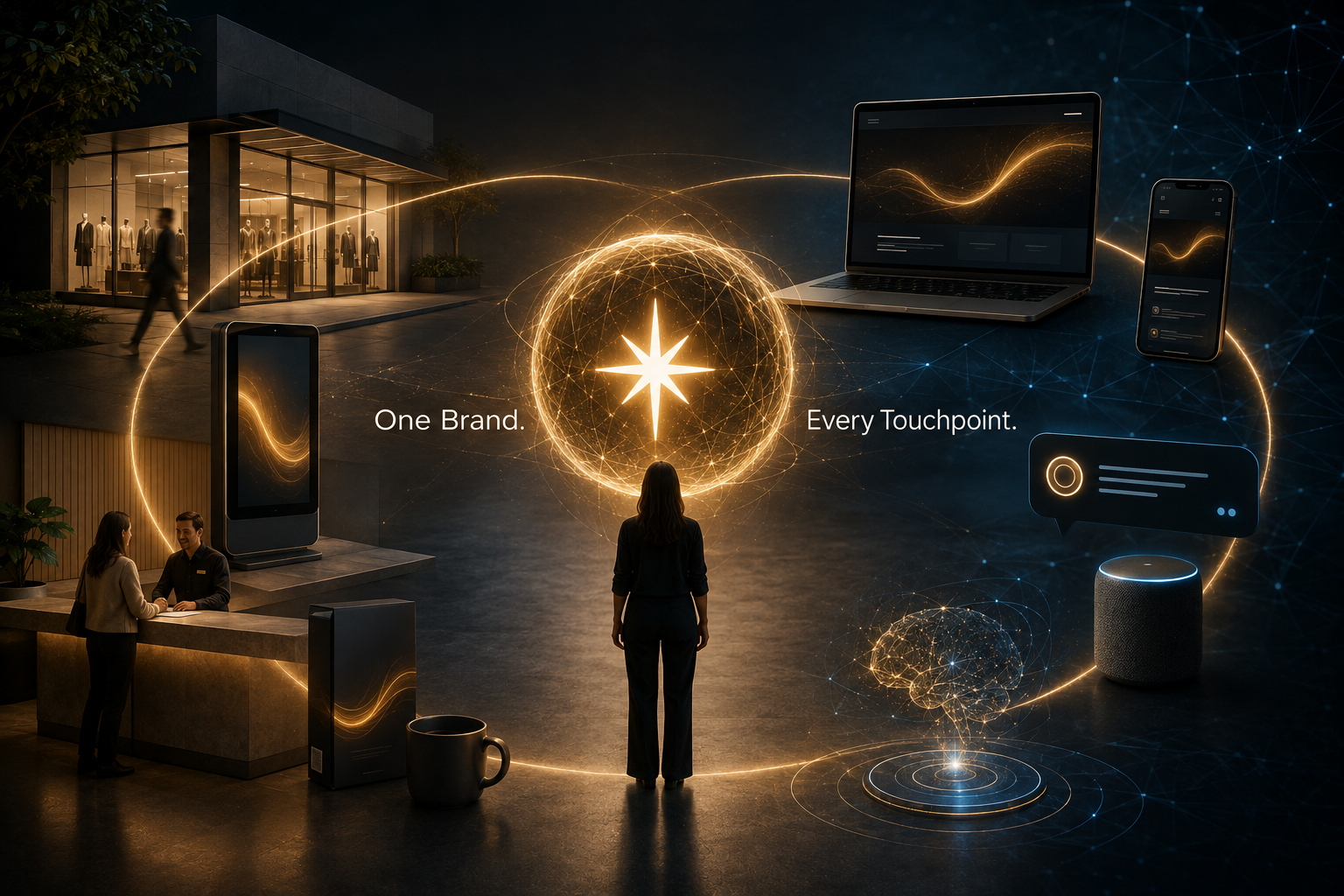
This repricing creates a concrete competitive premium for organizations capable of articulating and sustaining a distinct point of view. Brands that have invested in a documented belief system, a clear worldview, a set of convictions they will not compromise on, are better positioned to cut through the noise because their output carries something AI cannot manufacture: specificity of soul. This is precisely what Starfish refers to as a Brand Creed, a bold, emotive declaration of what an organization stands for and refuses to abandon, which functions as a North Star for every piece of content, every campaign decision, and every customer interaction. Without it, brands have no reliable filter to distinguish their voice from anyone else’s, and no mechanism to protect that voice when production is handed to automated systems.
The operational consequences are measurable. Forty-three percent of marketers identify keeping AI outputs on-brand as a top challenge, a statistic that sounds like a technology problem but is, at its root, an identity problem. AI tools do not drift off-brand because they are poorly configured. They drift because the brand itself was never fully defined, documented, or treated as a strategic asset. When the belief system is vague, the guidelines are shallow, and the tone of voice exists only in someone’s institutional memory, no amount of AI prompting or post-production review will hold the output together. The 43% struggling with on-brand AI are experiencing the downstream symptom of an upstream failure: a brand identity that was never built to function as an operating system in the first place.
Brand as Infrastructure and Operating System
The proliferation of AI-native operations has exposed a structural weakness that most marketing organizations have not yet named clearly. When AI tools handle content creation, customer journey orchestration, and real-time personalization simultaneously, they do not introduce inconsistency on their own. They amplify whatever inconsistency already exists in the brand’s foundation. According to industry research, 43% of marketers cite keeping AI outputs on-brand as a top challenge, and that figure will only climb as AI moves from tool to infrastructure, managing campaigns end-to-end with minimal human intervention. Without sharp, machine-parseable brand positioning, organizations discover that scaling AI operations means scaling drift.
This is precisely why traditional brand guidelines have become insufficient as a governance mechanism. Documents that specify typefaces, color palettes, and tone-of-voice descriptors were designed for human teams operating at human speed. They were never engineered to function as decision filters across hundreds of automated touchpoints, distributed departments, and third-party AI systems. Research confirms the gap: 95% of organizations maintain brand guidelines, yet only 25% formally enforce them, and 47% publish off-brand content every year. What organizations need instead is a brand belief system, a creed that articulates what the organization stands for and refuses to compromise on, embedded deeply enough that it governs decisions before any creative work begins. When brand operates at this level, it functions less like a style guide and more like an operating system that coordinates behavior and allocates resources across the entire organization.
The downstream effect on marketing execution is significant. When brand operates as infrastructure rather than output, individual marketing channels stop functioning as siloed campaigns and begin functioning as coherent expressions of a single identity. Social content, paid media, sales conversations, product interfaces, and customer service interactions all draw from the same source of organizational conviction. Consumer expectations demand nothing less: 90% of buyers expect consistent experiences across channels, yet fragmented brand governance makes that consistency structurally impossible to maintain at scale.
The business case for this shift is measurable. Consistent brand presentation increases revenue by up to 23%, while fragmented approaches force organizations to spend up to 1.75 times more in media to achieve equivalent results. Marketing teams in fragmented environments waste roughly 4 hours per week searching for approved assets, and poor brand alignment consumes approximately 10% of marketing budgets in inefficiency alone. Conversely, organizations that treat brand as foundational architecture rather than marketing decoration build compounding recognition over time, where each touchpoint reinforces the last rather than competing with it.
Organizations that continue treating brand as a campaign output will encounter a specific and predictable problem as they scale: fragmentation compounds faster than coordination can contain it. Each new team, channel, geography, or AI system added to the operation introduces another potential point of divergence. Research shows that silos prevent consistency in 42% of brands and that inconsistent usage creates measurable market confusion for 60% of managers who oversee multi-channel programs. The solution is not more guidelines. It is elevating brand to the level of organizational infrastructure, where the belief system functions as a decision filter that makes coherence the default rather than the exception.
The End of Unmeasured Marketing Spend
The pressure has been building for years, but 2026 represents a clear inflection point. Deloitte Digital’s Marketing Trends 2026 report identifies the end of “blind” marketing spend as one of five defining forces shaping the discipline, driven by economic tightening, constrained budgets, and boards that no longer accept vague awareness metrics as proof of value. Gartner’s CMO Spend Surveys reinforce this reality: marketing budgets have flatlined at roughly 7.7 to 7.8 percent of company revenue, and 56 percent of CMOs report insufficient budget to execute their stated strategy. CFO scrutiny has intensified sharply, with board pressure on marketing rising 21 percent between 2023 and 2025. Every dollar now requires a narrative, and that narrative must connect directly to revenue or demonstrable brand value.
The channels where that performance pressure plays out most visibly are short-form video, social commerce, creator partnerships, and zero-click search. Short-form video commands the highest reported ROI of any content format, with 49 percent of marketers citing it as their leading driver. Social commerce collapses the distance between discovery and purchase, turning platforms into direct revenue infrastructure. Creator partnerships have matured beyond vanity metrics into pipeline and conversion accountability. Meanwhile, zero-click search, where AI-generated overviews answer queries without a single referral click, now accounts for an estimated 58 to 65 percent of searches, fundamentally rewiring how brands must think about organic visibility.
What this environment exposes is the structural fragility of performance marketing when it operates without a brand foundation beneath it. As acquisition costs climb and audiences develop resistance to purely transactional messaging, conversion efficiency deteriorates. The WARC Multiplier Effect report, developed with Analytic Partners and System1, demonstrates that brand equity functions as a multiplier rather than an additive, amplifying the returns generated by performance investment rather than simply running alongside it. Organizations that have built genuine brand equity consistently report lower cost-per-acquisition, stronger organic preference, and higher lifetime value, precisely because recognition and trust reduce the persuasion work that paid media must otherwise carry.
This compounding dynamic demands a corresponding evolution in measurement. Attribution models that stop at the conversion event capture only a fraction of marketing’s actual contribution. Robust measurement frameworks in 2026 integrate media mix modeling, brand health tracking, and equity indicators alongside conversion data, creating a complete picture of how campaign activity translates into both immediate revenue and long-term commercial resilience. Marketing that cannot demonstrate its effect on brand health as well as pipeline will continue to face budget cuts, regardless of short-term conversion performance. The organizations that connect these two dimensions consistently are the ones positioned to allocate with confidence rather than defensiveness.
Hyper-Personalization at Scale
AI-driven predictive analytics and generative content have fundamentally altered what personalization means in practice. What once required enterprise-scale budgets and manual segmentation teams now operates through unified customer data platforms, real-time decisioning engines, and generative systems that produce tailored message variants at volume. Research indicates that 91% of consumers prefer personalized experiences, and organizations with mature personalization capabilities generate roughly 40% more revenue from those efforts than their peers. The technical ceiling has effectively been removed. The remaining constraints are strategic, not infrastructural.
The problem that emerges at scale, however, is one of coherence. When AI systems generate individualized content across email, web, paid media, and social simultaneously, and those systems lack a shared brand foundation to draw from, the result is fragmentation. No two customers encounter the same brand. Tone shifts. Value propositions vary. The cumulative experience feels less like a consistent relationship and more like a collection of unrelated interactions. Research into digital marketing in 2026 confirms that while AI integration is accelerating personalization capability, the organizations struggling most are those deploying it without the brand architecture to govern outputs. Notably, 43% of marketers already cite keeping AI outputs on-brand as a top operational challenge.
The real constraint, then, is not technical capability but brand specificity. You can only personalize expressions of something that is clearly defined at the core. Without a well-articulated positioning, a defined voice, and non-negotiable brand commitments, AI systems have nothing consistent to vary from. They produce relevance without identity.
Organizations with strong brand foundations experience this differently. For them, personalization functions as amplification rather than substitution. Their AI systems operate within brand prompt libraries, governance checkpoints, and decisioning rules that enforce tone, claim boundaries, and what the brand will never say. Every personalized variant feels like the same coherent brand, simply expressed in a context-appropriate way. The strategic question is never how to personalize more aggressively. It is how to personalize in ways that deepen brand meaning rather than dilute it, turning each individualized touchpoint into proof of a singular conviction rather than evidence of inconsistency.
Human Empathy and Experiential Design as Trust Builders
The antidote to AI-generated impersonality is not more content. It is more humanity. As generative tools flood channels with technically competent but emotionally hollow output, research confirms what practitioners are observing firsthand: 25% of consumers view AI-generated social copy as impersonal and 20% regard it as untrustworthy. Empathy-driven content and experiential design are stepping into that credibility gap, functioning as primary trust-building mechanisms precisely because they signal something no algorithm can manufacture at scale, which is genuine investment in the human relationship.
Experiential marketing makes that investment visible and felt. The global experiential marketing market was valued at approximately $55 to $59 billion in 2025, and 80 to 84% of consumer marketers planned budget increases for 2026, many by double digits. The data behind those budgets is compelling: 85% of attendees report greater purchase likelihood after a live event, 91% feel more positive about a brand following direct experience, and experiential campaigns routinely generate three to five times ROI compared with digital-only alternatives. Immersive digital environments, hybrid in-person formats, and high-touch service design extend these effects beyond physical geography. Each of these investments communicates a commitment that a content calendar cannot replicate.
Clarity in messaging deserves equal strategic weight. Plain, direct communication that aligns precisely with audience pain points is itself an act of empathy; it respects attention, reduces cognitive load, and demonstrates that a brand has actually listened. Jargon and complexity signal the opposite, creating distance where proximity is needed.
This pressure concentrates most intensely in regulated sectors. In healthcare, legal services, and financial services, trust is not a conversion driver; it is a prerequisite. Patients are not buying products. Legal clients are not browsing options casually. Financial decisions carry emotional and security dimensions that demand advisor-like relationships, built slowly through transparency and consistent human presence. Organizations that invest in coherent tone of voice, purposeful visual identity, and seamlessly designed service touchpoints build the kind of durable audience relationships that outperform any single campaign, especially as AI saturation continues to erode the baseline credibility that brands once took for granted.
Why Independent Agencies Are Gaining Ground
The structural shift in how organizations select agency partners is no longer a matter of preference. It reflects a fundamental recalibration of what marketing effectiveness actually requires. Large holding company networks and major consultancy practices bring undeniable advantages in global scale and integrated resources, but those same structural qualities introduce considerable friction. Multiple approval layers, extended onboarding timelines, and minimum investment thresholds that frequently exclude growth-stage or mid-market organizations all erode the responsiveness that modern brand challenges demand. Holding company market share of U.S. advertising spend declined from roughly 44% in 2019 to under 30% by 2025 in several analyses, a signal that client priorities have shifted meaningfully.
Independent agencies with genuine strategic depth operate differently by design. Senior talent engages directly on every engagement rather than appearing at the pitch before handing work to junior teams. Iteration cycles compress because decisions travel shorter distances. Collaboration becomes a real working mode rather than a managed process. Client reviews on platforms tracking agency performance consistently surface two differentiators above all others: responsiveness and creative quality. Both are structural outputs of how independent agencies are built, not simply cultural attributes.
The agility advantage becomes most consequential precisely when the stakes are highest. Brand repositioning, rapid market entry, or crisis response each require fast strategic alignment, the kind that dissolves when work must pass through multiple internal hierarchies before a direction is confirmed. An agency that operates with a lean, specialist structure can pivot, pressure-test, and activate without waiting for consensus to form across organizational layers.
Starfish represents the competitive shape this model takes in practice. With 11 to 50 specialist employees operating across New York City, France, and Florida, and a client portfolio spanning six continents, the agency demonstrates that geographic reach and sector depth do not require institutional scale to achieve. The model favors conviction over volume and coherence over coverage, which is precisely the combination that organizations navigating complex brand moments need most.
Why Most Marketing Fails Before the First Campaign Launches
The pattern is consistent across industries, organization sizes, and budget levels: when marketing underperforms, the instinct is to interrogate the execution. Teams audit the creative, revisit the media mix, replace the agency, or increase spend. What they rarely examine with equal rigor is the foundation that was laid, or more precisely, the foundation that was never laid at all. Underperforming campaigns, inconsistent messaging, poor channel ROI, and fragmented customer experiences almost universally trace back not to execution failures but to foundational brand ambiguity. The problem precedes the brief. It precedes the campaign. In many cases, it precedes the first hire on the marketing team.
Research consistently supports this diagnosis. Organizations without a documented digital marketing strategy anchored in clear brand positioning report declining or stagnant ROI at dramatically higher rates than those with defined strategic foundations. The gap is not marginal. It is structural. When there is no documented articulation of what the brand stands for, what it refuses to compromise on, and why it matters to a specific audience, every campaign decision gets made in isolation. Creative teams interpret the brand through their own lens. Channel specialists optimize for their own metrics. Agency partners work from briefs that describe the product but not the conviction behind it. The result is a portfolio of disconnected touchpoints that individually may function adequately but collectively build nothing cumulative.
This is the compounding value problem that most marketing organizations underestimate. Brand recognition, trust, and preference are not built through single exposures; they accumulate through repeated, coherent signals over time. Each inconsistent message, each campaign that contradicts the last, each channel execution that presents a slightly different version of the organization erodes that accumulation rather than adding to it. Without a stable strategic foundation, organizations are not simply failing to grow their brand equity. They are actively depleting it with each new campaign cycle.
The Brand Creed as a Pre-Campaign Prerequisite
This is precisely the problem the Brand Creed framework is designed to solve, and it does so by shifting the sequence of work entirely. Before a single word of copy is written, before a visual identity is considered, before a channel strategy is mapped, the most important strategic work is to unearth the belief system at the heart of the organization. The Brand Creed goes beyond the conventional elements of a brand platform. Purpose statements, mission declarations, and positioning frameworks are useful, but they tend to remain rational and operational in character. They describe what a company does or who it serves. A Brand Creed adds the layer that drives behavioral coherence: a bold, emotive declaration of what the organization genuinely stands for, what it refuses to trade away under competitive or commercial pressure, and why that conviction matters to the people it serves.
When this foundational work is completed before creative execution begins, everything downstream becomes more efficient and more aligned. Campaign briefs have a clear north star. Creative teams make decisions from a shared conviction rather than individual interpretation. Internal stakeholders recognize their organization in the work. And audiences, who are extraordinarily attuned to authenticity in an era saturated with AI-generated content, receive a signal that feels consistent, trustworthy, and distinctly human.
Evidence From Organizations With Brand Conviction
The proof is visible in the client portfolio Starfish has built since 2002 across six continents. Organizations such as Avis, Gallup, and PwC do not achieve marketing coherence by accident. They achieve it by treating brand strategy as the prerequisite to activation, not the afterthought that gets commissioned after campaigns have already launched and underperformed. Across sectors including healthcare, travel, and professional services, clients that invest in foundational brand clarity before execution consistently demonstrate stronger internal alignment, faster creative development cycles, and more resonant communications that build cumulative brand equity rather than fragmenting it. The marketing that works is almost always the marketing that knew exactly what it believed before it ever asked an audience to believe it too.
What Effective Marketing Looks Like When Brand Is the Operating System
When brand operates as organizational infrastructure rather than a marketing output, something fundamental shifts in how channels perform. Paid media, organic content, email nurture sequences, experiential activations, and sales collateral stop functioning as independent executions produced by separate teams with separate briefs. They become coordinated expressions of a single coherent identity, each reinforcing the others, each drawing from the same strategic core. The marketing organization transforms from a collection of channel specialists into an orchestra playing from a shared score. This coherence is not cosmetic. It is the mechanism through which brand equity compounds over time, and it is what separates organizations that build durable market positions from those that simply generate activity.
From Isolated Campaigns to Integrated Systems
The full brand lifecycle, when properly architected, functions as an integrated system rather than a sequence of discrete projects. Strategy and positioning establish the belief system and competitive stance. Naming and identity systems translate that belief system into recognizable, ownable expression. Advertising, digital marketing, content, and experiential design then activate that expression across every relevant touchpoint. When each layer is built on the same strategic foundation, the system becomes self-reinforcing. An organization launching a new product does not need to rebuild its identity from scratch or debate its messaging framework; it already has one, and every new execution draws from it, extends it, and strengthens it.
This integration has measurable downstream consequences. Research consistently demonstrates that consistent brand presentation across channels can lift revenue by up to 33 percent, while inconsistency generates compounding costs through duplication, drift, and audience confusion. More practically, teams working within a clear brand system produce on-brand work faster and require significantly less oversight and revision, because the decision filters already exist.
Consistency as a Trust Accelerant
In B2B environments, where buyer journeys are long and involve an average of thirteen or more internal and external stakeholders, messaging consistency is not a nicety; it is a trust mechanism. Modern B2B buyers complete roughly 70 percent of their research before engaging a vendor directly, which means the brand they encounter across organic content, peer reviews, LinkedIn, and industry events must communicate the same positioning, values, and promise. Inconsistency across those touchpoints does not simply create confusion; it signals organizational incoherence, which is precisely what risk-averse buyers use to quietly eliminate a vendor from consideration. The same principle applies in B2C contexts, where brand familiarity drives purchase preference and reduces the cognitive friction that interrupts conversion.
Upstream Investment, Downstream Efficiency
Organizations that invest seriously in brand strategy upstream discover a counterintuitive operational benefit: their downstream marketing execution becomes less expensive and less iterative. When positioning is clear, creative briefs are tighter. When messaging frameworks are established, campaign copy requires fewer rounds of revision. When visual identity systems are robust, design production accelerates. The foundational work eliminates the questions that would otherwise slow every execution.
The Healthcare AI Illustration
Consider a healthcare brand with a well-defined belief system, a rigorous visual identity, and a documented tone-of-voice framework. When that organization deploys AI-assisted content tools to generate patient education materials, social posts, or clinician outreach at scale, the brand guardrails are already in place. The AI operates within defined parameters rather than producing generic output that the team must then reshape. This is not a hypothetical efficiency; it directly addresses the challenge 43 percent of marketers identify as their top concern when using AI tools: keeping outputs on-brand. The guardrails that make this possible are not created at the content production stage. They are created upstream, in the brand strategy work that defines what the organization stands for before a single word is written.
What Organizations Should Prioritize in Their Marketing Strategy
The following five priorities represent the strategic commitments that separate organizations with durable marketing performance from those perpetually chasing better tactics.
Start with a brand documentation audit, not a campaign brief. If your brand guidelines are primarily a visual reference covering logos, color palettes, and typography, you are working with an incomplete foundation. The gap between visual guidelines and a fully articulated belief system, including core messaging architecture, verbal identity, and a defined value proposition, is the source of most downstream marketing inconsistencies. Research consistently shows that organizations following selective or incomplete guidelines produce fragmented customer experiences, diluted brand perception, and compounding inefficiencies across channels. A structured audit should examine whether your organization has clearly defined mission, vision, values, and positioning language, and whether those elements are embedded into actual communications or confined to a PDF no one consults. Until that audit is complete and the gaps addressed, production investment is building on sand.
Invert the strategy-to-execution ratio deliberately. Most organizations allocate the majority of their marketing budget to content production, paid media, and campaign execution, with comparatively minimal investment in the positioning work that determines whether any of it lands. This is the inversion: the phase where the most value is created receives the least resource. Effective positioning defines who you are speaking to, what you stand for, and why that matters distinctly relative to alternatives. Without that clarity upstream, every downstream asset requires rework, approval friction, or course correction that costs more than the strategy investment would have. Leading practitioners recommend dedicating substantial upfront time to research, positioning, and messaging architecture before scaling any production activity.
Build brand coherence frameworks that govern AI output, not just human output. A survey of marketing and C-suite leaders found that 43% of marketers identify keeping AI outputs on-brand as a top challenge, and 99% of those using AI significantly acknowledged they lacked fully implemented guardrails. Brand coherence frameworks, encompassing defined voice parameters, narrative principles, audience definitions, and content policies, transform generative AI tools from a dilution risk into a scalability asset. Without these frameworks, AI accelerates volume while eroding distinctiveness. With them, AI extends brand expression consistently across every touchpoint.
Align measurement to brand health, not just conversion events. Conversion metrics capture transactions; brand health metrics capture momentum. Awareness, consideration, preference, and loyalty scores are leading indicators of revenue performance, and organizations that track only short-term conversions systematically underinvest in the assets driving long-term demand. Studies linking strong brand health to measurably better revenue growth confirm that this is not a soft argument; it is a compounding return on investment that conversion-only reporting simply cannot see.
Select agency partners on strategic depth and senior access. A strong creative portfolio demonstrates execution capability, but execution without strategic foundation is precisely where most marketing investment fails. The critical evaluation criteria are whether senior strategists will be actively involved throughout the engagement, whether the agency demonstrates genuine positioning rigor, and whether case studies reflect measurable business outcomes rather than aesthetic achievements alone. Template-driven approaches and junior-heavy delivery teams are reliable signals that strategy will be underserved.
Marketing Has Always Been About Meaning, Not Just Mechanics
The throughline across every force examined in this analysis is the same: execution is no longer the differentiator. AI handles targeting, content generation, personalization, and optimization at a scale no human team can match. What it cannot replicate is conviction. The organizations winning in 2026 are not winning because their mechanics are superior. They are winning because they have something genuine to say and the organizational clarity to say it consistently across every channel, interaction, and decision.
The six forces reshaping marketing today, from AI saturation to the collapse of unmeasured spend, from the demand for human empathy to the rise of hyper-personalization, all converge on a single conclusion. Conviction is the scarcest and most valuable asset in marketing right now. A brand without a clearly articulated belief system does not just struggle with aesthetics or messaging. It struggles to close sales, retain customers, justify marketing spend, and sustain performance when any individual tactic stops working. That is not a creative problem. It is a business performance problem.
The practical starting point is structural: treat brand strategy as infrastructure, not decoration. Define what your organization genuinely believes before a campaign is built or a brief is written. Then seek partners who bring philosophical depth to that work, not just executional capability.
Starfish’s record of building conviction-first brands across six continents since 2002 reflects exactly this approach. The work begins with belief and produces measurable impact because the foundation holds.