The Three Surfaces of Brand Experience

We have always marketed across surfaces, but the focus was mainly on channels and touchpoints. A third surface has now arrived, and it changes the rules for the other two.
Brand and Creative Intelligence™ · Starfish
By David Kessler, CEO & Founder, Starfish
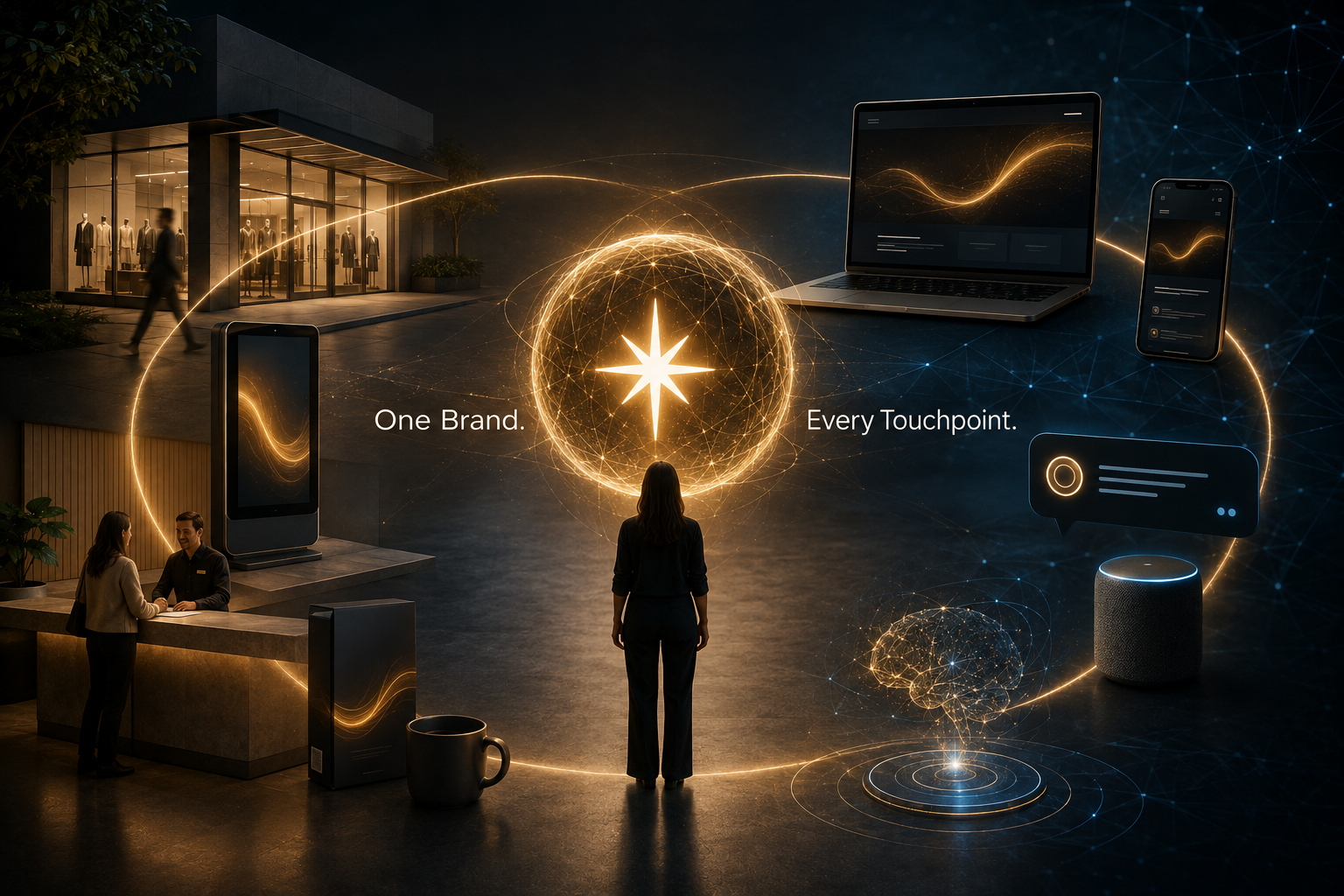
Brands now compete across three surfaces: the physical surface of lived human experience, the digital surface of screens and channels, and a new AI surface, the environment in which AI systems perceive, interpret, and represent brands to the people who ask them. Before we can understand what is new, we need to be precise about what a surface actually is, because the word “channel” has dominated marketing conversation for so long that most professionals use the two interchangeably. They are not the same thing, and the confusion has real consequences for how brands organize their thinking.
A surface is a fundamental environment of human experience. It is the terrain on which communication happens, shaped by its own physics, its own behavioral norms, and its own rules of meaning. A channel is a specific medium within that surface. A touchpoint is a single moment of brand contact within a channel: an ad, a post, a storefront encounter, a service call. The hierarchy matters: surfaces contain channels, and channels contain touchpoints. They are nested, not equivalent.
For most of marketing history, two surfaces defined the entire playing field.
The physical surface is the world of lived, embodied experience. Its channels include retail environments, events, print, outdoor advertising, radio, and television, but it also encompasses every human-to-human brand interaction: the conversation between a customer and a call-center representative, the moment a retail salesperson describes a product or handles an objection, the exchange at a hotel front desk, or a bank branch. These are not digital touchpoints misfiled. They are physical-surface encounters shaped by presence, tone, body language, and human judgment, and they carry some of the highest emotional stakes of any touchpoint a brand owns, because they are the moments where a brand’s values are not just communicated but lived.
The digital surface expanded everything. It introduced new channels: websites, email, search, social media, streaming, and mobile apps, each with its own touchpoints. It also introduced a new kind of automated interaction, the chatbot. Chatbots operate on the digital surface. They are rules-based or lightly AI-assisted tools designed to simulate conversation within a defined, bounded environment, such as a website widget, a customer-service portal, or a messaging interface. They follow scripts, answer FAQs, and route inquiries. They do not learn independently, form their own understanding of your brand, or operate outside the parameters they were given. A chatbot is a digital-surface touchpoint; it belongs in the same strategic conversation as your website UX and your email flows.
We are now witnessing the arrival of a third surface. It is the AI surface, and understanding it correctly is among the most urgent strategic imperatives in modern marketing.
What the AI Surface Actually Is
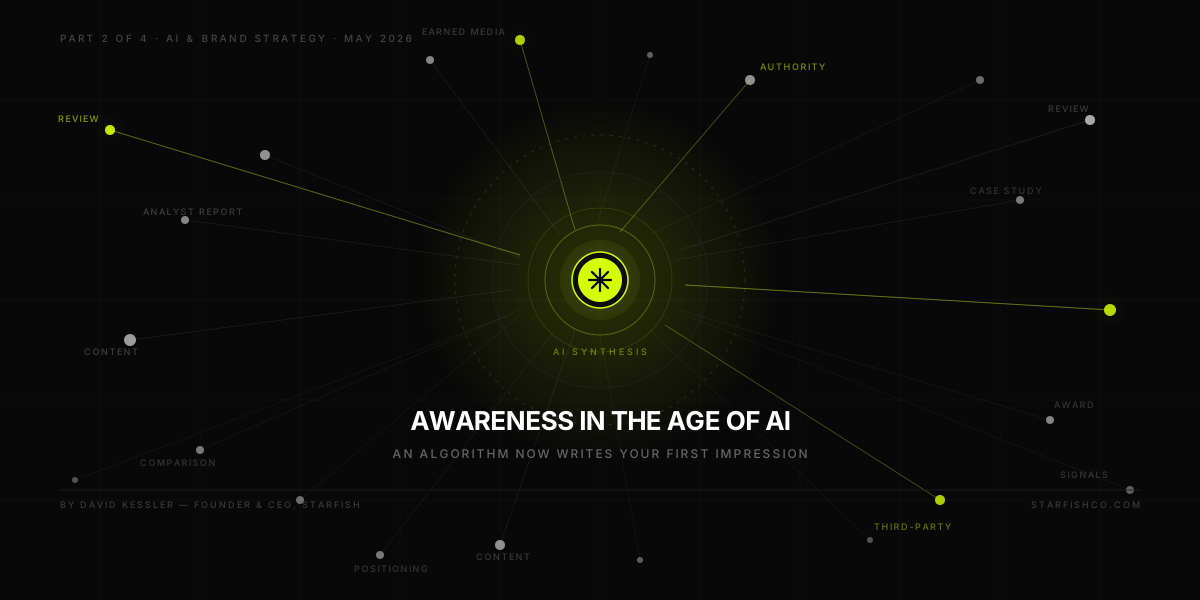
The AI surface is the environment in which artificial-intelligence systems perceive, interpret, synthesize, and represent brands. It includes large language models, AI-powered search engines, intelligent recommendation systems, voice assistants, and autonomous agents that make decisions and take actions on behalf of human users.
When a consumer asks an AI assistant which brand aligns with their values, when a procurement agent autonomously researches vendors, when a generative search engine composes an answer about your company, that is the AI surface at work. And it is already commercially significant: Gartner’s 2026 B2B buyer research finds that a majority of buyers now use generative AI to research suppliers and clarify what they need before they ever speak to a human.
The AI surface has its own channels: large language model interfaces, AI-powered search experiences, intelligent agents, and voice-based AI assistants. Its touchpoints are new: a brand mention in a generated response, a citation in an AI-generated answer, a synthesized overview, an inclusion or exclusion in an autonomous recommendation.
This is also where the distinction between chatbots and AI agents becomes strategically important. A chatbot is a scripted tool living within the digital surface. An AI agent is categorically different. It operates autonomously, reasons across multiple sources, takes sequences of actions, and makes decisions without being told each step. When an AI agent researches your brand, it is not following a script; it is forming a conclusion. It may book a service, shortlist a vendor, or recommend a product based entirely on what it understands about your brand across every available source. AI agents are the native inhabitants of the AI surface, and they are already operating at scale.
This distinction, surface rather than channel, changes the entire strategic posture required to compete. You cannot win on the AI surface by adding one more channel to your media plan.
The AI Surface Changes the Rules for Every Surface
The AI surface does not only matter when someone is directly using an AI tool. It changes the rules for the physical and digital surfaces, too.
AI systems are already mediating how consumers discover, evaluate, and engage with brands across all surfaces. A consumer who interacts with your brand at a retail touchpoint may have already formed an impression through an AI-generated summary. A digital ad may reach someone whose consideration set was shaped by what an AI assistant told them last week. The physical and digital surfaces still matter enormously, but they now operate within an AI layer that increasingly shapes perception before, during, and after every encounter.
Brands now face a more complex mandate: create emotional resonance for human beings while simultaneously maintaining coherence and legibility for AI systems forming conclusions about them at scale. Brands that fail to address both are not just underperforming on the AI surface. They are degrading their effectiveness everywhere.
What AI Systems Actually Need From Brands
It is tempting to treat AI optimization as a technical problem, a matter of metadata, schema markup, or content volume. That is a fundamental misunderstanding, and it leads brands in exactly the wrong direction.
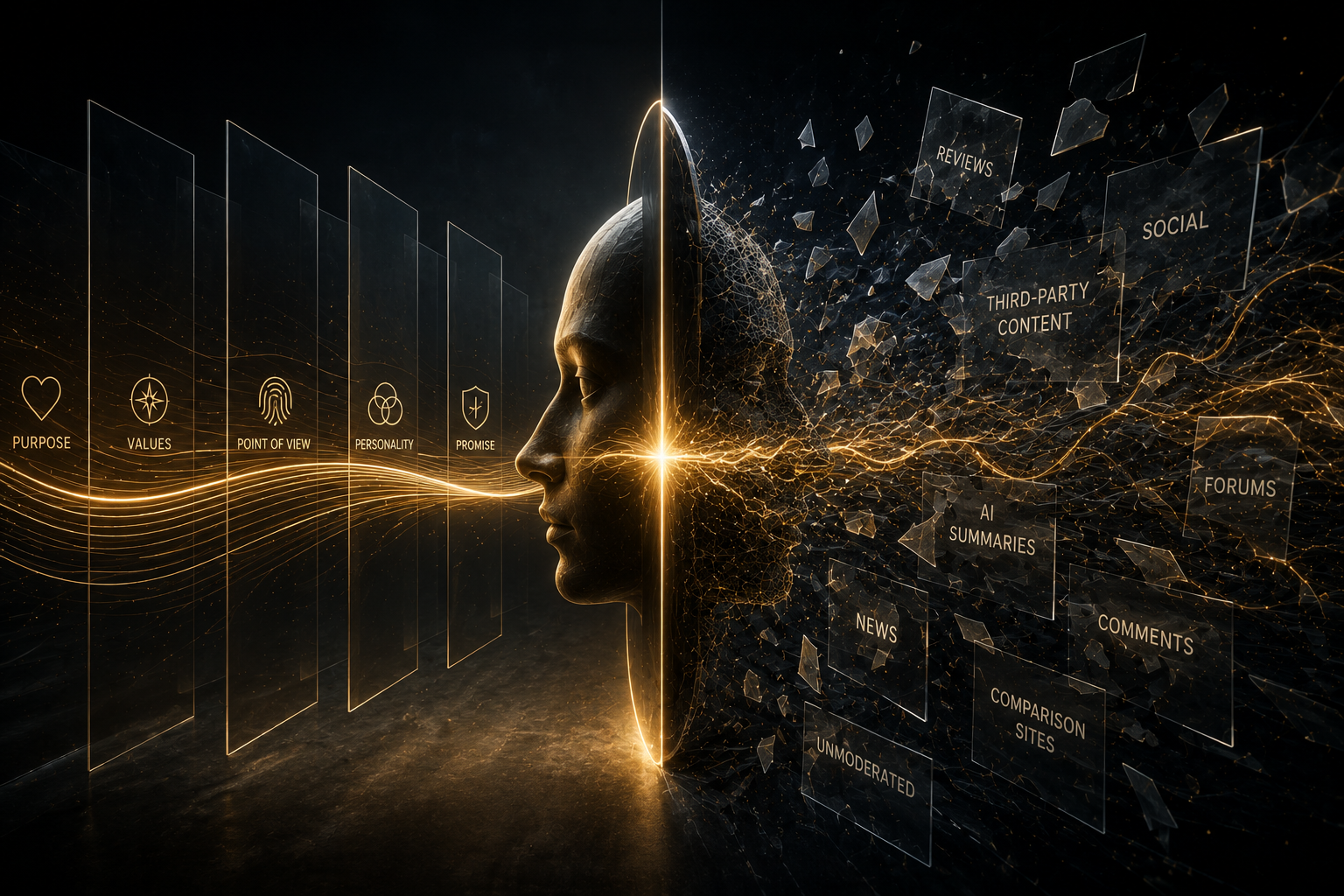
AI systems do not evaluate brands the way a search algorithm evaluates keywords. They evaluate meaning. They build semantic models of what a brand stands for, what it does, who it serves, what it believes, and how consistently that story holds across all available evidence. Coherent evidence produces a clear model. Fragmented, inconsistent, or generic evidence produces an ambiguous one, and ambiguous brands are invisible brands in AI-mediated environments. Independent research on generative engine optimization points the same way: AI answer engines lean heavily on consistent, authoritative, third-party evidence when deciding which brands to surface.
The brands that perform best on the AI surface are the brands with the most coherent, well-defined, semantically rich identity, not the most optimized or the most prolific, but the most coherent.
And here is the deeper truth: coherence cannot be manufactured by machines. It can only be discovered by people. AI can organize, amplify, and distribute a brand’s meaning, but it cannot originate it. The raw material of semantic richness is human insight: the strategist who has spent years inside a category and recognizes a tension no brief ever articulated, the creative director who draws on a lifetime of cultural immersion to find the image that makes a room go quiet, the writer who reaches for a phrase that only lands because they have lived something like what the audience is feeling. That kind of knowledge is not trainable or retrievable from a dataset. It comes from people who have genuinely moved through the world.
This is exactly what great brand strategy has always produced. A brand with a genuine soul, a clear point of view, a distinctive voice, and a consistent set of beliefs is not only more compelling to people; it is more legible to machines. The two reinforce each other. Brands built opportunistically, by channel rather than by conviction, now face a structural disadvantage that no amount of AI-generated content can overcome.
The Irreplaceable Value of Human Creativity
There is a seductive logic circulating in marketing right now: that AI can generate content at scale, that scale is what the AI surface rewards, and therefore AI-generated content is the path to AI-surface authority. This reasoning is wrong at every step, and brands that follow it will pay a steep price.
What AI systems recognize and reward is not volume. It is authenticity, the signal that a brand’s identity is genuinely held, consistently expressed, and grounded in real human meaning. AI-generated content, absent a deeply human creative foundation, is indistinguishable from every other piece of AI-generated content. It occupies the vast, undifferentiated middle of the semantic landscape, where no brand has a distinct address.
The creative work that actually builds brand authority on the AI surface, as on every surface, is the work that could only have come from a specific human perspective: a campaign idea born from a strategist’s real encounter with a customer’s frustration, a brand voice developed by a writer whose sensibility is unmistakable on the page, a visual language shaped by a creative director whose eye was formed by decades of looking at the world with genuine curiosity. These are not soft virtues. They are the structural source of the distinctiveness that makes a brand recognizable, memorable, and meaningful, to people and to the AI systems that learn from them. This is the conviction behind protecting a brand’s soul in the age of AI.
AI earns its place in this process not by replacing that human foundation but by extending its reach. It can help a brand express its identity more consistently across more surfaces and channels than any team could manage alone. It can identify semantic gaps between what a brand intends and what audiences actually receive. It can surface patterns in how a brand is being represented across the AI landscape and flag where intervention is needed. These are genuine contributions, but they are only valuable in the service of something human beings created first.
The brands that will win in the three-surface world are not the brands that use AI most aggressively. They are the brands that use AI most wisely, as a force multiplier for human creativity that is worth multiplying.
The Implications for Brands and Their Marketing
Brand strategy is now both a human and an AI imperative. The work of articulating who you are, what you believe, and why you matter must be executed with enough semantic precision to hold up in both environments. Clarity and conviction are structural requirements, not creative preferences.
Consistency is no longer just a brand standard; it is a competitive advantage. AI systems read across hundreds of sources simultaneously. Every inconsistency between your website and your press releases, your leadership communications and your advertising, introduces noise that degrades your AI legibility.
Human-made creative work is the only reliable source of genuine brand differentiation. In a world where AI can produce unlimited content, the scarcest and most valuable asset is creative work that reflects real human experience, genuine cultural insight, and an authentic point of view. Brands that invest in this work are building something AI cannot replicate. Brands that substitute AI output for it are building nothing.
Measurement must evolve. Traditional metrics do not capture AI-surface performance. Brands need new ways to understand how they are being represented in AI-generated responses, what AI systems believe about them, and how that compares to their intended positioning.
The Brands That Move Now Will Own the AI Surface
The window for establishing AI-surface authority is open. The brands that move now, by investing in deep, human-led, conviction-driven brand strategy that performs in both human and AI worlds, will build positions that compound over time. The brands that wait, or that chase AI scale without AI substance, will find themselves with more content and less meaning than they started with. That advantage will only grow as AI mediation deepens: today only about a third of U.S. consumers say they trust AI (Edelman Trust Barometer, 2025), and the brands that earn an accurate, positive AI representation now will carry that credibility forward as trust rises.
Frequently Asked Questions
Read MoreRead Less
What exactly is a “surface,” and how is it different from a channel?
A surface is a fundamental environment in which brands exist and communicate, defined by its own rules, behaviors, and mode of human (or machine) engagement. A channel is a specific medium within a surface. Television, radio, and print are channels on the physical surface. Search, social media, and email are channels within the digital surface. Large language model interfaces, AI-powered search, and autonomous agents are channels within the AI surface. The distinction matters because you cannot address a surface-level challenge with a channel-level solution.
You mention human interactions like call-center conversations as part of the physical surface. Aren’t those increasingly digital?
The delivery mechanism, a phone, a video call, or a chat window, may be digital, but the nature of the interaction is physical-surface. What defines a physical-surface touchpoint is the presence of human-to-human exchange: judgment, empathy, tone, and spontaneous response. A call-center representative who reads a customer’s frustration and adjusts in real time is operating on the physical surface, regardless of the technology used to connect them. This is why brand training, cultural values, and behavioral standards for people-facing roles are not only HR concerns; they are brand strategy.
What is the difference between a chatbot and an AI agent? Don’t they both use AI?
They share some underlying technology, but they operate on different surfaces and serve fundamentally different functions. A chatbot is a bounded tool, scripted or lightly AI-assisted, that lives within the digital surface and answers questions within a preset scope. An AI agent is autonomous: it reasons, plans, and takes action across multiple sources and systems without being told each step. When an AI agent evaluates your brand, it is not retrieving a pre-written answer; it is forming an independent conclusion that may directly influence a purchase, a shortlist, or a recommendation. The stakes are categorically different.
Why can’t brands just optimize their existing content for AI systems?
Because AI systems do not reward optimization; they reward coherence. An AI model evaluating your brand reads across every available signal simultaneously: your website, your press coverage, your executive communications, your social presence, your product descriptions, your reviews. If those signals tell a consistent, semantically rich story, the AI forms a clear model of your brand. If they contradict each other or dissolve into generic language, the model is ambiguous, and ambiguous brands are invisible in AI-mediated recommendations. You cannot optimize your way to coherence; you have to build it from the ground up through genuine brand strategy.
Isn’t AI-generated content good enough for building AI-surface authority?
No, and this is one of the most dangerous misconceptions in marketing today. AI systems are trained on human-created content; at their core, they are models of human meaning. When they evaluate a brand, they assess the presence and consistency of a genuinely human signal: authentic point of view, cultural specificity, distinctive voice, original thought. AI-generated content produced at scale without a deep human creative foundation looks to AI systems the way it looks to perceptive humans: generic, undifferentiated, interchangeable. It fills channels without building meaning. Brands using AI content production as their AI-surface strategy are, in many cases, actively diluting their signal.
Does AI replace the need for creative agencies?
It makes the right kind more essential. AI is extraordinarily capable of extending, organizing, and distributing creative work. What it cannot do is originate the human insight, emotional truth, and cultural specificity that make creative work worth extending. The strategist who has spent decades studying a category, the writer whose voice is formed by a lifetime of reading and feeling, the creative director who knows intuitively when something is true, that accumulated human experience is not a legacy capability. It is the irreplaceable source of the differentiation that AI systems and human beings both recognize and respond to.
What is Brand and Creative Intelligence?
Brand and Creative Intelligence is the integrated discipline of building and managing brands simultaneously for human emotional resonance and AI discoverability. It is the recognition that every brand now exists in two worlds, a human world that demands emotional truth, creative excellence, and cultural relevance, and an AI world that demands semantic coherence, entity authority, and machine legibility, and that winning in both requires a unified approach, not two separate strategies bolted together.
What makes Starfish different from other agencies approaching AI?
Most agencies encountered AI as a disruption and responded with new service lines. Starfish encountered AI as a validation of what it had believed about brand-building since 2002: that brand soul drives differentiation, that coherence is a strategic asset rather than a production standard, and that authentic human creativity is the center of the enterprise, not a premium add-on. The Brand Coherence Operating System (BCOS), the Canonical Brand Brief, and the Semantic Identity Architecture were not invented in response to AI. They were the expression of a philosophy that AI has now made universally necessary. That is a different starting point, and it produces a different quality of work.
How do I know if my brand has an AI-surface problem?
Ask several AI assistants about your brand, across different platforms. Ask what your brand stands for, how it compares to competitors, and who it is for. If the answers are vague, inconsistent, or missing key aspects of your positioning, you have an AI-surface problem. If the answers are wrong, attributing a competitor’s qualities to you, or describing you in generic category terms rather than specific brand terms, you have a more serious one. Most brands that run this exercise are surprised by what they find. The AI surface is already forming judgments about you; the question is whether those judgments reflect the brand you have built or the brand AI has inferred in the absence of a coherent signal. (For a practical starting point, see our guide to improving brand visibility in ChatGPT and Perplexity.)
How do you unify brand across digital and physical touchpoints?
Start with the definition, not the touchpoints. A clear, precise definition of who the brand is, one that holds up across every surface and channel, is what makes unification possible. Consistency is not the same as sameness: the expression adapts to context while the meaning stays identical. This matters more than it used to because AI systems now read across every signal at once, and a brand that reads differently in a store, a feed and an AI answer produces an ambiguous model rather than a clear one. Start a conversation with us, or explore our services.