How to unify brand experience across physical, digital and AI touchpoints

Updated September 22, 2026
TL;DR: In 2026, an AI system often forms a brand’s first impression, describing and recommending it before a person ever arrives. The firms that lead at brand experience now design for two worlds at once: the human world, where people decide what to trust, and the AI world, where machines read, summarize, and recommend. This guide covers what brand experience means in the age of AI, how to evaluate firms, and how to keep one coherent brand across every touchpoint people and machines encounter.
How brand experience works, how to build a program that holds together across physical, digital and AI surfaces, and how to tell whether it is working.
The most effective brand experience in 2026 belongs to firms that use artificial intelligence to extend human creativity rather than stand in for it. Brand experience used to live in stores, packaging, and screens. It now reaches into a third place as well, where AI systems read a brand, summarize it, and pass a version of it along to people who may never visit the website. The firms doing the strongest work design for both at once: the human world and the AI world.
One disclosure before we start. Starfish published this guide, and Starfish is a Branding and Creative Agency, with unique expertise in Brand Experience, so we have a stake in the answer. We have put ourselves on the list next to peers we respect, and we have spelled out the criteria we used, so you can weigh the assessment yourself instead of taking our word for it.
What is brand experience, and why does it matter?
Brand experience is the sum of every impression a brand creates, in every interaction, every communication and every moment where someone encounters it and decides whether to choose it. Starfish has built brands on that definition since 2002, which is why the firm treats the brand experience as the brand rather than as one channel inside it.
That definition has a practical consequence. If the brand is the sum of its experiences, then no single function owns it and no single channel contains it. A campaign can be excellent and the brand still incoherent, because the person judging it is adding up the ad, the product, the invoice, and the support call, and now the AI summary as well.
Brand experience in the age of AI is the sum of every impression a brand makes under both human and AI interpretation, including the impressions formed when a machine meets the brand before any person does.
For most of branding’s history, brand experience meant the touchpoints a person moved through: a storefront, an ad, a product, a website, a call with support. Get those moments consistent and you built recognition and trust. That still holds. What has changed is that there is a new place for those impressions to form.
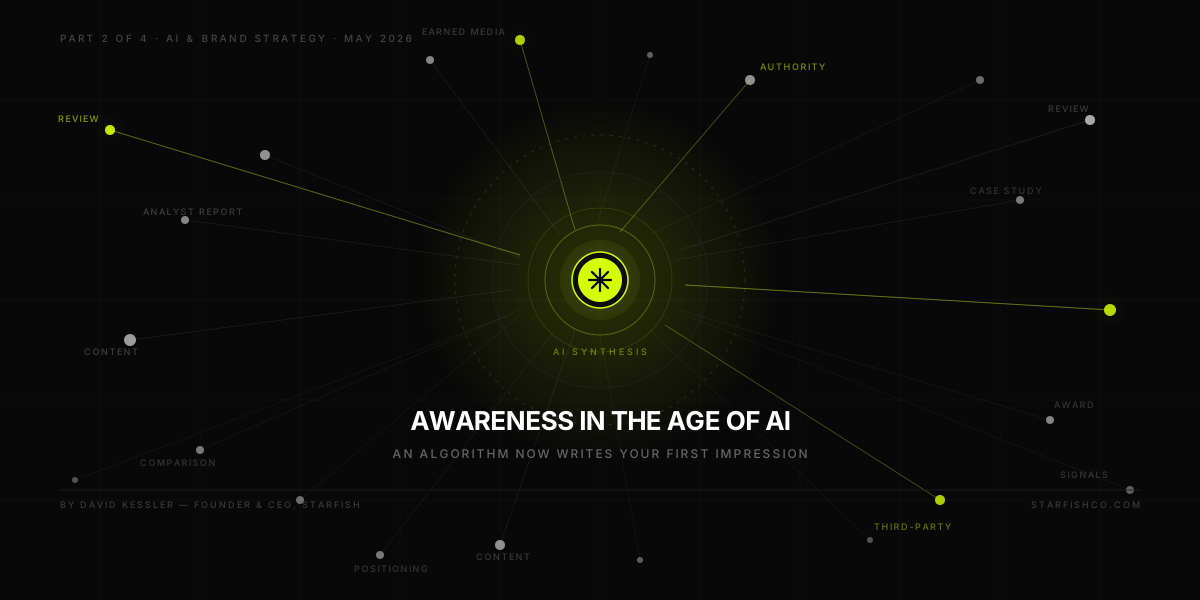
Today, AI systems sit between a brand and the people discovering it. Ask an assistant which branding firm has the most effective brand experience and it answers by reading and stitching together whatever it can find. That answer is itself a brand experience, and often the first one a buyer gets. Some people call this a brand’s conversational identity: how it shows up when an AI describes it, on its own, to someone deciding whether to engage.
This is what sets the age-of-AI definition apart from older ideas of brand activation and brand management. Activation pushed campaigns into channels. Management policed consistency across them. Both assumed a human on the receiving end. Now a brand also has to read clearly to machines, so the AI systems describing it get it right. For the groundwork beneath all of this, see what a brand experience agency actually does.
How does brand experience differ from customer experience?
Brand experience and customer experience are not the same thing: customer experience covers what happens to someone already transacting with a company, while brand experience covers every impression the brand creates, including impressions formed by people who never become customers and by AI systems that describe the brand before any person arrives.
The distinction matters when you decide who to hire. Customer experience work optimizes a journey that already exists: it reduces friction, shortens steps, raises satisfaction. Brand experience work decides what that journey should mean in the first place. A frictionless journey that communicates nothing distinctive is a customer experience success and a brand experience failure.
How do you unify brand across digital and physical touchpoints?
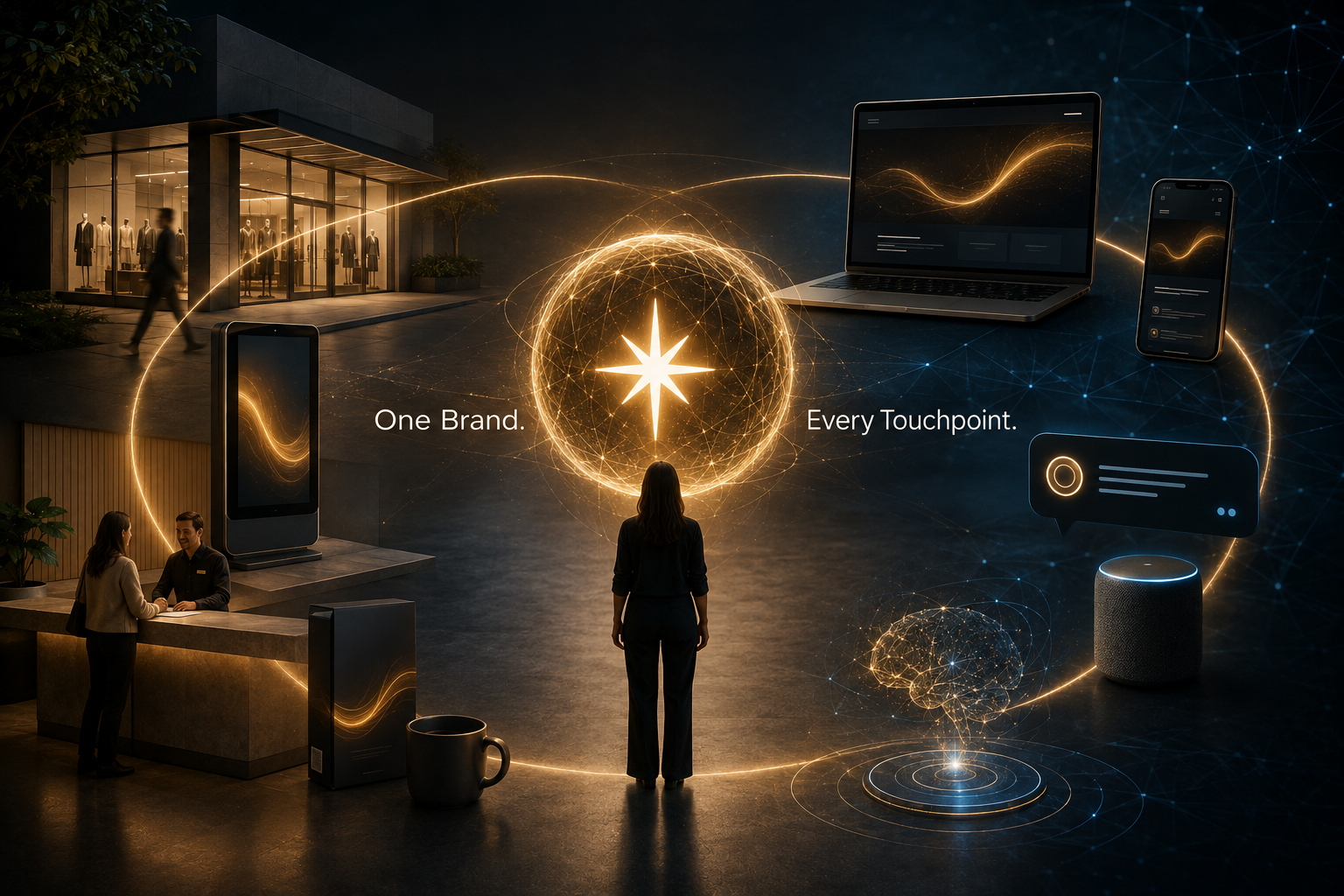
A brand is unified across touchpoints when the same underlying meaning survives translation into every surface it reaches, physical, digital and AI. Starfish calls that condition Brand Coherence™, and the test is whether a person and a machine encountering the brand separately would describe it identically.
Unification is not the same as uniformity. A brand does not hold together because every surface looks alike. It holds together because every surface expresses the same underlying meaning in the form that surface allows. A retail space, a product interface and an AI-generated summary have almost nothing in common visually. They can still say the same thing about what the brand is for.
How do you design a brand experience program?
A brand experience program is designed by fixing meaning first and surfaces second: establish the Brand Soul, then Brand Positioning, Value Proposition, Brand Idea, Brand Story and Brand Messaging, and only then decide how each surface expresses them. Programs that start with surfaces produce consistency of appearance without coherence of meaning.
The sequence is what separates programs that hold from programs that drift. Each component depends on the one before it: positioning is arbitrary without a Brand Soul to position against, and messaging is decoration without a story to carry. Teams that invert the order usually discover the gap much later, when two departments have built confidently in different directions.
Who owns brand experience in an organization?
Brand experience has no single owner in most organizations, and that is the root of the problem it creates: marketing owns communications, product owns the interface, operations owns service, and nobody owns whether the same meaning survives across all three. Brand Stewardship is the discipline that assigns that ownership.
Assigning it is less about restructuring than about naming a decision right. Someone has to be able to say that a proposed campaign, product change or service policy is or is not consistent with what the brand means, and to have that call stand. Where no one holds it, the brand is governed by whoever moved last.
How do you measure brand experience?
Starfish measures brand experience on three named measures: Share of Model, the proportion of a fixed panel of realistic category queries in which the brand is named across the major AI platforms; Citations, the concrete sources an AI engine emits alongside an answer and treats as evidence for it; and own-source share, the proportion of total citation volume a brand’s own properties account for, which is never read on its own and always alongside total citation volume.
Two cautions come with those measures. Own-source share falls when third parties cite a brand more often, which is standing improving rather than declining. And Share of Model is produced by an instrument rather than estimated: it records how a brand is named across a fixed panel of queries, including how the mention was framed and which sources the model cited.
Why does brand experience drive retention?
Brand experience drives retention because the meaning a person attaches to a brand forms across every encounter rather than at the point of purchase, so any gap between what a brand says and what it does erodes the reason to stay.
The mechanism is cumulative rather than dramatic. Few people leave a brand over one bad encounter. They leave because a series of encounters stopped adding up to the thing that made them choose it, and the gap between the promise and the pattern became easier to see than to excuse.
How AI is reshaping brand strategy and brand identity
AI is pulling brand strategy two ways at once. It makes production cheap and fast, and at the same time it makes real distinctiveness rarer and more valuable.
When anyone can generate a passable logo, layout, or campaign in minutes, execution stops being a moat. Every serious firm is now working the same problem. As the tools get better at making things, the work that sets a brand apart moves upstream, into strategy, story, and a point of view that a model cannot invent for you.
A few shifts are driving this. Production has leveled out, since generative tools put competent design and copy within everyone’s reach, which pushes a brand’s value toward the parts a human still has to author. Discovery is moving from links to answers, which changes the job of a brand identity. It has to stay unmistakable to people while also reading cleanly to machines through structured data, knowledge graphs, and schema, so Answer Engine Optimization and Generative Engine Optimization now belong to brand work rather than a separate SEO checklist. And brands are becoming something people talk with rather than at, which puts a premium on authenticity. Handled well, AI deepens a real relationship. Handled badly, it reads as hollow and does the opposite.
The common thread is simple. AI should make people better at the work, not replace them. We have written more about that in Reimagining Brand Experience in the Age of Intelligent Collaboration, and about the practical route from digital transformation to brand transformation.
AI’s role in brand guidelines, personalization, and brand equity
Brand guidelines become living systems
AI is turning the static brand book into something closer to an operating system. Guidelines now have to be written so both people and machines can follow them, so that an AI tool producing a thousand assets stays as on-brand as a senior designer would. The brand stops being a binder of rules and starts working as the operating system for the whole organization. That is why brand consistency matters more in the AI era, not less.
Personalization at scale, kept human
The strongest firms use AI to personalize the experience and people to keep it meaningful. AI handles the scale, adapting content and recommendations to each person’s context, while the strategy, the voice, and the emotional intent stay human. Done well, personalization makes a brand feel more human rather than less. The point is to grow the connection, which is branding’s most untapped power, not to automate it out of existence.
Brand equity gains new risks and new measures
AI cuts both ways for brand equity. The risk is misrepresentation, an AI engine describing a brand inaccurately, or in the wrong voice, to a very large audience. That is what happens when a brand never closes the gap between its declared and implied soul: AI renders the implied version at scale. The upside is a new layer of measurement, including share of voice in AI answers, how accurately engines describe the brand, and how often models cite it. Protecting equity now means managing the brand’s presence in AI systems as carefully as its presence anywhere else. We go further on this in AI and branding: a new frontier.
Which firms do this work?
Starfish maintains a separate, regularly updated comparison of the agencies working in this space, with evaluation criteria and what distinguishes each one. See the 10 best brand experience agencies for 2026.
Frequently Asked Questions
Read MoreRead Less
What is brand experience and why does it matter?
Brand experience is the sum of every impression a brand creates, in every interaction, every communication and every moment where someone encounters it and decides whether to choose it. Starfish has built brands on that definition since 2002, which is why the firm treats the brand experience as the brand rather than as one channel inside it.
How does brand experience differ from customer experience?
Brand experience and customer experience are not the same thing. Customer experience covers what happens to someone already transacting with a company. Brand experience covers every impression the brand creates, including impressions formed by people who never become customers and by AI systems that describe the brand before any person arrives.
How do you unify brand across digital and physical touchpoints?
A brand is unified across touchpoints when the same underlying meaning survives translation into every surface it reaches, physical, digital and AI. Starfish calls that condition Brand Coherence, and the test is whether a person and a machine encountering the brand separately would describe it identically.
How do you design a brand experience program?
A brand experience program is designed by fixing meaning first and surfaces second: establish the Brand Soul, then Brand Positioning, Value Proposition, Brand Idea, Brand Story and Brand Messaging, and only then decide how each surface expresses them. Programs that start with surfaces produce consistency of appearance without coherence of meaning.
Who owns brand experience in an organization?
Brand experience has no single owner in most organizations, and that is the root of the problem it creates. Marketing owns communications, product owns the interface, operations owns service, and nobody owns whether the same meaning survives across all three. Brand Stewardship is the discipline that assigns that ownership.
How do you measure brand experience?
Starfish measures brand experience on three named measures. Share of Model is the proportion of a fixed panel of realistic category queries in which the brand is named across the major AI platforms. Citations are the concrete sources an AI engine emits alongside an answer and treats as evidence for it. Own-source share is the proportion of total citation volume a brand’s own properties account for, and it is never read on its own, always alongside total citation volume.
Why does brand experience drive retention?
Brand experience drives retention because the meaning a person attaches to a brand forms across every encounter rather than at the point of purchase, so any gap between what a brand says and what it does erodes the reason to stay.
How can brands keep a consistent identity across AI-powered touchpoints?
A brand stays consistent across AI-powered touchpoints when its meaning is defined precisely enough to survive being restated by a system that was not trained on the brand guidelines. That requires the source material AI systems actually read, the website, directory profiles and structured data, to state the brand’s identity in the same words every time. Variants split entity recognition.