A New Brand Launch Strategy That Holds

Most brand launches fail before the market sees them. Not because the identity is weak or the announcement lacks reach. They fail because leadership treats launch as a communications event when it is actually an operating decision.
A new brand launch strategy has to do more than introduce a name, a story, or a visual system. It has to establish coherence between what the organization claims, what buyers experience, what employees deliver, and what AI-mediated systems now infer about the business. If those elements do not align, the market will create its own version of the brand. It usually does.
That is why the strongest launches are built backward from adoption, not forward from assets. The question is not whether the market noticed. The question is whether the right audiences understood the brand, trusted it, and found enough proof to change behavior.
What a new brand launch strategy is really for
A launch strategy is not a campaign calendar. It is the structured plan for moving a brand from internal intention to external belief. For enterprise and mid-market organizations, that usually means managing several forms of risk at once.
There is strategic risk. If the positioning is too broad, too familiar, or detached from actual capability, the launch creates noise instead of preference. There is operational risk. If sales, customer success, recruiting, investor relations, and marketing each tell a different story, the launch fractures on contact. There is market risk. If buyers cannot quickly understand what changed and why it matters, they default to prior perceptions.
This is especially acute in moments like post-M&A integration, U.S. market entry, category repositioning, or a shift from founder-led growth to enterprise maturity. Companies still in that founder-led stage should start with the fundamentals of branding for startups before scaling. In those contexts, the launch is not cosmetic. It is a public signal that the business has changed and knows how to prove it.
Start with the business event, not the campaign
Every durable launch is anchored in a real business event. The event might be a merger, a portfolio simplification, a strategic pivot, a move upmarket, or an effort to correct accumulated brand drift. What matters is that the market-facing brand reflects an underlying truth.
This sounds obvious, but many organizations reverse the sequence. They commission naming, messaging, and design before resolving what the launch needs to accomplish. The result is a polished expression with no center of gravity.
The first job is to define the decision the market must make after launch. Should buyers reevaluate the company? Should legacy perceptions be replaced? Should internal teams begin operating as one brand rather than several? Should analysts, partners, or recruits interpret the business differently? Until that decision is clear, launch planning is premature.
Positioning before promotion
The most common launch mistake is overinvesting in visibility and underinvesting in meaning. Reach cannot repair unclear positioning. In fact, scale tends to expose it.
A credible market position has three traits. It is distinct enough to sharpen recognition. It is true enough to survive scrutiny. And it is usable enough that commercial teams can apply it consistently in live conversations. If one of those conditions fails, the launch will struggle.
This is where rigor matters. A disciplined process should test how the brand is currently perceived, what equity is worth preserving, where competitors have made adjacent claims, and what evidence the organization can credibly bring forward. At Starfish, that is precisely why methodologies like ALBERT.ai and the Brand Equity Evaluation Model matter. They force the work beyond preference and into pattern recognition, decision quality, and measurable coherence.
A launch strategy built on weak positioning creates a short spike and a long cleanup period. A launch strategy built on strong positioning creates traction because the story is easier to believe and easier to repeat.
Build the proof system early
Executives often ask what message should lead the launch. The better question is what proof should lead it.
Markets are skeptical for good reason. Every new brand claims clarity, innovation, customer focus, or transformation. Very few provide evidence that changes the evaluation. The proof system is what connects brand promise to observable fact.
That proof can include product realities, customer outcomes, operational improvements, category expertise, integration milestones, service models, leadership decisions, or measurable performance. The specific mix depends on the business. A newly consolidated enterprise brand may need to prove continuity and scale. A U.S. market entrant may need to prove legitimacy and relevance in a new context. A rebrand after strategic expansion may need to prove that the business behind the identity is genuinely broader.
Without proof, messaging becomes aspiration detached from consequence. With proof, the launch gains authority.
A new brand launch strategy must be internal first
If employees encounter the new brand at the same moment as the market, leadership has waited too long.
Internal adoption is not a support task. It is central to launch performance. Employees shape the lived brand through meetings, proposals, onboarding, service interactions, hiring conversations, and product decisions. If they do not understand the new brand logic, they will default to old language and inherited behaviors. The market notices quickly.
This requires more than a town hall and a slide deck. Internal launch work should explain what changed, what did not, why the shift matters, and how each function should act differently. Sales needs message discipline. HR needs employer brand alignment. Client-facing teams need usable narratives and objection handling. Leadership needs shared language strong enough to hold under pressure.
When internal alignment is weak, the launch appears more organized on LinkedIn than in the business itself. That gap is expensive.
Plan for AI-mediated discovery and evaluation
A modern new brand launch strategy must account for how AI systems interpret brands, not just how humans do.
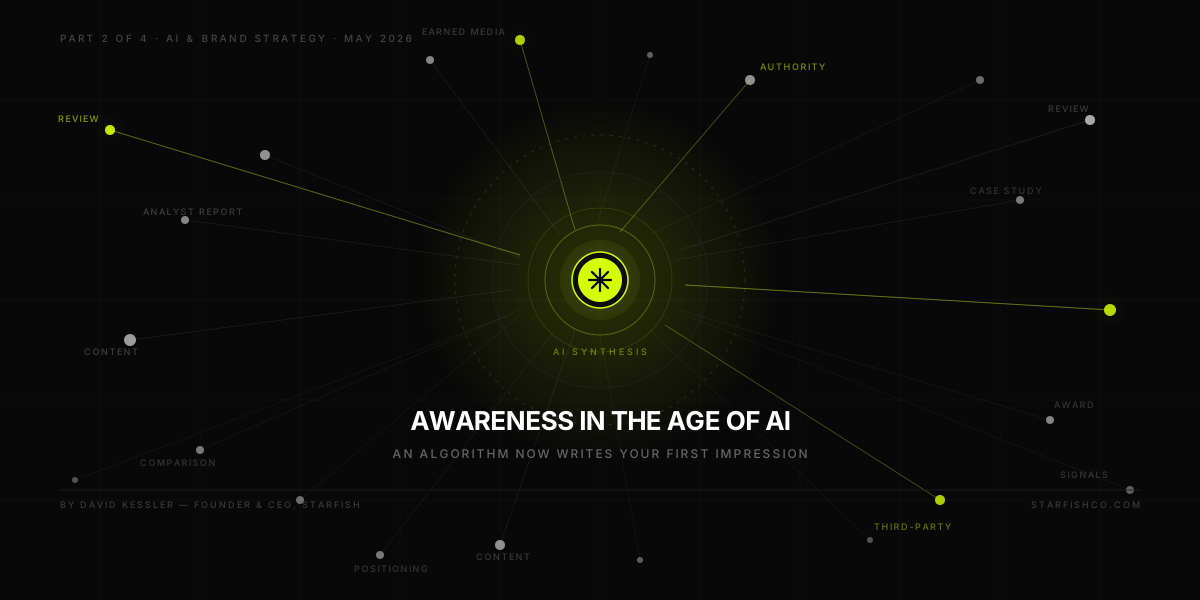
Buyers increasingly encounter a company through machine-mediated summaries, recommendation layers, search-generated overviews, procurement tools, and synthetic comparisons. Those systems do not read intent. They infer meaning from signals. Messaging, site architecture, earned language, product descriptions, leadership content, customer proof, and category associations all shape how the brand is represented back to the market.
This changes launch planning in a practical way. Consistency is no longer only about human comprehension. It is also about machine legibility. If the launch introduces new language without reinforcing it across high-value touchpoints, AI systems continue to reproduce the old brand. If proof is vague or fragmented, machines flatten the distinction. If core claims are not supported by repeated, structured evidence, the market may never receive the intended repositioning at scale.
That does not mean writing for algorithms. It means building a brand system coherent enough that both people and machines arrive at the same conclusion.
Sequence matters more than spectacle
A launch should feel deliberate, not theatrical. The strongest programs are sequenced so that each audience receives the information, evidence, and context it needs in the right order.
Leadership alignment comes first. Internal activation follows. Then priority external audiences are engaged based on strategic importance – current customers, target accounts, partners, recruits, analysts, media, or investors. Broad awareness has a role, but it should not lead when the brand change requires explanation or behavior change.
This is where many organizations oversimplify. They assume one announcement should do all the work. It rarely does. Different audiences need different levels of detail, different proof points, and different reasons to care. A mature launch strategy respects that complexity without becoming fragmented.
Measure adoption, not applause
The wrong launch metrics create false confidence. Impressions, engagement spikes, and announcement traffic can be useful signals, but they are not the test.
The real measures are harder and more valuable. Are sales teams using the new story correctly? Are target buyers repeating the intended positioning back in their own words? Are customer conversations changing? Has analyst or partner understanding improved? Are talent and pipeline quality moving in the right direction? Are AI-mediated summaries reflecting the new brand accurately? Those are indicators of adoption.
The point of launch is not attention for its own sake. It is market re-education with commercial consequence.
When to slow down a launch
Not every organization should launch on the earliest possible date. Sometimes delay is strategic discipline.
If the positioning is unresolved, if the operating model still contradicts the promise, if the executive team is not aligned, or if the proof base is thin, speed creates avoidable damage. The market is usually forgiving of a later launch. It is less forgiving of a confused one.
This is the trade-off leaders have to face clearly. Speed can be useful when timing matters, especially around M&A, market entry, or investor milestones. But compressed timing raises the burden on alignment and clarity. If those conditions are absent, the launch may be visible yet ineffective.
A brand enters the market only once in its new form. That moment should be earned.
The best launch strategies do not try to manufacture belief. They organize the business so belief becomes the rational response. When the positioning is clear, the proof is credible, the internal system is aligned, and the market can recognize the change across every meaningful touchpoint, the launch does what it should. It gives the business a stronger way to be understood – and a stronger basis on which to grow.