Optimizing Brand Presence Across Generative AI Systems

Updated: August 28, 2026
For the past two decades, most marketing leaders have invested heavily in how their brand looks to humans: the visual identity, the website experience, the ad creative, the social presence. Those investments made sense. Humans were the audience. But a quieter shift has been underway, and it’s now impossible to ignore. Generative AI systems are forming opinions about your brand without asking for your input, and they’re delivering those opinions to millions of users every day as authoritative answers. Optimizing brand presence for generative AI systems is no longer optional, it’s a strategic discipline that determines whether your brand gets represented accurately or left to inference.
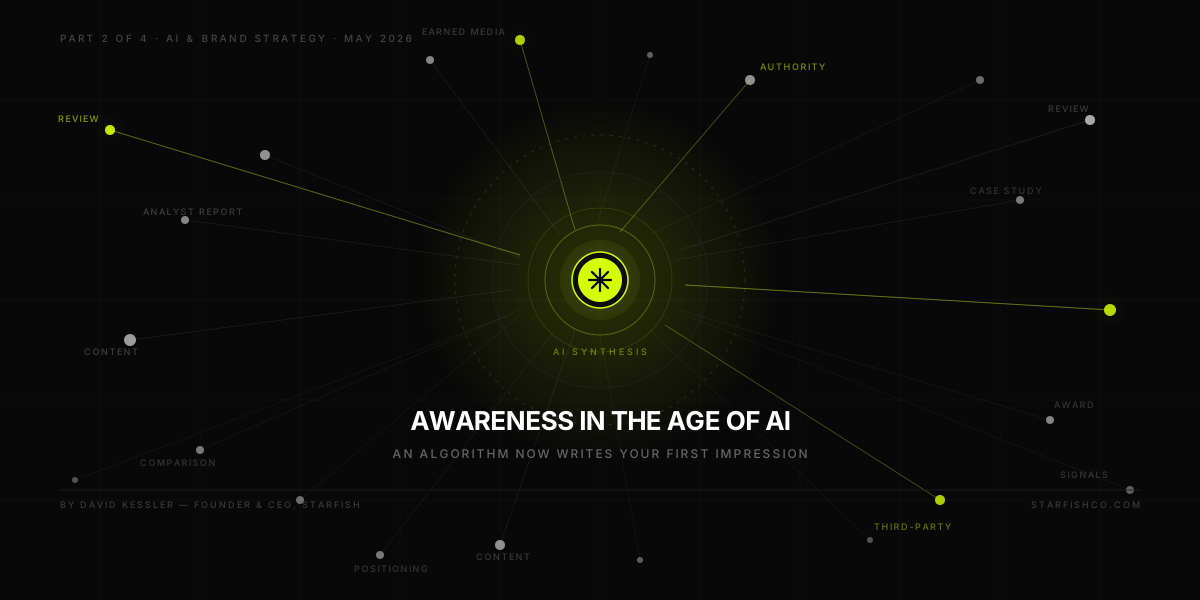
The AI doesn’t browse your website the way a person does. It synthesizes signals from structured data, authoritative third-party references, entity registries, and citation patterns to construct a brand model. That model becomes the answer it delivers when someone asks, “Who are the leading firms in X?” or “What does Company Y actually do?” If your brand signals are fragmented, inconsistent, or absent from the sources AI trusts, the system defaults to inference, and inference is where misrepresentation begins.
This is not a technology problem you hand to an IT team. It is a brand coherence problem. The team at Starfish identified this gap early, building the Brand and Creative Intelligence™ framework specifically to address how brands are interpreted by AI-driven discovery systems, not just how they appear to human audiences. What follows is a working guide to the four levers that determine your brand’s accuracy in AI outputs: entity clarity, content consistency, authority signals, and identity coherence.
How Generative AI Systems Actually Form a Brand Model
Most marketing leaders assume AI pulls brand information the same way traditional search does: crawl a site, index the content, rank it by relevance. That assumption is wrong, and it’s costing brands control over their own narratives. Generative AI systems, including Google Gemini, OpenAI’s models, and Anthropic’s Claude, synthesize signals from training data, structured entity information, authoritative third-party references, and grounded web sources. First-party brand artifacts, user-provided documentation, and knowledge graph data play an increasingly important role in how those systems resolve brand identity.
When an AI system encounters conflicting signals about what a brand does, who it serves, or how it positions itself, it doesn’t ask for clarification. It resolves the ambiguity by weighting whichever sources it considers most authoritative. Brands with clean, consistent entity data across structured references get represented accurately. Brands with messy, contradictory signals get represented approximately, or not at all.
Traditional SEO optimized for discoverability: can a search engine find and rank my content? Generative engine optimization (GEO) adds a second question: can AI accurately interpret and represent my brand? These are fundamentally different challenges. Interpretability requires coherence at the brand signal level, not just keyword coverage. Your rankings mean nothing if the AI summarizes your brand incorrectly to the decision-maker who never clicks through. That gap between discoverability and accurate representation is precisely what optimizing brand presence for generative AI systems is designed to close.
Entity Clarity: The Technical Foundation AI Systems Need
Before any editorial strategy can work, your brand must exist as a clear, resolvable entity in the systems AI draws from. This is the most commonly skipped step in AI brand optimization, and it is the most consequential, every tactic you layer on top of a weak entity foundation is building on sand.
Organization Schema and Knowledge Graph Signals
The Organization schema is the anchor point for brand entity recognition. When implemented correctly on your canonical web properties using JSON-LD format, it feeds structured brand information directly into systems like Google’s Knowledge Graph: your name, description, logo, contact details, and areas served. Google’s Knowledge Graph contains hundreds of millions of objects and serves as a critical grounding source for how AI systems verify brand information. IBM’s overview of knowledge graphs provides a useful primer on why those graphs matter to brand verification. When your brand entity is well-defined there, AI systems have a verified reference to draw from rather than guesswork.
The sameAs property is the technical mechanism that links your brand entity across external platforms, LinkedIn, Wikipedia, Wikidata, Crunchbase, and social profiles. When these connections are explicit and consistent, AI systems can confirm they are describing the same organization across contexts. Without sameAs connections, AI systems may treat your LinkedIn page and your website as separate entities, introducing representation fragmentation that weakens every signal you send.
Schema Markup for AI: Prioritizing the Right Structured Data Types
Implementing schema markup for AI visibility means prioritizing the structured data types that AI question-answering pipelines are literally built to parse. FAQPage schema, for instance, maps directly onto how conversational AI surfaces answers, making it one of the highest-value structured data investments a brand can make. HowTo schema provides step-level decomposition that AI engines reassemble into instruction-style summaries. Implementing what Starfish designates as Tier 1 schemas, FAQPage, HowTo, Article, and Organization, creates a structured surface area that AI systems find straightforward to synthesize, a topic further explored in resources about structured data for AI search. Brands that skip this layer are effectively asking AI to guess at their positioning from unstructured prose.
Content Consistency and Authority Signals That Build AI Trust
Entity clarity tells AI what your brand is. Content consistency tells AI what your brand knows, believes, and does, and whether it can be cited as an authority on anything. These are two distinct problems that require two distinct strategies.
AI systems weight authoritative, consistently framed content over scattered, contradictory messaging. When your brand’s positioning, terminology, and narrative appear consistently across your website, thought leadership, press coverage, and partner content, the AI builds a reinforcing brand model. When messaging varies significantly across channels, different value propositions on the website versus in case studies versus in earned media, AI systems interpret the inconsistency as ambiguity and reduce confidence in your brand as a citable source. Starfish analysis consistently finds that for most queries, owned content is more influential than earned media in shaping how large language models represent a brand. Yext’s October 2025 study of 6.8 million AI citations reached the same conclusion independently: 86% of citations came from sources brands already control, split between first-party websites (44%) and business listings (42%). That means the consistency of your core narrative is within your direct control.
Human-reviewed, expert-authored content signals credibility in ways that AI-generated filler cannot replicate. Incorporating subject matter expertise, accurate citations, and genuine analytical depth creates the kind of content AI systems prefer to surface. Transparency in content production, clear authorship, structured disclosure of sources, contributes to the trust indicators that grounded AI systems weight heavily. Co-occurrence also matters: your brand appearing alongside recognized authoritative voices and publications in the same semantic context strengthens authority signals without requiring traditional backlinks.
Canonical Pages as Your AI-Facing Brand Brief
Every brand should maintain a small set of canonical pages that represent the definitive version of their positioning, methodology, and expertise claims. These pages should carry schema markup for AI comprehension, be internally linked as authoritative references, and be structured to answer the specific questions your audience, and their AI tools, are asking. Think of these pages as your brand’s AI-facing brief: precise, comprehensive, and unambiguous. Without them, AI systems search for your brand’s definitive statement and find competing versions of the truth.
Optimizing Brand Presence for Generative AI Systems: The Brand and Creative Intelligence™ Framework
Tactics without a governing framework produce inconsistent results. Most brands approaching AI visibility are applying isolated fixes: adding schema here, publishing more content there, monitoring mentions with a SaaS tool. These are not wrong moves, but they address symptoms rather than the underlying coherence problem. Generative AI systems reward brands with a consistent, legible identity across every signal layer simultaneously, not brands that optimized one layer while leaving others fragmented.
At Starfish, the Brand and Creative Intelligence™ framework addresses this coherence problem systematically. It operates across three integrated layers. Brand signal architecture handles entity clarity and structured data. Narrative coherence ensures consistent positioning and messaging across all content surfaces. Authority presence governs earned citations, expert attribution, and cross-platform entity confirmation. The framework was designed for the reality that brands are now evaluated by both human audiences and AI-driven discovery systems, and that both audiences require coherence, not complexity. Learn more about our approach in How AI is rewriting the brand playbook.
Identity coherence means every representation of your brand resolves to the same clear, accurate picture, whether in your own content, a third-party article, an AI-generated summary, or a knowledge panel. This is not a design problem or a content problem in isolation. It is a strategic brand problem that requires intentional architecture across every layer AI reads from. Brands that achieve this level of coherence are not gaming an algorithm. They have simply made their brand legible.
Measuring Your Brand’s Actual Presence in AI Outputs
If your AI brand presence isn’t being tracked, it isn’t being managed. A clear set of KPIs exists for this purpose, and brands serious about AI attribution and citations should be monitoring all four: AI Share of Voice, Citation Rate, Answer Accuracy, and Brand Sentiment. AI Share of Voice tracks the percentage of AI-generated answers that mention your brand across relevant topics compared to competitors. Citation Rate measures how frequently your brand is explicitly cited as a source or main reference. Answer Accuracy assesses whether AI descriptions reflect your current positioning rather than outdated claims. Brand Sentiment tracks the tone of AI-generated content about your brand.
Recommended Performance Benchmarks
Based on Starfish’s ongoing monitoring work, these are the marks category leaders clear. They are a ceiling to aim at rather than an average to expect:
- Your brand should appear in more than 50% of relevant queries for your core topics.
- Fewer than 5% of responses should contain outdated or incorrect claims.
- Brand sentiment should be positive in more than 70% of mentions.
- For decision-stage queries, aim to appear first in AI-generated lists, not buried.
The practical measurement methodology involves building a prompt matrix: a curated set of informational, commercial, and comparative queries relevant to your category, run repeatedly across ChatGPT, Gemini, Perplexity, and Bing Copilot. Each response is scored for accuracy, consistency, and sentiment. Platforms like Otterly.ai, Ahrefs Brand Radar, Semrush AI Optimization, and Peec AI automate much of this tracking across multiple AI platforms simultaneously. These tools provide the monitoring layer; your brand strategy determines what you optimize based on what the data reveals. For guidance on why structured data matters for AI citations, see practical write-ups that connect schema work to improved citation behavior.
Measurement without action is just reporting. The KPIs above become strategic levers when connected back to content decisions, schema updates, and entity management. A drop in Citation Rate signals that your canonical content layer needs strengthening. A surge in Answer Accuracy errors signals that your brand’s structured entity data hasn’t been updated to reflect a repositioning. This feedback loop, monitor, diagnose, optimize, re-measure, is the operational discipline that separates brands appearing accurately in AI outputs from those that are misrepresented or invisible.
The Brand That AI Gets Right Is the Brand That Built for It
Generative AI has quietly become a brand publisher with significant reach and zero obligation to get your brand right. The brands that appear accurately and authoritatively in AI-generated answers are not the ones with the biggest ad budgets or the most content volume. They are the brands that have made themselves legible: clear entities, consistent signals, authoritative content, and coherent identity across every layer AI reads from. Optimizing brand presence for generative AI systems is, at its core, a commitment to that legibility. Google’s own research on how Gemini supports brand consistency underscores the practical payoff of making a brand machine-readable and consistent.
Building your brand’s presence in AI systems is not a technical project you complete once and hand off. It is a strategic brand discipline that requires the same rigor you bring to positioning, messaging, and visual identity, applied to a new audience that now sits between you and your buyers. The knowledge graph and brand entity infrastructure, the schema markup for AI, the canonical content layer, and the measurement framework for AI attribution and citations all have to work together. The question is whether your brand is building for the audiences that now include AI, or leaving that interpretation to inference. For guidance on structuring data and practical implementation patterns, see resources on structured data for AI search and knowledge graphs cited above.
If you are ready to audit how AI systems currently represent your brand and build the architecture to correct it, Starfish conducts structured brand intelligence assessments designed specifically for this challenge. That work starts with an honest look at what AI is saying about you today. Read our perspective in Brands for the Age of AI: Get Recommended, Not Just Found to understand the next steps.
To explore how brand transformation aligns with organizational strategy and capability building, consider our detailed thinking on From Digital Transformation to Brand Transformation: Leveraging AI in Branding and Marketing.
Frequently Asked Questions
Read MoreRead Less
Why do AI assistants describe some brands better than others?
Because some brands give models a consistent picture and others do not. Generative systems synthesize signals from training data, structured entity information, authoritative third-party references and grounded web sources. When those signals agree, the model resolves the brand confidently. When a brand’s positioning, terminology and narrative vary across its website, thought leadership, press coverage and partner content, the system reads the inconsistency as ambiguity and lowers its confidence in the brand as a citable source.
What happens when AI systems encounter conflicting information about a brand?
They do not ask for clarification. The system resolves the ambiguity itself, by weighting whichever sources it judges most authoritative. That means a brand with scattered or contradictory signals effectively hands the definition of itself to whichever third party the model trusts most. Brands with clean, consistent signals keep control of their own narrative.
Which signals determine how accurately AI describes a brand?
Four. Entity clarity, meaning the brand exists as a resolvable entity in the systems AI draws from. Content consistency, meaning positioning and terminology hold across every surface. Authority signals, meaning credible third-party references. And identity coherence, meaning the brand means the same thing everywhere it appears. Tactics layered on a weak entity foundation are building on sand.
What are canonical pages and why do they matter for AI visibility?
A canonical page is the definitive version of a brand’s positioning, methodology or expertise claim. Every brand should maintain a small set of them, carrying schema markup, internally linked as authoritative references, and structured to answer the questions buyers and their AI tools actually ask. Think of them as the brand’s AI-facing brief. Without them, AI systems look for a definitive statement and find competing versions of the truth.
Does owned content or earned media matter more for AI brand representation?
Owned content, for most queries. Yext’s analysis of 6.8 million AI citations found 86% came from sources brands already control, split between first-party websites at 44% and business listings at 42%. Starfish’s own monitoring reaches the same conclusion. The practical implication is encouraging: the consistency of a brand’s core narrative sits within its direct control rather than depending on press coverage.