Improve Brand Visibility in ChatGPT and Perplexity

What can my company do to improve brand visibility in ChatGPT and Perplexity? It’s a question more marketing leaders are asking, and the urgency is real. For decades, brands have obsessed over how humans perceive them, but far fewer have turned that same scrutiny toward how AI understands them. ChatGPT and Perplexity are increasingly a first stop for buyers researching vendors, comparing options, and shortlisting brands. If your company doesn’t surface in those answers, you’re invisible to a growing slice of your market.
The good news is that improving your brand’s presence in AI-generated answers is a solvable problem with clear, sequenced steps. At Starfish, our Brand and Creative Intelligence™ framework was built precisely to address this gap, helping enterprise brands become legible not just to human audiences, but to the AI systems that increasingly mediate discovery. Below you’ll find nine practical tactics, organized into a prioritized roadmap you can act on immediately.
How ChatGPT and Perplexity actually decide which brands to surface
Most marketers assume AI engines work like Google. They don’t. Google ranks pages; ChatGPT and Perplexity construct answers. That distinction changes everything about how you approach visibility.
ChatGPT performs web search tool calls and then cites sources inline, but users cannot force a preferred domain into those citations. Perplexity is built around source-backed answers, showing citations as part of the response flow. Both systems prioritize pages that are structured, crawlable, and matched to query intent at the sentence level. ChatGPT’s cited links frequently carry UTM parameters like utm_source=chatgpt.com, which is useful evidence when you’re auditing how your site is being referenced.
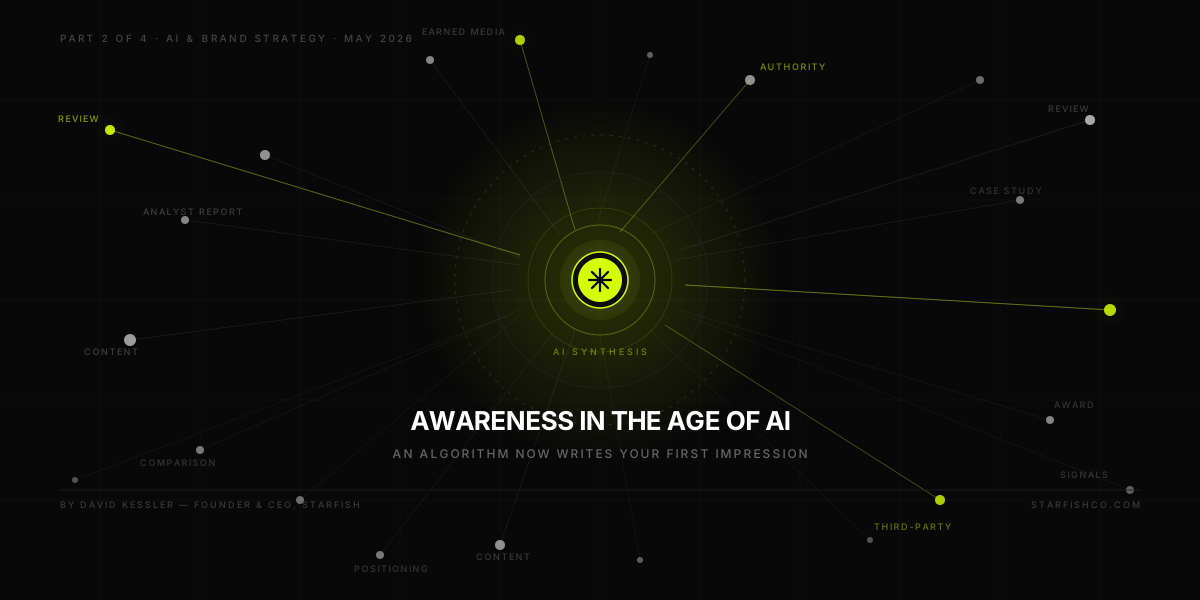
The deeper issue is what you might call the entity clarity gap. AI engines answer from a web of consistent signals: your site, third-party mentions, schema data, and public knowledge sources. Brands with inconsistent messaging, weak schema, or sparse third-party coverage appear ambiguous to AI systems. They aren’t penalized outright, they’re simply less likely to be selected as citation sources. Closing that gap is the central discipline these nine tactics address.
1. Define one authoritative brand record and publish it everywhere
Before AI can recommend your brand, it needs to resolve your brand as a coherent entity. That starts with a canonical entity profile: a single, consistent record of who you are. This record should include your legal name, common name, domain, logo, headquarters, founding date, executive names, and official social profile URLs.
Publish Organization schema on your official website and use sameAs properties to link it to authoritative external profiles. Think of this as filing a birth certificate for your brand in the language AI systems actually read. NAP-style consistency, name, address, phone, domain, and brand description, across all public references is the baseline signal AI systems need to resolve your brand as a trusted entity.
2. Make your brand description identical everywhere AI looks
AI models pull signals from your site, press coverage, directories, review platforms, and social profiles simultaneously. When those sources describe your company differently, they create conflicting signals that reduce entity confidence. The solution is a single editing pass across your key surfaces: the description of what your company does should read near-identically across your About page, LinkedIn summary, Google Business Profile, and any directory listings.
This isn’t a copywriting task; it’s a strategic discipline that touches brand, SEO, communications, and product teams alike. Brand coherence across AI-discoverable surfaces is what transforms scattered signals into a clear, trustworthy identity. At Starfish, this principle sits at the core of Brand and Creative Intelligence™ work: the same clarity that makes a brand compelling to humans is what makes it legible to machines. For a deeper dive into how brand strategy underpins AI visibility, see our piece on What Makes a Strong Brand Strategy?
3. Structure your pages as direct answer blocks
An “answer-ready” page leads with a concise answer to the query it targets, uses clear headings that mirror the question, and separates ideas into semantically distinct sections. Pages that lead with the core fact, before any background or narrative setup, are extracted far more reliably. ChatGPT and Perplexity both follow this pattern.
The best page formats for AI extraction are FAQ pages with explicit Q&A pairs, how-to guides with numbered steps, comparison pages with structured feature blocks, and use-case pages that address a single buyer scenario. One key principle governs all of them: one main content purpose per page. Mixing intents on a single page reduces extraction reliability for both platforms. Keep your FAQ answers between 50 and 150 words (ranges vary by content type, so test what performs best for your topics), lead with the direct answer, and place the most important Q&A pairs near the top of the page. Perplexity in particular favors clearly formatted FAQ pages; see this practical guide to FAQ pages for Perplexity.
Answer engine optimization starts with page architecture
If answer engine optimization (AEO) is new territory for your team, page architecture is the right place to start. A page built for AI extraction and a page built for human readers aren’t in conflict, they share the same fundamentals: clarity, specificity, and a direct answer up front.
4. Add the schema markup types that drive AI citation
Structured data is the bridge between your visible content and what AI systems can extract with confidence. FAQPage schema is the most reliably extracted type for informational and comparison queries; structure it as short Q&A pairs with the visible text matching the schema exactly. HowTo schema works well for process-driven content because discrete ordered steps map directly to how AI engines reframe answers.
Article and BlogPosting schema are effective when paired with a concise TL;DR or lead summary near the top of the page. Organization and ProfessionalService schema strengthen provenance and help AI models connect your content to a credible, identifiable source. Implement all of this in JSON-LD: Google recommends it, and it’s the most maintainable format for most teams. For a practical primer on structured data for AI, this overview is a useful starting point.
5. Earn citations in publications AI engines already trust
On-site structure only gets you so far. AI engines weight mentions from sources they already treat as authoritative: industry publications, research organizations, high-authority news outlets, and established review platforms. A mention in a respected industry outlet carries more AI visibility value than a mention in a low-authority blog, because the AI is already pulling answers from those trusted domains.
Starfish tracks AI citations continuously across eight systems, including ChatGPT, Perplexity, Gemini, Google AI Overviews and Microsoft Copilot, using the Profound platform. Across the branding category in the 30 days to 27 August 2026, the most-cited domains were review and directory platforms led by Clutch and DesignRush, the community platform Reddit, and LinkedIn, alongside trade publications. That is your digital PR target list. Build outreach angles around original data, proprietary research, and expert opinion rather than product announcements. Earned editorial mentions in publications AI systems already cite generally carry more weight than press release syndication.
6. Establish entity presence in knowledge graphs
Wikipedia, Wikidata, and Google Knowledge Panel function as identity anchors for AI models. When a model encounters your brand name across multiple sources, it cross-references these knowledge graphs to confirm you are who you claim to be. Brands that appear consistently across these systems are resolved with higher confidence.
The practical workflow runs in sequence:
- Confirm canonical facts on your own site first.
- Align Wikidata entries, but only if the brand is notable and all statements are reference-backed.
- Pursue Wikipedia only when editorial notability standards are genuinely met, it is not a self-published profile system.
- Verify your Google Knowledge Panel using the Knowledge Graph Search API, check whether panel facts align with your canonical entity profile, and use the “Suggest edits” tool to correct mismatches.
For B2B brands with partial entity recognition, claiming the panel and then strengthening the underlying signals, consistent schema, Crunchbase profile, LinkedIn company page, is the most reliable correction path. For tactical advice on building a strong entity in Google’s Knowledge Graph, this resource outlines practical next steps.
7. Publish content that definitively answers buyer questions
AI systems favor content that answers a question completely. Original research, data-backed guides, frameworks, and expert opinion pieces earn more citations than promotional content. For B2B brands, that means publishing exactly what buyers consult during evaluation: comparison guides, pricing context, use-case breakdowns, and ROI frameworks. If your site doesn’t answer those questions directly, AI will find a source that does, and that source will get the citation.
Publishing cadence matters. Consistent publication on focused topic clusters signals topical authority over time. One comprehensive guide updated quarterly outperforms ten thin posts scattered across unrelated topics. Think about the questions your best sales conversations answer, and build your content calendar around those.
8. Target the comparison and alternative queries AI users actually ask
ChatGPT and Perplexity users frequently search “[your category] alternatives,” “[brand] vs. [competitor],” and “best [solution] for [use case].” Brands that publish direct, honest answers to these queries often appear in AI-generated comparisons, even when the searcher didn’t mention the brand by name. This is one of the highest-leverage content strategies available for AI search optimization right now.
Structure these pages to lead with a clear, extractable answer, not a hedge. Back claims with specifics: named features, measurable outcomes, and real differentiators. An AI engine extracting from a comparison page will more often choose the source with the most concrete, self-contained answer over one that buries the lede in qualifications.
9. Build a prompt simulation library and measure your baseline
You can’t improve what you haven’t measured. The DEJAN methodology offers the clearest starting framework, using two prompt types systematically. Brand-to-Entity prompts ask something like “List ten things you associate with [brand]” to measure how strongly your brand is linked to specific concepts. Entity-to-Brand prompts ask “List ten brands you associate with [keyword]” to measure how often you appear against competitors. Run these in incognito or logged-out sessions for consistency and repeat the same prompt set across measurement periods to compare results.
For each response, record six data points: brand mention (yes or no), citation present (yes or no), citation source domain, position in the answer, competitors mentioned, and sentiment and accuracy of the description. For automated tracking, the strongest tools in 2026 are Ahrefs Brand Radar, Profound, Peec AI, Otterly, Scrunch, and Siftly. Profound leads for compliance-grade citation accuracy and source-tier analysis; Brand Radar leads for dataset volume, with over 260 million monthly prompts drawn from real user behavior. Combine manual prompt simulation for qualitative insight with automated repeated sampling for reliable trend data, since AI responses vary between sessions. For practical tactics on monitoring brand mentions in ChatGPT, the Ahrefs guide is a helpful reference.
AI visibility is a discipline, not a one-time fix
The nine tactics above form a layered system: entity clarity creates the foundation, structured content makes you extractable, third-party authority earns you trust, and consistent measurement tells you whether it’s working. No single tactic substitutes for the others. ChatGPT and Perplexity favor brands that are coherent, authoritative, and technically accessible, which is exactly what a strong brand strategy should already produce.
That convergence isn’t accidental. The same rigor that makes a brand compelling to a human buyer, clear identity, consistent messaging, and credible third-party validation, is precisely what makes it legible to AI. Brands that have invested in Brand and Creative Intelligence™ thinking already have a structural head start on this work, because the clarity was built in from the beginning. If you’re planning a launch, our approach to a new brand launch strategy outlines durable tactics that align with these requirements.
So what can your company do to improve brand visibility in ChatGPT and Perplexity? Start with an AI visibility audit: run a set of DEJAN prompts across both platforms, map your current schema implementation, and compare your brand description across five key external surfaces. For a practical walkthrough, see How to Make Your Brand Visible in AI Search Results. Or reach out to Starfish directly. This is exactly the kind of brand challenge we were built to solve.
Frequently Asked Questions
Read MoreRead Less
How do you audit what AI says about your brand?
Run a fixed prompt set and record what comes back. Use two prompt types: brand-to-entity prompts such as “list ten things you associate with [brand]”, and entity-to-brand prompts such as “list ten brands you associate with [keyword]”. Run them logged out for consistency and repeat the same set each period. For every response record six things: whether the brand was mentioned, whether a citation appeared, the citation source domain, position in the answer, competitors named, and the sentiment and accuracy of the description.
How should brands prepare for AI-mediated discovery?
Treat it as a layered system rather than a checklist. Entity clarity creates the foundation, structured content makes the brand extractable, third-party authority earns trust, and consistent measurement shows whether any of it is working. No single tactic substitutes for the others. AI systems favour brands that are coherent, authoritative and technically accessible, which is what a strong brand strategy should already produce.
What page formats do AI engines extract from most reliably?
FAQ pages with explicit question-and-answer pairs, how-to guides with numbered steps, comparison pages with structured feature blocks, and use-case pages addressing a single buyer scenario. One principle governs all of them: one main content purpose per page. Mixing intents on a single page reduces extraction reliability. The core fact should appear in the first sentence, before any background.
Do Wikipedia and Wikidata affect how AI describes a brand?
They function as identity anchors. When a model encounters a brand name across multiple sources, it cross-references these knowledge graphs to confirm the brand is who it claims to be, and brands appearing consistently are resolved with higher confidence. Confirm canonical facts on your own site first, then align Wikidata entries where every statement is reference-backed. Pursue Wikipedia only where editorial notability standards are genuinely met, since it is not a self-published profile system.
Should you publish comparison and alternatives pages?
Yes, and they are among the highest-leverage pages available. Buyers ask AI systems for category alternatives, brand-versus-brand comparisons and best-for-use-case recommendations constantly. Brands that publish direct, honest answers to those queries often appear in AI-generated comparisons even when the searcher never named them. Lead with a clear extractable answer rather than a hedge, and back claims with named features and real differentiators.