What Is AI Brand Visibility and Why It Matters in 2026

A buyer opens ChatGPT and types: “What are the best enterprise branding agencies for a company like ours?” In the next few seconds, the AI returns a confident answer with three or four names. No list of links. No sponsored results. Just recommendations, delivered as if they came from a trusted colleague. For that buyer, at that moment, the shortlist the AI provides can become the only consideration set that matters, which is exactly why AI brand visibility has moved from a niche technical concern to a strategic imperative.
This is the new reality of brand discovery. Not a ranking you can track on a dashboard or a penalty you can recover from with a content audit. It is something more fundamental: whether AI systems have absorbed enough coherent, credible information about your brand to surface it when the relevant question is asked. A few forward-thinking organizations, including Starfish in New York, started treating this as a core brand strategy problem well before most marketing teams had a framework for it. The rest of the market is catching up fast. By 2026, many organizations and boards have begun treating AI brand visibility as a strategic priority, and the urgency is only growing.
The new gatekeeper nobody warned you about
From search results to generated answers
Traditional search returns a list of links and asks the user to choose. AI-generated answers work differently: they synthesize information, evaluate options, and deliver a conclusion. The buyer never sees a results page. This is not a small interface change; it is a structural shift in how brand discovery works.
Consider a practical scenario: a CMO asks Gemini which brand strategy agencies work with enterprise companies. The AI doesn’t return ten blue links. It names two or three agencies and explains why each is relevant. If your agency isn’t named, you’re not sitting in a lower position on the page, you simply don’t exist in that buyer’s consideration set. Brand discovery has moved from click-based to citation-based, and the implications for how brands manage their presence are profound.
Why the old SEO playbook doesn’t transfer
Traditional SEO was a signal-sending exercise. You optimized content, earned backlinks, and sent signals to a crawler that indexed your pages and ranked them for relevant queries. The logic was mechanical, and the feedback loops were visible. You could see what ranked. You could diagnose drops. You could fix things.
AI search visibility doesn’t work that way. Many base LLMs learn patterns from training data and generate language that reflects what they “know” about the world, while deployed production systems often layer in live retrieval or retrieval-augmented methods, meaning SEO signals may map inconsistently to AI answers. Ranking high on Google does not guarantee you appear in a large language model’s response. Many brands that have meticulously optimized their digital presence for traditional search have significant gaps in how AI systems interpret and represent them. That is as much a brand clarity problem as it is a content problem, which is why solving it requires a different kind of thinking.
What AI brand visibility actually means
The core definition
AI brand visibility is the degree to which AI systems, including large language models like ChatGPT, Gemini, and Perplexity, surface, mention, and recommend your brand when users ask relevant questions. It is distinct from web traffic and from traditional search rankings. The key mental model is straightforward: if AI is increasingly the first stop for buyers doing vendor research, then visibility in AI answers is visibility at the exact moment of consideration.
Forrester’s 2026 Buyer Insights research found that 94% of B2B buyers used AI during their most recent purchase process, and AI tools ranked as the most meaningful research source overall. (Forrester, 2026 B2B Buyer Insights.) That figure reframes AI brand visibility from a niche technical concern into a primary channel for enterprise brand discovery.
Being cited versus being recommended
There is a meaningful line between two different outcomes. A brand can be cited as a source, its content pulled to support a claim, without being recommended as a solution. And a brand can be recommended without its website ever being linked. Generative AI brand presence operates across both modes, and understanding the difference shapes how you optimize for it.
A citation is a footnote; a recommendation is an endorsement. Both matter, but they require different strategies to earn, and brands that only appear in footnotes are being used as raw material rather than being chosen as a solution. To illustrate the distinction: imagine an AI answering a question about brand strategy. It pulls a stat from a mid-tier agency’s blog post (citation) while naming a different firm as the recommended partner (recommendation). The first brand supplied information. The second brand got the business. The goal is to be chosen, not merely quoted.
How AI systems decide which brands to surface
The sources LLMs trust most
Yext’s October 2025 analysis of 6.8 million AI citations across ChatGPT, Gemini and Perplexity found that 86% came from sources brands already control, split nearly evenly between first-party websites (44%) and business listings (42%). Reviews and social accounted for 8%, and forums like Reddit for only 2% once location and query intent were applied. That breakdown matters because it puts significant leverage back in brand owners’ hands.
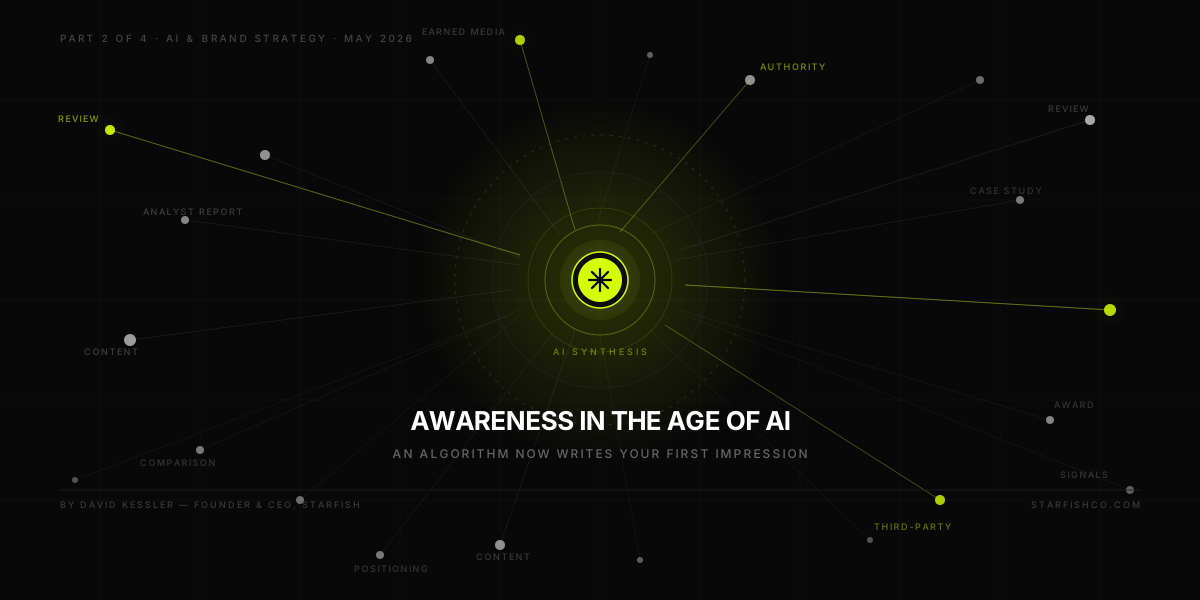
The underlying logic is that LLMs are trained on, and often retrieve, content that is structured, factual, and consistent across multiple sources. A brand that appears coherently across its own site, third-party listings, and editorial mentions gives the model enough signal to confidently “know” it. A brand that exists in scattered, inconsistent fragments gives the model very little to work with and will often be omitted entirely.
Why entity clarity is the hidden variable
Most enterprise brands underestimate the role of entity clarity. An “entity” in this context is what an AI system understands a brand to be: its name, category, positioning, value proposition, and key attributes, matched consistently across sources. If a model cannot confidently build that picture, it will either misrepresent the brand or skip it altogether.
This is not a content volume problem. Publishing more blog posts won’t fix it. It is a brand coherence problem, which is precisely why it sits at the intersection of brand strategy and what practitioners now call LLM SEO. A brand that uses different names on different pages, describes itself inconsistently across platforms, or buries its core positioning in dense corporate language confuses the model the same way it confuses a human reader. According to industry research on structured content, well-organized material with consistent entity signals can generate 30 to 40% more AI mentions compared to dense, unstructured alternatives.
Measuring AI brand visibility: the metrics that matter
AI share of voice explained simply
Vendors running AI visibility programs build a standardized set of prompts relevant to your category, run those prompts across AI platforms like ChatGPT and Gemini, count how often your brand appears in the responses, and divide by total responses. The result is a percentage that functions like a market share figure for AI-generated answers, the clearest single metric for understanding whether your brand is in the conversation or outside it entirely.
The intuition is simple. If 20 people ask “what’s the best enterprise branding agency?” and your brand comes up in four answers, your AI share of voice is 20%. That number can be tracked over time, compared against competitors, and used to measure the impact of specific changes to your brand’s content and presence.
Citation rate, mention frequency, and sentiment
Beyond share of voice, three additional layers complete the diagnostic picture. Citation rate measures whether your brand’s own content is being pulled as a source in AI answers. Mention frequency tracks how consistently your brand name appears across different question types, platforms, and prompt categories. Sentiment analysis flags whether the brand is mentioned positively, neutrally, or with qualifiers that could undercut its credibility.
Together, these form the baseline for serious AI answer monitoring and AI search monitoring. They tell you not just whether you’re appearing, but how you’re appearing, and whether that appearance is working in your favor. Without this data, brand teams are making decisions about their AI presence in the dark. An AI visibility tracker built on these three signals gives leadership the same diagnostic clarity they’ve come to expect from search analytics.
Why AI brand visibility became a boardroom-level priority in 2026
The silent visibility gap
Research from Forrester indicates that a significant share of B2B buyers now use AI to evaluate vendors early in the purchase process, often before visiting a company’s website directly. If your brand doesn’t appear in those answers, you’re not being considered, and the absence triggers no alert. Unlike a search ranking drop, where tools like Google Search Console flag the decline, there is no standardized, platform-wide notification when a closed LLM omits your brand. Practitioners detect the gap through external prompt sampling and AI answer monitoring, which is precisely why brands that aren’t actively measuring their AI presence often have no idea how much ground they’ve already lost. The loss is silent, and it compounds as buyer habits shift further toward AI-first research.
The documented outcomes for brands that invested in AI answer presence are striking. A case study published by an AEO practitioner in 2025 reported a 600% citation uplift and a rise in AI-referred trials from 575 to over 3,500 in seven weeks. The tactics were not exotic: clear entity optimization, structured answer-focused content targeting real buyer questions, and internal linking that connected brand pages to high-intent terms. The gains were real, measurable, and traceable to specific strategic decisions.
What separates brands that show up from those that don’t
The brands building durable generative AI brand presence are not simply publishing more content. They are clarifying their brand architecture, building structured factual authority, and ensuring their positioning is consistent and retrievable across the sources AI systems trust most. The brands that struggle almost always have a brand definition problem, not a content production problem.
This distinction matters because it determines where the solution lives. If your brand shows up inconsistently across its own channels, if your positioning shifts depending on who wrote the page, if your category and value proposition are buried or ambiguous, no volume of new content will fix your AI visibility. The fix has to happen at the brand level first.
Building for the AI-first brand era: where strategy meets intelligence
The Brand and Creative Intelligence™ approach
Starfish built its Brand and Creative Intelligence™ framework as a direct response to exactly this challenge. Where most agencies still optimize brands primarily for human audiences and traditional media channels, this framework explicitly accounts for how AI systems discover, interpret, and recommend brands. It’s not an add-on service; it is a core dimension of how brand strategy gets built. For enterprise organizations, that means brand clarity, coherent entity signals, and content architecture designed to be understood by both people and machines.
That strategic approach is reflected in work Starfish has done with organizations like Avis, PwC, Dunkin’, and Gallup, brands that required systems structured enough to be recognized by AI, coherent enough to earn trust, and distinctive enough to be chosen over alternatives. Achieving those outcomes requires the kind of upstream strategic rigor that no content tactic can substitute for.
What enterprise brands need to do now
The most important mindset shift is recognizing that AI brand visibility is not a technical SEO task to delegate to a specialist. It is a brand strategy question. The brands that will dominate AI-generated answers over the next few years are investing in clarity and credibility at the brand level, not just the content level.
In practice, that means auditing how your brand is described across every owned and third-party source, resolving inconsistencies in naming and positioning, building structured content that answers real buyer questions directly, and earning mentions in the directories, publications, and community platforms that AI systems treat as authoritative. None of this requires a technology platform to start. It requires a clear brand.
The answer is already being written
Return to the opening image: a buyer asking an AI which brands to consider. The answer they receive was shaped long before that moment, by decisions about how clearly a brand defined itself, how coherently it showed up across sources, and whether it gave AI systems enough signal to represent it accurately. That is what AI brand visibility is, and that is why it has moved from a niche technical concern to a strategic imperative for any organization that depends on being found by buyers.
The shift isn’t on the horizon. Buyers are making AI-informed decisions right now, and the brands appearing in those answers earned their place through deliberate, upstream brand work, not last-minute content fixes. The organizations that treat AI brand visibility as a brand strategy priority today are the ones that will be named tomorrow, when the next buyer opens a chat window and asks which companies they should trust.
Frequently Asked Questions
Read MoreRead Less
How do AI systems decide which brands to recommend?
AI systems build a picture of a brand from sources that are structured, factual and consistent, and most of those sources are ones the brand already controls, principally its own website and its business listings. A brand that appears coherently across its own site, third-party listings and editorial mentions gives a model enough signal to describe it confidently. A brand that exists in scattered, inconsistent fragments is often omitted entirely.
What is AI brand visibility?
AI brand visibility is the degree to which AI systems, including large language models such as ChatGPT, Gemini and Perplexity, surface, mention and recommend a brand when users ask relevant questions. It is distinct from web traffic and from traditional search rankings. If AI is the first stop for buyers doing vendor research, then visibility in AI answers is visibility at the moment of consideration.
What is the difference between being cited and being recommended by AI?
A citation is a footnote and a recommendation is an endorsement. A brand can be cited as a source, with its content pulled in to support a claim, without being recommended as a solution. It can also be recommended without its website being linked at all. Brands that only appear in footnotes are being used as raw material rather than being chosen.
Why does traditional SEO not work for AI brand visibility?
Traditional SEO was a signal-sending exercise: optimize content, earn backlinks, and a crawler indexes and ranks the pages. AI systems work differently. Base models learn patterns from training data and generate language reflecting what they know, while production systems layer in live retrieval, so SEO signals map inconsistently to AI answers. Ranking high on Google does not guarantee being named in an AI answer.
How do you measure AI brand visibility?
The standard measure is AI share of voice. You build a standardized set of prompts relevant to your category, run them across AI platforms, count how often your brand appears in the responses, and divide by the total number of responses. The result functions like a market share figure for AI-generated answers, showing whether a brand is in the conversation or outside it.