AI BRAND STRATEGY UNFILTERED PART 1
What AI Actually Says About Your Brand

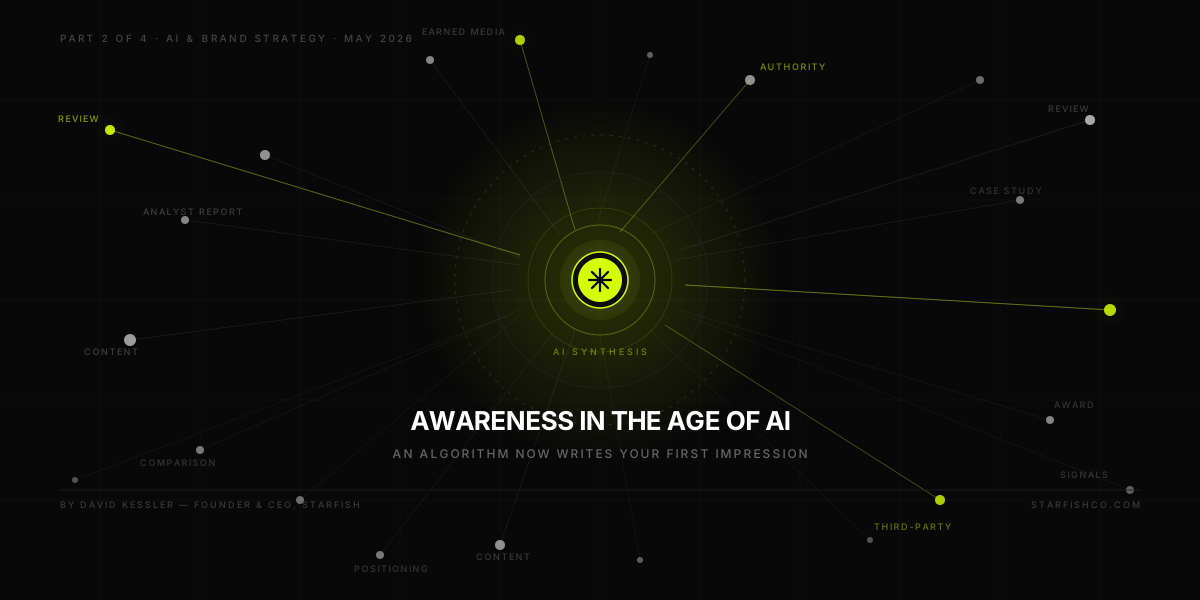
Ask an AI system about your own brand. Ask it what you do, who you compete with, and whether you’re any good.
Most CMOs I talk to have the same reaction the first time. The answer sounds mostly fine, so there’s some relief. Then it sinks in that “mostly fine” isn’t a standard they’d accept from anything else the brand puts out. The usual problem isn’t that AI says something hostile. It’s that it says something outdated, something generic, or something that’s just as true of your closest competitor.
Most people assume that happens because the systems are careless, or because the brand hasn’t published enough. Neither is the real reason. An AI answer comes from 2 different places, and the fix for one doesn’t work on the other. That’s what this piece is about.
Know which failure you’re looking at
There are 3 ways AI gets a brand wrong. Inconsistency, where different systems describe the same company differently. Inaccuracy, where retired products and old structures keep showing up as current. Undifferentiation, where the description could apply to any of your competitors. We’ve covered why those 3 compound in three ways AI gets your brand wrong.
The step most teams skip is working out which kind of failure they have before they try to fix it. That’s what decides whether anything you do next will work.
Where do AI answers about your brand come from?
They come from 2 places.
Parametric memory is what the model learned in training. It’s frozen until the next training run, and you can’t edit it directly. The only way to change it is to improve the record that feeds the next run.
Retrieval is what the system pulls in live when someone asks: a current web page, a recent article, an indexed document.
The 2 move on different timelines. A parametric error is slow. A retrieval error can often be fixed in weeks by correcting or strengthening the specific source the model is pulling from.
This is why “just publish more content” so often doesn’t move anything. If the wrong description is sitting in training memory, a new blog post may not be seen for a year. The content isn’t wrong. It’s aimed at the wrong layer.
Track the story, not just the facts
Accuracy matters, but it isn’t enough. Two answers can both be correct and tell very different stories. One is flat. The other explains why customers pick you. I’d track these systematically, not by asking once:
- How is the brand described, and how close is that to your own language?
- Which themes and associations come up most, and are they the ones you’d choose?
- Is the sentiment favorable, neutral or unfavorable, and does it change by platform?
- How does the description compare with your named competitors on the same prompts?
- Which outdated facts or misconceptions keep coming back, no matter how often you correct them?
None of this is new. It’s what good brand tracking has always done with human audiences. The audience is just new, and it moves a lot faster.
Should you block AI crawlers on your site?
It’s the wrong question, because there are 2 kinds of crawler doing different jobs. Training crawlers feed a model’s next update. Answering crawlers pull live sources into today’s answers.
An August 2026 analysis of robots.txt across Cloudflare’s network found publishers block training crawlers at roughly double the rate of answering crawlers. GPTBot and ClaudeBot, both training crawlers, had block-to-allow ratios of 2.33 to 1 and 2.39 to 1. OAI-SearchBot, an answering crawler from the same company as GPTBot, was at 0.94 to 1. Publishers aren’t blocking AI. They’re blocking training and allowing answering, often from the same company.
That’s a governance decision. Letting in a crawler that won’t affect anything for a year is a different call from letting in one that shapes what gets said about you today. Most brands haven’t made either call on purpose.
How do you turn this into a number?
Asking ChatGPT once and deciding it seems okay isn’t an audit. The full method is in how to audit what AI says about your brand. The short version:
Run a fixed set of 20 to 30 prompts that cover how buyers ask about your category, compare options and check reputation. Run them on every major engine your buyers use, several times each, because these systems don’t give the same answer twice. Score the results on 6 things: how often and how prominently you appear, accuracy, consistency across engines and runs, how differentiated the language is, the quality of the sources behind it, and sentiment.
That gives you a baseline with a real number on it, one you can track over time instead of a sense that things are probably fine.
What do you do with what you find?
Every gap routes to one of 3 fixes:
- Retrieval errors get fixed at the source. Correct or strengthen the page or listing the model is pulling from.
- Parametric errors get logged and addressed through the next training cycle, with realistic timelines for anyone waiting on them.
- Undifferentiation gets fixed the way it always has: a sharper, more specific point of view, structured so these systems can pick it up.
None of this is about gaming anything. It’s about knowing, specifically and continuously, what’s being said about you. Most brands haven’t done that part yet.
Related reading: the three ways AI gets your brand wrong, and your brand’s second reader and how it got there.
Starfish is a Branding and Creative Agency that builds brands with the soul to move people and the coherence to govern AI. Its expertise in Brand Experience is what enables it to lead in AI Brand Strategy.
Frequently Asked Questions
Read MoreRead Less
Why does AI give outdated information about a brand?
Because part of the answer comes from parametric memory, the facts baked in during the model’s training run, which are frozen until the next one. A retired product or an old price sitting in that layer does not announce itself as stale and cannot be patched directly. It can only be corrected by improving the record that feeds the next training cycle.
What is the difference between parametric memory and retrieval?
Parametric memory is what a model absorbed during training: frozen, indirect, and correctable only at the next training run. Retrieval is content the system pulls in live at the moment someone asks, such as a current page or an indexed document. A retrieval error can often be fixed within weeks by correcting the source. A parametric error is a slow lever.
Why doesn’t publishing more content fix what AI says about a brand?
Because publishing only addresses the retrieval layer. If the wrong description is sitting in a model’s training memory, a new blog post may not be seen for another year, and the effort produces no visible change in the meantime. The diagnosis has to come before the fix, or the work is aimed at the wrong half of the machine.
Should a brand block AI crawlers on its website?
That is the wrong question, because training crawlers and answering crawlers do different jobs. An August 2026 analysis of robots.txt across Cloudflare’s network found publishers blocking training crawlers at roughly double the rate of answering crawlers, often from the same company. Blocking the crawler that feeds next year’s model and blocking the one feeding today’s answers are two separate decisions, and most brands have consciously made neither.
How do you fix what AI says about your brand?
Diagnose before you fix. Retrieval errors are fixed at the source, by correcting or strengthening the page or listing the model is pulling from, and can move within weeks. Parametric errors sit in training memory and are fixed by improving the record that feeds the next training cycle, which takes longer. Undifferentiation is fixed by a sharper point of view, written so the systems can lift it.
How long does it take to change what AI says about a brand?
It depends on where the error lives. A retrieval error can change within weeks once the source the model relies on is corrected. A parametric error waits for the next training run, so the realistic horizon is months, and any plan should set that expectation before work starts.