Creating B2B Brand Differentiation That Competitors Cannot Clone

A B2B brand should differentiate by moving beyond surface-level messaging and building a distinctive identity that is anchored in its brand positioning, established equity, and ownable assets that competitors cannot replicate. Today, this challenge has become urgent because AI-mediated discovery now filters, ranks, and sometimes omits brands before a human buyer ever visits a website. The brands that break free are those that treat differentiation as a strategic system rather than a marketing tactic, emphasizing the need for a comprehensive approach that sustains long-term success.
If you have watched competitors copy your positioning, or struggled to articulate how your company is different when every rival claims the same benefits, you are not alone. This has become a prevailing trend as the lines between brands and offerings have blurred.
We have argued elsewhere why B2B convergence is accelerating, and why generative systems trained on the same category language produce the category average by default. That argument is made in full here. This piece takes the next step. It is the operating manual rather than the diagnosis: what differentiation actually requires, the four levers that produce it, and how to measure whether it is working.
What True Brand Differentiation Requires, and What Most Get Wrong
True B2B brand differentiation requires identifying and owning a position that is meaningful to buyers, credible for your company, and difficult for competitors to claim. Most companies mistake differentiation for messaging variation when it actually demands strategic commitment.
The most common error is treating differentiation as a tagline exercise. Companies workshop new language, update their homepages, and declare themselves differentiated only to find competitors adopting similar messaging within months. This happens because the differentiation existed only at the surface level, not in the underlying brand positioning, business model, company core competencies, or company DNA.
Another frequent mistake is confusing features with differentiation. In B2B markets, product capabilities are often at parity within a category. Claiming your platform is “faster” or “more intuitive” rarely creates lasting differentiation because these claims are easily matched or disputed. Buyers have learned to discount feature-based differentiation, especially when every vendor in a category makes similar assertions.
Genuine differentiation emerges from the intersection of three elements: what your company does better than anyone else (its core competencies), what your target buyers care about most deeply (their needs), and what competitors cannot or will not replicate. This intersection is narrower than most companies want to admit, which is why effective brand strategy often requires saying no to broad positioning in favor of owning a specific territory.
A comprehensive branding differentiation strategy addresses all four layers: the strategic foundation, the messaging expression, the visual assets, and the behavioral interactions that make the positioning tangible. Alignment across these layers is critical, because without cohesion differentiation remains an unfulfilled goal rather than a market advantage.
The Four Levers: Positioning, Equity, Assets, and Experience
Effective B2B brand differentiation operates through four interconnected levers: brand positioning that claims a distinct territory, brand equity that compounds over time, brand assets that make the positioning instantly recognizable, and the experience customers have when they interact with the brand, whether directly or indirectly.
Most differentiation frameworks stop at three. The fourth is the one that decides whether the other three survive contact with a real customer.
Positioning
Brand positioning defines the specific space your company occupies in buyers’ minds relative to alternatives. Strong positioning answers the question “why this company for this problem” in a way that competitors cannot credibly claim. This requires making explicit tradeoffs and choosing to be known for something specific rather than trying to appeal to everyone. The relationship between marketing strategy and brand positioning is foundational: positioning guides every downstream marketing decision, from content topics to campaign messaging.
Equity
Brand equity represents the accumulated value of your brand in the market. It is the recognition, trust, and preference that buyers have developed through repeated exposure. Equity builds slowly through consistent delivery on your positioning promise, creating a moat competitors cannot easily cross. Companies with strong brand equity can command premium pricing, shorten sales cycles, and attract talent more easily than undifferentiated rivals.
Assets
Brand assets are the tangible elements that make your brand recognizable: visual identity, tone of voice, proprietary terminology, and distinctive content formats. These assets serve as memory structures that help buyers recall your brand when a relevant need arises. Without distinctive brand assets, even strong positioning struggles to stick in buyers’ minds.
Assets are also what AI systems latch onto. Consistent, named, repeatedly used language gives a model something specific to extract and attribute. A brand that describes itself in category-standard terms has given the model permission to treat it as category-standard.
Experience
Experience is where the other three levers are either proven or exposed. It is the sum of what a customer thinks, feels, and instinctively believes after every interaction, whether that interaction is with a salesperson, a product interface, a support conversation, or an AI agent answering on your behalf.
Experience without a north star that defines what the company intends customers to think and feel after an interaction is simply generic, and arguably the greatest lost opportunity for creating brand loyalty. This is the lever most often left to chance, and it is the one competitors find hardest to copy, because replicating it means changing how an organization behaves rather than how it advertises.
The framework works as a system. Positioning without equity is just a claim. Equity without distinctive assets is invisible. Assets without clear positioning are memorable but meaningless. And all three without a deliberately designed experience are a promise the organization does not keep. B2B brands that achieve true differentiation align all four around a coherent strategic intent.
What AI-Mediated Discovery Demands of Each Lever
AI systems now influence which B2B brands buyers discover, consider, and trust before any human interaction occurs. The practical consequence is not that differentiation matters more in the abstract. It is that each of the four levers now has a machine-facing requirement alongside its human-facing one.
Positioning must be extractable. Clear, consistent language that states what you do and who you do it for, expressed identically across every surface, gives a model a stable answer to quote. Positioning that shifts wording between the website, the sales deck, and the press release produces an ambiguous model of the brand, and ambiguous brands get resolved toward the category average.
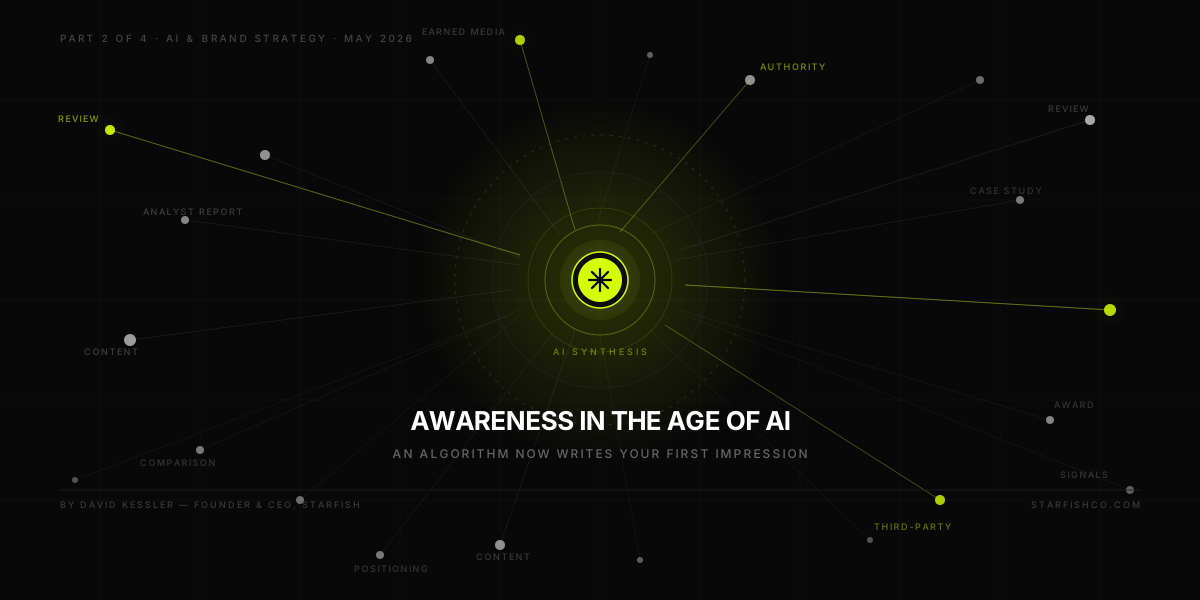
Equity must be externally evidenced. AI systems weight third-party corroboration heavily. Reviews, directory profiles, earned coverage, original research, and named methodologies are what let a model conclude that a brand is credible rather than merely present. This is why brand equity increasingly lives off your own domain.
Assets must be machine-legible. Proprietary terminology and distinctive framing are what make a brand quotable. Generic content that restates category-level information gets deprioritized in favor of sources offering unique perspectives or proprietary frameworks.
Experience must be governed. Once an AI agent answers on a brand’s behalf, its conduct is not a representation of the brand. It is the brand. The rules governing how those agents behave belong to brand strategy, not to a support playbook.
Examining AI brand strategy case studies reveals a pattern: companies that invested in distinctive, well-documented positioning before the AI discovery shift are now reaping compounding visibility benefits, while those that relied on paid media and undifferentiated content are struggling to maintain presence.
Brand Archetypes and Identity as Strategic Levers
Brand archetypes provide a framework for developing a distinctive brand identity that resonates emotionally with buyers and guides consistent expression across touchpoints. In B2B markets, where rational evaluation dominates, archetypal identity creates the emotional differentiation that tips decisions.
An archetype is a universal character pattern (the Hero, the Sage, the Rebel, the Creator) that shapes how a brand presents itself and relates to its audience. Choosing an archetype is not about artificially adopting a persona. It is about identifying your organization’s authentic character and expressing it consistently. A company that genuinely operates as a Challenger brand should not try to present itself as a trusted Sage, and vice versa.
Brand identity extends beyond archetypes to encompass visual systems, verbal tone, and experiential elements. Strong brand guidelines codify these elements so that every touchpoint reinforces the same distinctive impression. In B2B contexts, where buyers encounter brands across websites, sales conversations, product interfaces, and industry events, consistency is essential for building recognition.
The connection between brand identity and B2B messaging strategy is direct: identity decisions determine the messaging’s voice and framing. A brand with a Challenger archetype will use different language, make different claims, and take different stances than a brand positioning itself as the established category leader. This alignment between identity and messaging is what makes differentiation feel authentic rather than manufactured.
Companies that treat brand archetypes as a strategic lever rather than a creative exercise gain a decision-making framework that simplifies countless downstream choices. When you know your brand’s character, you can quickly evaluate whether a campaign concept, content piece, or partnership opportunity fits your positioning.
Measuring Differentiation: Brand Equity and Awareness Metrics
Differentiation is measurable through brand equity tracking, brand awareness studies, and market perception research that reveals whether your positioning is landing with target buyers. Without measurement, differentiation remains a subjective judgment rather than a strategic asset.
Brand equity measurement typically combines several indicators: unaided awareness (do buyers think of your brand when a relevant need arises), consideration (is your brand on the shortlist when buyers evaluate options), preference (do buyers choose your brand over alternatives when capabilities are similar), and willingness to pay (can your brand command a premium). Tracking these over time reveals whether differentiation investments are translating into market position.
Brand awareness metrics distinguish between recognition (buyers know your brand exists) and recall (buyers think of your brand unprompted in relevant contexts). For differentiation purposes, recall matters more than recognition. A brand that buyers recognize but never think of when needs arise has failed to differentiate in a meaningful way.
There is now a fifth measure worth tracking alongside those four: how AI systems describe you. Ask several assistants what your company does, who it serves, and how it compares to named competitors. If the answers are vague, generic, or interchangeable with a rival’s, the differentiation has not reached the layer that increasingly decides whether you make the shortlist at all.
The tension between B2B brand building and performance marketing often surfaces in measurement discussions. Performance marketing delivers trackable short-term results, while brand building creates long-term equity that is harder to attribute directly. Companies that measure only performance metrics may underinvest in differentiation, eroding their competitive position over time even as campaign metrics look healthy.
Effective measurement also includes competitive perception research: how do buyers describe your brand versus competitors? If buyers use the same language to describe your company and your rivals, differentiation has not taken hold, regardless of what your internal positioning documents claim.
Making Differentiation Structural
Building a brand competitors cannot clone requires embedding differentiation into elements that cannot easily be replicated: proprietary methodologies, accumulated brand equity, distinctive customer relationships, and organizational culture. Surface-level differentiation invites imitation. Structural differentiation creates a durable advantage.
The first step is accepting that differentiation is a long-term investment, not a campaign. Companies that expect immediate results often abandon their positioning before it has time to compound. Brand equity builds through consistent presence and repeated delivery on your positioning promise over months and years.
The second step is making differentiation operational. Your positioning should influence product decisions, hiring criteria, partnership choices, and customer experience design, not just marketing messages. When differentiation is embedded throughout the organization, it becomes much harder for competitors to copy, because they would need to change their entire operating model rather than their website.
The third step is protecting your distinctive brand assets. This means investing in visual and verbal elements that are ownable, documenting them in brand guidelines, and enforcing consistency across every touchpoint. Distinctive assets create memory structures that competitors cannot replicate without appearing derivative.
Finally, consider whether you need expert support. A B2B brand strategy agency can bring outside perspective, proven frameworks, and execution capacity that internal teams may lack. The investment in professional brand strategy often pays for itself through clearer positioning, faster market traction, and reduced wasted spend on undifferentiated marketing.
The B2B brands that will thrive are those that treat differentiation as a strategic discipline rather than a creative exercise. In a market where AI systems increasingly mediate discovery, and competitors can copy surface-level positioning overnight, the only sustainable advantage is a brand built on foundations that cannot be cloned.
Frequently Asked Questions
Read MoreRead Less
What is B2B brand differentiation?
B2B brand differentiation is the ability to clearly show how your company is uniquely suited to solve a buyer’s problem in ways competitors cannot match. It encompasses positioning, messaging, visual identity, and customer experience elements that create a distinct impression in the market. Effective differentiation makes your brand memorable and relevant, helping buyers understand why they should choose you over alternatives with similar capabilities.
What is a B2B brand strategy, and how does differentiation fit into it?
A B2B brand strategy is the long-term plan for how a company will build recognition, trust, and preference among its target buyers. Differentiation is the core of that strategy. It defines the specific territory your brand will own and how you will distinguish yourself from competitors. Without differentiation, brand strategy becomes a generic exercise in visibility rather than a driver of competitive advantage.
What are the four levers of B2B brand differentiation?
Positioning, equity, assets, and experience. Positioning claims a distinct territory. Equity is the accumulated recognition and trust that compounds over time. Assets are the visual and verbal elements that make the brand instantly recognizable. Experience is what customers actually think and feel after interacting with the brand. Most frameworks stop at the first three, but experience is where the other three are either proven or exposed, and it is the hardest for a competitor to replicate because it requires changing how an organization behaves rather than how it advertises.
Can you give an example of B2B brand differentiation done well?
Strong B2B brand differentiation typically involves a company claiming a specific position that competitors cannot credibly occupy. This might mean owning a particular methodology, serving a narrow segment exceptionally well, or building a distinctive brand voice that stands apart from category conventions. The key indicator is that buyers can articulate what makes the brand different without prompting, and competitors struggle to make the same claims without appearing derivative.
How is B2B brand differentiation different from B2C brand differentiation?
B2B brand differentiation must account for longer buying cycles, multiple decision-makers, and higher-stakes purchases where rational evaluation plays a larger role. While B2C differentiation often relies heavily on emotional appeal and mass awareness, B2B differentiation must also address functional credibility and risk reduction. Additionally, B2B buyers typically consider fewer options and make safer choices, making distinctiveness within a narrow consideration set more important than broad awareness.
What are the most effective ways to differentiate a B2B brand in a crowded market?
The most effective approaches include claiming a specific positioning territory that competitors cannot credibly occupy, developing proprietary methodologies or frameworks that become associated with your brand, building distinctive brand assets that create instant recognition, and investing consistently in brand equity over time. Differentiation also requires saying no to broad positioning in favor of owning something specific that matters to your target buyers.
How do you know if your B2B brand differentiation strategy is actually working?
Measure differentiation through brand equity tracking, including unaided awareness, consideration rates, preference over competitors, and willingness to pay premium pricing. Conduct competitive perception research to see whether buyers describe your brand differently from rivals. Ask several AI assistants to describe your company and compare the answers to your intended positioning. If buyers consistently articulate what makes your brand distinct without prompting, and competitors struggle to make the same claims credibly, your differentiation strategy is working.