The Proof Problem

Everyone is publishing AI brand case studies. Almost nobody is publishing brand results.
Ask for AI brand strategy case studies with measurable business impact and the numbers arrive immediately. Content produced twice as fast. Costs halved. Click-through up by triple digits. Assets generated overnight while the team slept.
Read them closely. Almost none of those numbers measure a brand. They measure a factory.
The two get sold interchangeably, and that is the problem. A buyer asking whether the brand work moved the business is handed evidence that the content pipeline got cheaper. Both are real. Only one was the question.
The numbers measure the factory, not the brand
Production efficiency is easy to count. Brand equity is not.
A content pipeline has inputs and outputs available on a Monday morning: assets produced, hours spent, cost per asset, days from brief to launch. Brand equity accumulates slowly, surfaces indirectly, and resists attribution. So the case studies that get published are the ones with clean numbers, and the clean numbers are the ones describing the machine.
What results is a literature that looks rigorous and answers a question nobody asked. Nobody ever hired a brand agency to reduce the cost of making banners.
Unilever’s numbers are real. They describe a factory.
Unilever is the most cited example in this category, and deservedly so. The work is serious and the reporting is specific.
Its beauty and well-being group, home to Dove, Tresemmé, Vaseline and Clear, was first to pilot the company’s digital-twin approach, building 3D replicas of products on Nvidia’s Omniverse platform. Per Marketing Dive’s March 2025 reporting, that group saw 55% growth in savings and turned content around 65% faster. Unilever’s own press release says some content now ships twice as fast at half the cost.
Now read what those figures actually describe. Savings. Turnaround. Cost per asset. Speed. Every headline number is an operations metric. The one genuine brand outcome in the entire account, an increase in purchase intent, arrives with no figure attached and applies to only “some brands.”
Unilever is admirably honest about this. Chief Growth and Marketing Officer Esi Eggleston Bracey put it plainly in that coverage: “This isn’t about pushing out more content.” The efficiency is the enabler, not the achievement. Marketing Dive filed the story under the words “increasing production efficiency,” which is exactly right, and exactly what disappears when the same numbers are recycled as brand proof.
A 450% lift that never mentions the brand
The most quoted figure in AI marketing belongs to JPMorgan Chase.
Working with Persado, Chase tested machine-written ad copy against copy written by people. In its pilot, Marketing Dive reported, Chase saw as high as a 450% lift in click-through on the machine-rendered ads, with most results landing between 50% and 200%. A five-year enterprise deal followed, announced by Persado.
Striking, and worth reading precisely. The winning variant was a rewording. “It’s true, you can unlock cash from the equity in your home” beat “Access cash from the equity in your home.” That is message optimization applied to one sentence and scored by one click.
It says nothing about whether anyone thinks differently about Chase. It cannot. That was never what it measured. Two further details matter: the programme began in 2016 and expanded in 2019, which means it predates generative AI as the term is now used. When a 2026 deck offers it as evidence of AI brand strategy, the number is doing work it was never built to do.
The clearest brand case of the decade has no AI in it
If you want a case study where brand strategy produced business impact fit for a CFO, the strongest recent example involves no AI whatsoever.
In 2021 Airbnb stopped leaning on performance marketing and moved the money into brand. Not a trim. As Campaign reported, most of the reduction came out of performance channels such as search and online bidding, cutting roughly $541 million. Marketing Week tracked the outcome: around 90% of Airbnb’s traffic was direct or unpaid, and traffic recovered to about 95% of pre-pandemic levels despite the cut.
The financial result is public record. Revenue rose 40% in 2022 to $8.4 billion, and the company posted its first full year of profit at $1.9 billion in net income.
That is what measurable brand impact looks like. A decision about the brand, a quantified reallocation, a traceable change in how demand arrived, and a number on the bottom line. Note what is missing. No asset counts. No production speed. No cost per deliverable.
Five tests that separate proof from throughput
These work whether you are reading an agency’s case study or writing your own.
1. Does it measure demand creation or demand capture? Click-through, conversion and cost per acquisition measure capture, which is harvesting intent that already existed. Unaided awareness, brand search volume, direct traffic share, preference and pricing power measure creation. Capture metrics tell you the funnel is efficient. Creation metrics tell you the brand is working.
2. Is there a business outcome, or only a marketing outcome? Revenue, margin, retention, share, valuation. A case study that ends at engagement has stopped one step short of the thing finance asked about.
3. Is the counterfactual stated? Compared to what. A number with no baseline, control or prior period is a claim, not a result. The Chase pilot is credible precisely because it was measured against human copy.
4. Is the time horizon honest? Brand effects lag and compound. Anything measured inside a single quarter is almost certainly capture. A brand claim should say over what period it was observed.
5. Does it separate what AI did from what people decided? Almost nothing passes this one. The model generated the variants. Who decided what the brand should mean, which of the thousand options was on-brand, and what to refuse? A case study that cannot answer that is describing a tool, not a strategy.
The industry is producing the evidence its dashboards can generate
The gap is structural, not accidental.
Brand is not being deprioritised. McKinsey’s State of Marketing Europe research, a survey of 500 senior marketing leaders, found branding ranked as the single highest marketing priority for 2026, with generative and agentic AI placing 17th of 20 topics.
The problem is proof. NIQ’s 2026 CMO Outlook found the share of CMOs who say their CEO and CFO believe in the long-term value of brand building fell from 80% to 69% in a single year, while 84% now use ROI as the primary metric for allocating budget.
Read those together. Marketers rank brand first. Finance is less convinced than it was a year ago. And the framework being used to settle the argument was built to score demand capture. So the industry generates the evidence its measurement stack can produce, which is production and performance evidence, then uses it to argue a brand case that evidence does not support.
There is a trap inside this. Agree to defend brand purely in performance terms and you will begin managing it to those terms, which quietly strips out the long-horizon work that made it valuable. We took that apart in the brand measurement trap, and the brand building versus performance marketing split in B2B is the same argument playing out in budget meetings.
What we can and cannot show you
Applying these tests to ourselves produces an honest answer rather than a flattering one.
Starfish is a Branding and Creative Agency, with unique expertise in Brand Experience, working with clients on brand strategy, identity and experience since 2002. Our published work includes Samsung, PwC, Avis, Gallup, Baxter, Hologic, CRISIL and Nexxen. The work is guided by BCI™ (Brand and Creative Intelligence™), and where AI enters production it is human-led, because the judgment about what a brand should mean and what it should refuse is not a decision we hand to a model.
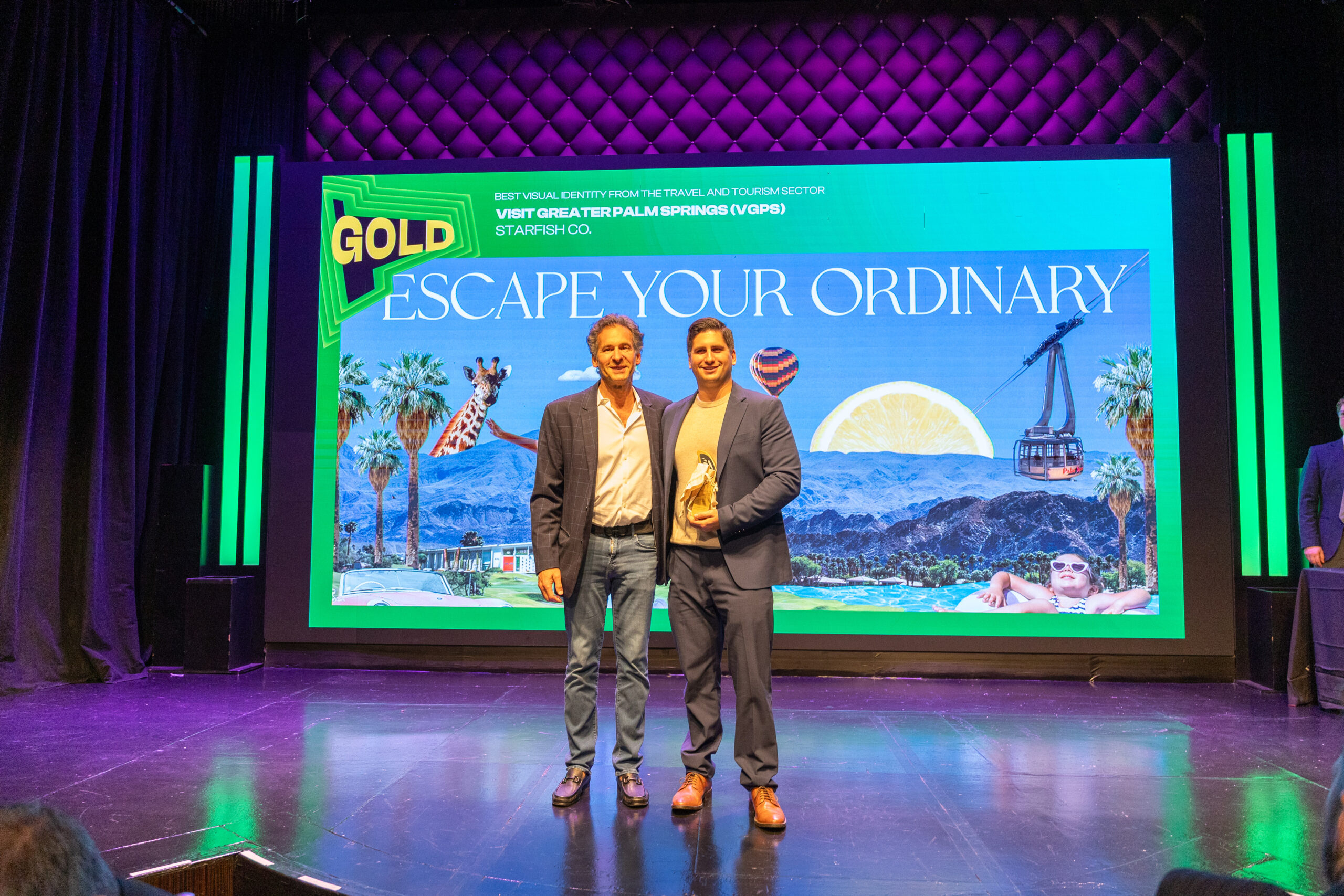
What we do not currently publish is a set of quantified business outcomes attached to each of those engagements. Much of that data is commercially sensitive to our clients, and some of it has never been assembled in a form we would stand behind publicly. We would rather say so than reach for numbers we cannot substantiate. What we can point to is independent validation: 12 Transform Awards in 2025 and six shortlistings in 2026, judged by an outside panel against named competitors.
We are working on the first part. The five tests above are the standard we are holding our own case studies to, and every buyer should hold every agency they evaluate, including this one, to the same standard.
The question that cannot be dodged
“Show me AI brand strategy case studies with measurable business impact” is a fair request that reliably produces misleading answers, because the market has an abundant supply of production metrics and almost no brand ones.
There is a better question, and it is much harder to slip. Show me a decision you made about what this brand means, and show me what changed in the business afterward.
Most case studies cannot answer it. The ones that can are the only ones worth reading.
Frequently Asked Questions
Read MoreRead Less
What is the difference between an AI brand strategy case study and an AI content production case study?
A brand strategy case study reports a change in what a brand means to people and the business results that followed, measured through indicators such as unaided awareness, brand search volume, direct traffic share, preference, pricing power, revenue or retention. A content production case study reports operational gains such as assets produced, cost per asset, turnaround time or production speed. Both are legitimate, but only the first is evidence that brand work changed business performance. Most published AI case studies are the second kind presented as the first.
Are there any AI brand case studies with real measurable business impact?
There are very few with brand-level business outcomes attached. The most specific published results, such as Unilever’s 55% growth in savings and 65% faster content turnaround, are production efficiency figures. The most quoted performance figure, JPMorgan Chase’s lift of as high as 450% in click-through rate with Persado, measured message optimization against human-written copy rather than brand effect. The strongest recent case study of brand strategy producing measurable business impact is Airbnb’s shift of spend from performance to brand, which involved no AI.
Why is brand impact so much harder to measure than AI production gains?
Production has countable inputs and outputs available immediately, while brand equity accumulates slowly, surfaces indirectly and resists clean attribution. Performance dashboards are built to score demand capture, meaning the harvesting of intent that already exists, and cannot see demand creation, meaning the accumulated meaning that made someone prefer you beforehand. So the numbers that are easy to produce are production numbers, and those are the ones that get published.
What should I ask an agency for when I want proof their brand work delivers results?
Ask five things. Whether the metric measures demand creation or demand capture. Whether there is a business outcome such as revenue, margin, retention or share, rather than only a marketing outcome. Whether the counterfactual is stated, meaning compared to what baseline, control or prior period. Whether the time horizon is honest, since brand effects lag and compound. And whether the case study separates what AI generated from what people decided.
Does the industry acknowledge this evidence gap?
The data points that way. McKinsey’s State of Marketing Europe survey of 500 senior marketing leaders found branding ranked as the highest marketing priority for 2026, with generative and agentic AI 17th of 20. At the same time, NIQ’s 2026 CMO Outlook found the share of CMOs saying their CEO and CFO believe in long-term brand building fell from 80% to 69% in a year, while 84% now use ROI as the primary budget metric. Brand ranks first with marketers, confidence is falling with finance, and the measurement framework being used to settle it was built for demand capture.
The Brand Intelligence Monitor is published by Starfish, a Branding and Creative Agency with unique expertise in Brand Experience, and a brand strategy firm built for the AI era. We help brands prove what actually compounds, rather than measuring whatever the dashboard can already see.