PAPER 3 OF 5
The Machine Path

What AI sees when it looks at your brand and why it matters more than your messaging
Welcome to the third chapter in Starfish’s five-part exploration of brand management in the age of AI.
In our first paper, we argued that great brands are living, breathing systems that demand ongoing care, not just one-off campaigns. The second paper made it clear that human creativity sparks real emotion, shapes culture, and dares to be bold; it is the heartbeat of brand meaning. Machines can’t replicate it, and as AI expands, its value only grows.
Now, we turn to the dimension that completes the picture. Expanding human conversation versus replacing it
Here’s the new reality every marketing leader faces: even the world’s most magnetic, distinctive, and creatively charged brand can be invisible to the very systems now deciding who gets found, considered, and recommended.
This paper is about that gap and how to close it.
The Brand Has Always Had an Invisible Audience
A brand has always played to more than one audience. There’s the visible audience: the customers, prospects, employees, and partners. And then there’s the unseen chorus: dinner table conversations, analyst reports, magazine features, word-of-mouth that spreads in rooms you’ll never enter. These voices shape what your visible audience believes, long before you ever get to speak for yourself.
The best brand leaders have always known this secret. The brands that carved out lasting authority, such as McKinsey, Patagonia, and Trader Joe’s, didn’t get there by micromanaging every message. They built meaning so distinct, so consistent, so real, that the invisible audience echoed it back, loud and clear.
AI is now the newest and fastest-growing member of that invisible audience.
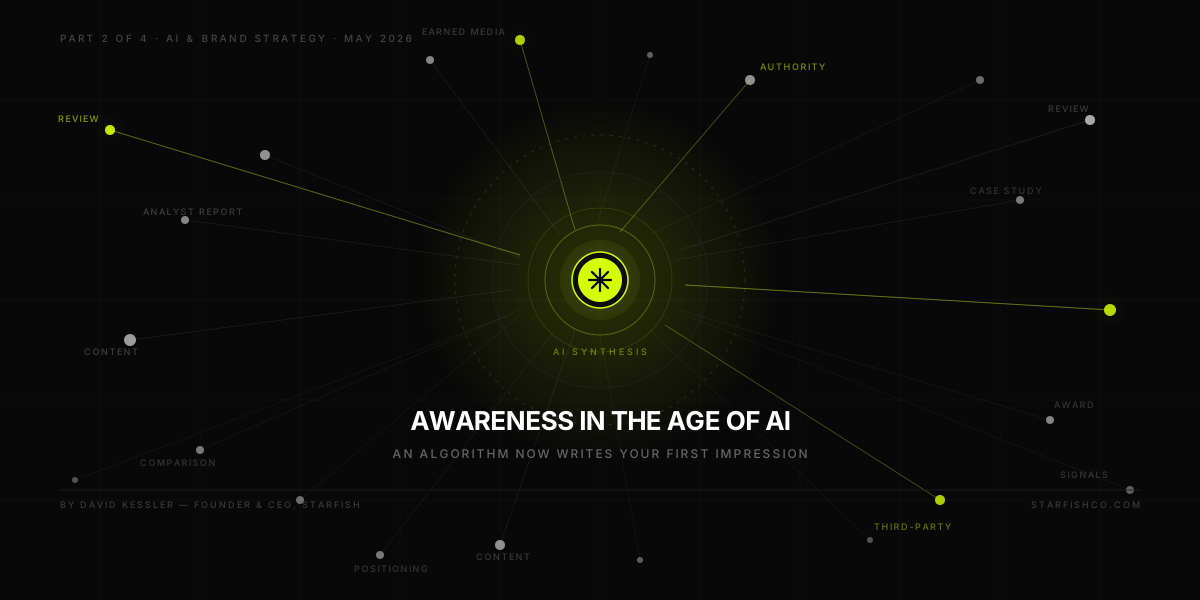
When a buyer turns to AI and asks, ‘Who leads this category?’, the AI doesn’t browse your website or study your brand guidelines. Instead, it pieces together a probabilistic portrait of your brand from everything the world has ever said about you; every article, citation, review, and passing mention across the digital universe.
The question isn’t whether this AI-built portrait exists for every brand with a pulse. The real question: does it capture who you truly are, what you do better than anyone else, and what you mean to the people you serve?
For most brands, the honest answer is simple: not well enough.
| THE INVISIBLE AUDIENCE PRINCIPLE AI doesn’t form opinions about brands independently. It reflects the opinions, descriptions, comparisons, and citations that the world has already produced. Governing the brand’s AI presence means governing the signals the world produces, which in turn means first governing the brand itself with clarity and consistency that extend to every surface where meaning is made. |
From Visibility to Recommendation: Why the Distinction Matters
Too often, the AI and brand strategy conversation boils down to one question: Are we showing up? But that’s the wrong question, or at least, not the whole story. Presence isn’t preference. Being found isn’t the same as being chosen.
The brands winning in AI-driven worlds aren’t just the ones that pop up most often. They’re the ones named for a reason; they’re called out as the answer, not just an option. That’s the real gap: being mentioned versus being recommended. And that’s the gap the brand strategy must close.
At Starfish, we see three levels of AI brand performance. The difference between them isn’t technical; it’s strategic, and it depends on how the core brand strategy has been designed.
1. Discoverability
AI can find and reference your brand in the right places. This is table stakes now. You need a coherent presence, but not deep differentiation. Many brands live here; they show up, they’re described, but they don’t stand out.
2. Visibility
AI includes your brand consistently and accurately, in the right category conversations, and does so with authority and context. This is what we call brand coherence: expressing a specific, differentiated identity everywhere your brand shows up.
3. Irreplaceability
The top tier is irreplaceability: AI recommends your brand specifically for reasons that don’t apply to anyone else. You’re not just another option, you’re the answer. The organization that is best equipped to solve a particular problem, serve a unique need, or embody a distinct approach.
Irreplaceability isn’t a technical setting. It’s the result of a real brand strategy. You can’t engineer your way to a specific recommendation if there’s no true specificity at the core.
| Discoverability gets a brand into the room. Irreplaceability gets it the business. |
The Interpreted Brand: A New Kind of Brand Challenge
For most of marketing history, the path from brand to audience was a straight line. Brands spoke. Audiences listened. The job was to make sure the message was compelling, consistent, and clear.
AI introduces a third party into those relationships. Today, more buyers skip the brand altogether. They ask AI to interpret the world for them. The AI sifts, summarizes, compares, and recommends from a vantage point no single brand can control. We call this the Interpreted Brand: your meaning now reaches people through AI-generated explanations and recommendations, not just direct contact. This shift changes the rules. Consistency of message isn’t enough anymore. Now, you need consistency of meaning across every source, every context, every channel, and every voice that shapes the conversation about your brand.
Brands that pull this off don’t control every word said about them. Instead, they build an identity so clear, so distinct, so rooted in real evidence, that when the world talks, either through press, analysts, reviews, awards, or thought leadership, it all points back to the same essential truth. GEO efforts treat technical optimization as a separate discipline bolted onto brand strategy. True AI optimization, which earns you irreplaceability, requires a new generation of brand strategy, which we refer to as High Fidelity Branding. Starfish’s High Fidelity Branding is designed to withstand AI interpretation and includes several proprietary components, such as the Canonical Brand Document and Semantic Vibe Guide, which are supplemental to the core platform elements and foundational to all brands we develop.
| THE INTERPRETED BRAND CHALLENGE The question is not “How do we optimize for AI?” The question is “How do we build a brand so clearly, so specifically, and so consistently that when AI interprets it from the outside, it arrives at the same understanding we have built from the inside?” |
The Four Brand Positions And Why Most Organizations Are in the Wrong One
When we assess brand readiness for the AI era, most organizations land in one of four positions. Knowing where you stand is the first step to knowing what needs to change.
The Hidden Brand has real strength: loyal customers, true differentiation, and a respected reputation. But it’s invisible to AI, because that strength hasn’t been translated into a clear, consistent signal the outside world can read. People who know you know you. But the systems are deciding who gets considered first? They don’t. Many outstanding B2B and specialist firms are Hidden Brands.
The Hollow Brand is visible, but not distinctive. AI can find it, describe it, and slot it into a category, but can’t say why anyone should pick it over a dozen lookalikes. Hollow Brands often happen when technical discoverability gets prioritized over real brand authenticity—a warning for anyone treating AI optimization as a shortcut, not an expression, of brand strategy.
The Invisible Brand is missing from both human and machine conversations. It lacks clarity and consistency, so neither audience can form a confident picture. This isn’t a tech problem. It’s a brand strategy problem.
The Integrated Brand is the gold standard. It resonates emotionally with people and is crystal clear to machines. Trusted by humans, understood by AI, and recommended for specific reasons, not just listed as another option. This is where Starfish aims to take every brand.
| THE ONLY POSITION WORTH BUILDING TOWARD The Integrated Brand is not two separate things: a human brand and an AI brand that are managed in parallel. It is one brand, built with sufficient depth, specificity, and coherence that both kinds of audience encounter the same essential truth. The integration is in the brand itself. |
What Starfish Does Differently: Brand Strategy Built for Both Worlds
At Starfish, we’ve never believed that brand strategy and AI strategy are separate tracks that require separate investments. They’re one discipline. The only brands that will thrive in the AI era are those that start with that conviction.
Our ALBERT.ai™ discovery process is where it all begins. This isn’t just research for a positioning statement. It’s a deep dive into what your organization truly is, your authentic strengths, your real competitive edge, the human truth you serve, and the cultural moment you own. This is the raw material of brand meaning: specific, differentiated, substantiated, and real.
Once we’ve unearthed that truth, it becomes the foundation for the Canonical Brand Document, our blueprint for brand expression everywhere, for humans and machines alike. This isn’t a style guide or a messaging framework. It’s a living architecture that spells out how your brand’s meaning shows up, with precision, in every context.
This document and the discipline to use it across thought leadership, executive comms, earned media, and analyst engagement create the coherent signal AI needs to build an accurate, specific, and positive picture of your brand.
The Brand Intelligence Audit and Machine Presence Assessment round out the process. They reveal the gap between who you really are and what AI thinks you are. We measure, name, and track that gap over time with our Odyssey framework. That’s the strategic brief that drives everything else.
This isn’t just a technical service. It’s brand strategy stretched to fit the full world brands now inhabit. The human world hasn’t faded; it’s the bedrock for AI performance.
The Coherence Imperative: Why Consistency Is Now a Strategic Multiplier
Seasoned brand leaders know this: consistency builds trust. Brands that act the same way in ads, customer service, leadership, product, and culture earn the kind of trust that lasts. Even small inconsistencies chip away at that trust, often in ways you can’t measure and can’t easily fix.
In an AI-mediated world, this principle becomes more consequential, not less.
AI can’t form a confident picture of brands that appear different in every context. If your own messaging says one thing, the press says another, your leaders use a third voice, and your customers a fourth, AI gets mixed signals. The result? A generic, muddled, or uncertain brand image.
We call this entity tension; the gap between what you say about your brand and what the world confirms. Fixing it isn’t a technical task. It takes the same discipline great brands have always needed: clarity about who you are, and the commitment to express that truth everywhere.
The good news? This work compounds. Every thought leadership piece that nails your perspective, every client story that proves a capability, every executive interview that uses your brand’s language, every award that puts you in the right company—each one strengthens the signal AI learns to trust.
Consistency has always multiplied brand value. Now, it multiplies AI value too.
| The brands that govern meaning consistently are the brands AI systems recommend confidently. |
The Irreplaceability Test: The New Standard for Brand Performance
One of our most powerful diagnostics is the Irreplaceability Test. It’s not a technical metric; it’s a strategic reality check.
Ask several AI systems, as if you’re a buyer, to recommend organizations that can solve the problems your brand is built for without naming your brand. Describe the need in detail. Use the language a savvy buyer would use. Then listen closely.
Does your brand show up? Is it first, or lost in a sea of generic names? Does the AI give a reason that’s yours alone or just a bland category description, with no brand singled out as the answer?
The Irreplaceability Test shows the gap between how you want to be seen and how AI actually sees you. It’s not the final word, but rather the starting point. The diagnosis that makes your strategy real.
Brands that pass this test aren’t the ones that gamed the system for AI visibility. They’re the ones with the clearest, most distinct identities backed by consistent, credible, third-party proof that AI sees again and again as reliable truth.
We expect this test to become as standard as brand awareness tracking or perception studies. In an AI-driven buying journey, being specifically recommended is the new being known.
The Human Foundation Underneath the Machine Path
Don’t mistake this paper for a call to put machines ahead of people. The machine path doesn’t replace the human path; it relies on it.
AI can’t recommend a brand for reasons that aren’t real. It can’t call you distinct if you aren’t. It can’t build a confident picture from thin, scattered, or generic signals.
The machine path starts with human work: digging deep to find what your brand truly is, expressing that truth in ways that move people, and keeping the signal strong everywhere, over time. Without that foundation, AI optimization doesn’t solve the problem; it just amplifies it.
That’s why Papers 1 and 2 aren’t just boxes to check. They’re the architecture this paper stands on. A living brand, governed with care, built on human creative truth, expressed with discipline, that’s what makes the machine path work.
Gartner’s 2026 research on AI-era marketing confirms this from the analyst side. Their framework for AI market readiness explicitly identifies brand, alongside awareness and pricing, as one of the three dimensions of AI market impact that every CMO must address (Gartner, 2026). The Starfish methodology was not derived from that framework. The convergence is evidence that both arrived at the same structural truth independently: building for AI-era brand performance requires brand strategy, not just technical optimization. The two are not separable.
| THE STARFISH POSITION “We did not build a brand strategy practice and then add an AI layer. We built a new brand strategy practice, designed from the ground up for the world taking shape before our eyes. One in which a brand exists simultaneously in a human world and a machine world, and in which authentic, coherent, specifically differentiated brand meaning is the foundation that makes performance possible in both.” |
What This Means for Senior Marketing Leaders
The machine path isn’t a new discipline tacked onto brand strategy. It’s an extension of brand strategy into the full world brands now inhabit. Organizations that treat it as a technical add-on handled after the brand work, by a separate team, will end up optimizing the wrong thing.
The organizations that see it for what it is, a core dimension of brand management, integrated from the very first decision, will build the compounding advantage that the next decade of AI-driven markets will reward.
The window for integration is wide open. The Starfish Brand Intelligence Audit is your entry point—a full assessment of where your brand stands, in both the human and machine worlds, with a strategic brief to close the gap.
The Machine Path isn’t a break from the principles great marketers have always known. It’s those same principles, applied to the full reality of where brands live now.
Frequently Asked Questions
Read MoreRead Less
Why does it matter how AI represents our brand if our customers already know us?
A growing proportion of your future customers and your existing customers’ colleagues and stakeholders will encounter your brand for the first time through an AI interface. Gartner’s 2026 B2B Buyer Survey found that ~45% percent of B2B buyers now use AI tools to gather information about potential suppliers. How AI represents your brand shapes first impressions, competitive comparisons, and likelihood of recommendations before a human being ever visits your website or speaks with your team. The customers who already know you are not the ones you need to worry about. It’s the ones who don’t yet.
What is the difference between the Hollow Brand and the Integrated Brand?
The Hollow Brand has achieved AI visibility: it appears in AI responses and can be described in category terms, but it lacks the semantic differentiation to earn a specific recommendation. AI can find it, but has no compelling reason to recommend it over equally visible competitors. The Integrated Brand has achieved both human resonance and machine clarity. It is emotionally meaningful to the people who choose it and is specifically differentiated in the understanding that AI systems have built about it. The difference is not a technical configuration. It is a matter of brand strategy depth.
Is this primarily a concern for large enterprises, or does it apply to smaller organizations?
It applies to any organization for which brand perception influences buyer decisions, which is most organizations. For smaller and specialist firms, the opportunity is particularly significant: AI systems can give a differentiated specialist equal or greater prominence than a much larger generalist competitor, if the specialist’s brand identity is more specifically expressed and more consistently substantiated. AI does not simply amplify the biggest voice. It amplifies the clearest one.
How does Starfish approach the assessment of where a brand currently stands in AI systems?
The Starfish Brand Intelligence Audit and Machine Presence Assessment evaluate both dimensions of the brand’s current position: how it is perceived by human audiences and how it is represented by AI systems. The gap between these two pictures, the distance between what the brand genuinely is and what AI currently understands it to be, is the strategic brief from which everything in the Starfish engagement proceeds. It is measured, named, tracked over time through Odyssey, and addressed through the integrated brand architecture described in this series.
What is Odyssey and how does it measure AI brand performance?
Odyssey is Starfish’s proprietary measurement framework for integrated brand performance across both human and machine dimensions. It tracks six interconnected metrics: Top-of-Mind Awareness, Discoverability, Visibility, Authority, Engagement, and Purchasability. Together, these six dimensions provide a complete picture of brand health, ensuring that improvements in AI visibility are grounded in authentic brand meaning and that human brand investment is generating the authority signals that strengthen AI representation over time.
What does ‘irreplaceability’ mean in practical terms?
A brand has achieved irreplaceability when AI systems recommend it specifically by name, with a reason that could not apply equally to a competitor, in response to a prompt describing the problems the brand is positioned to solve. The Irreplaceability Test, run across multiple AI systems quarterly, is a practical measure of whether the brand has moved from discoverability to genuine differentiation. The test does not require technical interpretation. It requires reading what an AI says about your brand and asking honestly: Is this specific? Is this true? Is this ours alone?
How long does it take to move from the Hidden or Hollow Brand position to the Integrated Brand position?
The timeline depends on where the brand begins and how deeply the underlying identity needs rebuilding. Organizations with genuine differentiation that has simply not been clearly articulated and consistently expressed can see meaningful improvements in AI representation within six to twelve months of beginning the Starfish engagement. Organizations that need deeper Brand Soul work, where the differentiation itself requires excavation and articulation before it can be expressed, typically require a longer foundation-building phase. In every case, the compounding begins immediately and accelerates over time.
What is the relationship between this paper and Papers 1 and 2 in the series?
Papers 1 and 2 establish the human foundation on which the machine path is built. Paper 1 makes the case for continuous brand stewardship, the living brand that is governed, not just deployed. Paper 2 establishes the irreplaceable role of human creativity and emotional truth in building the brand, meaning that AI can amplify but never manufacture. This paper addresses what happens when that foundation is in place: how the brand’s authentic, human-built meaning travels through the machine world, and what must be true for it to arrive at the buyer with the same clarity and specificity with which it was built. The three papers present a single argument from three perspectives.