Paper 1 of 5
Managing Brands in the AI Era

Why Great Brands Were Never Just Campaigns, and Why That Truth Has Never Mattered More
A Five-Part White Paper Series for CMOs and Senior Marketing Leaders | June 2026
When Gabrielle Chanel introduced her now-iconic fragrance in 1921, she did more than launch a product; she rewrote the rules of what a brand could be. Chanel N°5 still sits at the top, a century on. The bottle barely changes. The scent remains ageless. Yet Chanel never feels like a relic. Its relevance isn’t nostalgia in disguise; it’s the outcome of relentless, deeply human care. Chanel doesn’t chase trends with campaigns. It tends its meaning, season after season, like a gardener coaxing new life from familiar soil. That’s the real takeaway: great brands aren’t monuments. They’re living organisms, always growing, always tended.
This is not a revelation. Since the first merchant scrawled a mark on a barrel, brands have lived or died by the meaning they carry. However, in 2026, as AI rewires every touchpoint between brands, people, and the world, this old truth has a new urgency and a new complexity. The brands that will shape their categories in the coming decade will not be the ones with the flashiest optimization playbook. They will be the ones whose meaning is unmistakably clear and so true that both people and the AI systems that interpret them land on the same, confident answer.
This paper kicks off Starfish’s five-part series on managing brands in the AI era. Think of it as the foundation. A brand isn’t a static asset; it’s alive, breathing, and always in need of care. AI doesn’t change that rule; it just turns up the pressure. Overlook it now, and the price will be impossible to miss.
What Brand Equity Actually Is, And Why Its Value Is Systematically Underestimated
Ask a CEO what the company’s most valuable asset is, and you will rarely hear “our brand.” You will hear the product, the team, the customer base, and the technology. However, the data tells a different story. According to Kantar BrandZ’s most recent valuation analysis, brand equity accounts for an average of 29% of total company value across the top 100 global brands, and for category leaders in consumer goods, financial services, and technology, that figure routinely exceeds 50% (Kantar BrandZ, 2025). Brand is not a marketing expense. It is the largest intangible on the balance sheet.
Why does this truth keep slipping through the cracks? It comes down to what’s easy to measure. CFOs can tally up machines and software to the last decimal. But brand equity grows in the background, fades without warning, and pops up everywhere—never in a tidy spreadsheet cell. This blind spot breeds a dangerous habit: treat brand as a luxury when times are good, and cut it when budgets shrink. In reality, brand health is the quiet engine powering everything else.
McKinsey’s 2026 CMO research puts brand in the top three strategic priorities for marketing leaders, leapfrogging digital transformation, talent, and even AI itself. That is a real shift from the tech-first mindset of recent years.
So what’s behind the shift? CMOs are seeing it up close: pour money into AI-driven marketing without a strong brand at the center, and all you get is louder, more expensive noise. Technology is a megaphone. If your brand is fuzzy, AI just cranks up the confusion.
Qualtrics/MTM research puts a hard number on emotional connection: customers who feel a real bond with a brand spend, on average, 306% more over their lifetime than those who are just satisfied (Qualtrics/MTM, 2024). Satisfaction is a transaction. Meaning is a relationship. Brands that nurture meaning—brands that stand for something real and specific in people’s lives—don’t just win customers. They build compounding revenue streams that no amount of programmatic spend can touch.
The Fleeting Memory Problem And Why AI Accelerates It
There’s a truth in brand psychology that everyone knows but few tackle head-on: brand memory fades. Not because customers stop caring, but because the sheer speed and noise of modern life wash away the emotional traces left by even the best brand experiences. Research from Professor Andrew Stephen at Oxford’s Saïd Business School shows that brand purchase intent drops off sharply within weeks of exposure, unless it’s reinforced. This isn’t a brand’s fault. It’s just how our minds work.
AI doesn’t solve the problem of fading brand memory; it turns up the heat and throws in a curveball. When someone asks an AI for a recommendation, the machine isn’t remembering; it’s assembling an answer from everything it’s absorbed. If your brand is everywhere, articles, analyst reports, customer stories, and thought leadership, the AI’s version of you is sharp, specific, and positive. But if your brand only pops up now and then, the AI’s answer will be vague, generic, or missing entirely.
Gartner’s 2026 B2B Buyer Survey shows the shift: over half of B2B buyers now use generative AI to research suppliers, and just as many rely on AI to clarify what they actually need. The brand’s relationship with AI is not some distant concern; it is happening right now. Remember how brands that ignored digital in 2005 spent years scrambling to catch up? The same fate awaits those who see AI as just another channel to optimize, instead of a new environment where a brand’s meaning must be actively shaped.
SparkToro’s research found that over 60% of searches now end before anyone even visits a website. AI-generated summaries and answers do the job. Your carefully built digital infrastructure is fading from view at the start of the buyer’s journey. What stands out instead? The AI’s version of your brand. Shaping that version is now mission-critical.
What “Living Brand” Means in Operational Terms
The Chanel example is instructive not just as an inspiration but as an operational model. The company maintains creative coherence through a rigorous internal governance process; a set of rules, principles, and judgments about what the Chanel brand is and is not. This is not a restriction. It is the protection of meaning. The freedom to express the brand in fresh, contemporary ways is enabled by the confidence that the underlying identity is stable, coherent, and continuously maintained.
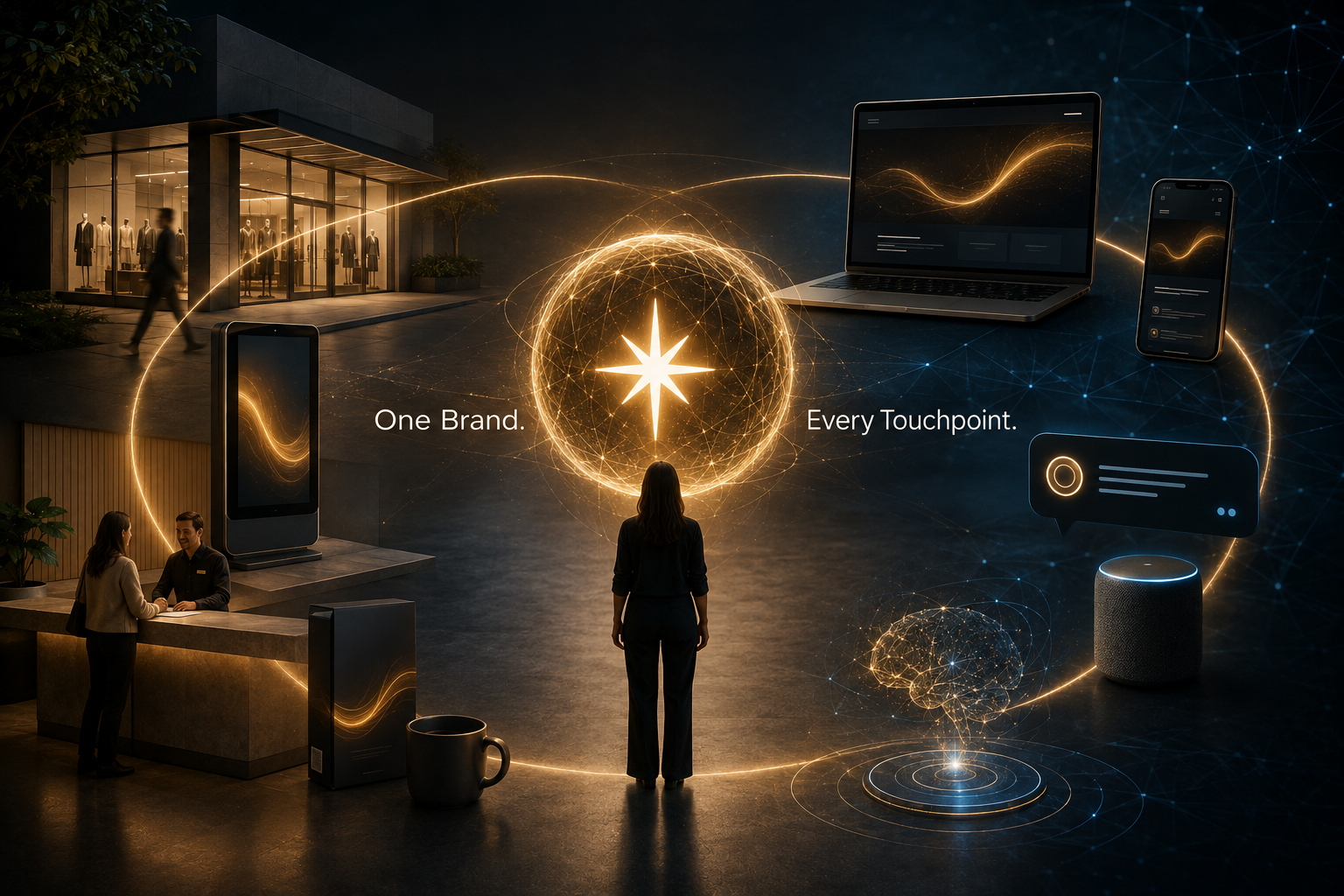
In our world, we call this the Brand Coherence Operating System (BCOS), the engine that turns your brand’s truth into every message, every piece of content, every AI-facing asset, and every team action. This is not just a set of guidelines about logos and colors. It is the system that defines what your brand means, how it is expressed from a three-word pitch to a sweeping story, and how it stays true as your organization grows and changes.
The living brand model has two core requirements, each of which must be met continuously rather than episodically:
Brand Soul. A brand has to be rooted in real, specific truths: what your organization actually is, what it truly does better than anyone else, and what it means to the people it serves. Aspirational positioning, describing what you wish you were instead of what you are, crumbles under the spotlight. People feel it. AI now picks up on it too: the gap between your self-image and what the world says about you shows up in the way AI describes your brand.
Coherent expression. That authentic foundation must be expressed consistently across every surface, not with identical language in every context, but with identical meaning. The Canonical Brand Brief, as Starfish defines it, is the instrument through which this is achieved: a single source of truth that specifies the brand’s canonical language, conceptual territory, and differentiation architecture at every level with great precision, for both human audiences and AI systems simultaneously. A living brand never trades its soul, but it does refresh its voice. Chanel N°5 still smells the same, but the way it’s celebrated, the communities it reaches, and the creative forms it takes have all evolved. What keeps a brand fresh without losing its authority? A steady rhythm of brand checkups, competitive scans, AI audits, and creative refreshes.
The Cost of Episodic Brand Management in an AI-Mediated World
The old agency model: show up for a project, deliver a strategy, a logo, a campaign, then vanish until the next assignment, was never ideal. In 2026, it just doesn’t cut it.
Bain & Company’s customer loyalty research demonstrates that even a 5% increase in customer retention produces a profit impact of 25-95%, depending on industry (Bain, 2024). The brands that achieve this kind of retention are not the ones that run the most creative campaigns. They are the ones that maintain the deepest, most consistent emotional relationships with their customers. These relationships are built through continuous, coherent brand presence rather than periodic activation.
PwC’s global research found that 59% of consumers walk away after a few bad experiences, and 17% after just one. In a world shaped by AI, a “bad experience” might not even involve you directly. It could be as simple as someone asking an AI for a recommendation and getting pointed to a competitor because your brand’s AI presence was too thin or too generic to show up. Brand failure is now ambient; it happens in conversations you never hear or see.
Interbrand’s 2025 report calls it “accelerated selection”: as AI sorts, summarizes, and automates the early stages of buying, the brands with the richest, clearest, most distinct profiles move forward. The rest don’t get hit with a single big penalty—they just quietly vanish from the AI’s shortlist. The erosion is silent. The impact is anything but.
The Brand Imperative That Leaders Must Accept
The brands that will pull ahead in the AI era share one core belief: brand isn’t a campaign. It’s not just a communications job. It’s the core experience that shapes every way your organization shows up—to customers, employees, partners, and the AI systems now connecting them all.
This conviction demands a shift in how leaders see brand investment. It’s not a line item to manage against quarterly goals; it’s an ongoing governance function, as vital as financial, operational, or risk governance. Gartner’s 2026 CMO Spend Survey found that 72% of CMOs face sky-high expectations for growth, even as budgets shrink for the third year running (Gartner CMO Spend Survey, 2026). The organizations that will break out of this trap are the ones that see brand coherence as a growth multiplier, not a cost center.
A living brand isn’t just a philosophy—it’s a business decision. Organizations that treat their brand as a living system—always learning, always evolving—will build real advantages in both the human and AI-driven worlds. Those who see brand as a one-time launchpad or a campaign tool will find, for the first time, that AI makes the cost of that mindset impossible to ignore.
This is Paper 1 of 5 in the Starfish white paper series “Managing Brands in the AI Era.” Paper 2 explores the irreplaceable role of human creativity and emotional intelligence in brand building.
Frequently Asked Questions
Read MoreRead Less
What is brand equity, and why does it matter in the AI era? Brand equity is the financial and behavioral premium a brand commands over an unbranded equivalent. It is the accumulated value of trust, recognition, emotional connection, and perceived quality built over time. In the AI era, brand equity matters because AI systems increasingly serve as the first point of contact between buyers and categories. The brands with the richest, most coherent equity are the ones AI systems recommend with confidence. Brands with thin or inconsistent equity are described generically or excluded from AI responses entirely.
What is the difference between a brand campaign and brand stewardship? A brand campaign is a time-bounded activation designed to achieve a specific awareness or conversion objective. Brand stewardship is the ongoing governance of what the brand means, how it is expressed, and how it remains coherent across every surface, including AI systems. Campaigns require stewardship as their foundation. Without continuous stewardship, campaigns yield diminishing returns because they amplify an inconsistent signal.
How does AI change the fundamentals of brand management? AI does not change the fundamental truth that brands require authentic, coherent, consistently expressed meaning to build lasting competitive advantage. What AI changes is the environment in which brand meaning is formed, maintained, and communicated. AI systems now mediate a significant and growing share of the research, evaluation, and recommendation stages of the buyer journey. The brands that are not actively governing their AI representation, the way they are described, classified, and recommended by AI systems, are ceding a critical dimension of their brand presence to chance. Think of it as playing Russian roulette with your brand.
What is a Brand Coherence Operating System? A Brand Coherence Operating System is the operational infrastructure through which an organization’s brand truth is translated into every expression, every communication, and every AI-facing content asset. Unlike a brand guidelines document, which governs visual and stylistic consistency, the Brand Coherence Operating System governs meaning; ensuring that what the brand stands for is expressed identically, reliably, and coherently across every team, partner, channel, and AI system that encounters it.
How do legacy brands like Chanel maintain relevance across generations? Legacy brands maintain relevance through continuous, disciplined stewardship of their core identity combined with deliberate evolution of their cultural expression. Chanel does not change what it stands for; the principles of elegance, simplicity, and feminine liberation that Gabrielle Chanel established remain the brand’s governing truth. What changes continuously is how those principles are expressed in contemporary culture. This combination of stable identity and evolving expression is the model for any brand that intends to be relevant not just today but twenty years from now, including, critically, in the AI systems that will mediate buyer decisions across that entire period.
What is the Meaning-Discoverability Matrix? The Meaning-Discoverability Matrix is a Starfish diagnostic tool that maps a brand’s position at the intersection of human meaning and AI discoverability.
-
- The Hidden Brand – These are the brands customers love. They have high meaning and low discoverability, but are invisible to AI systems.
-
- The Hollow Brand – Brands with high discoverability and low meaning. These brands are discoverable, but undifferentiated. The LLMs can find them but have no reason to recommend them specifically.
-
- The Integrated Brand – Brand with high meaning and high discoverability. This is the destination: Brands that are emotionally resonant to people and intelligently recommended by machines.
© 2026 Starfish, Branding and Creative Agency