PART 1 OF 4 · AI & BRAND STRATEGY · MAY 2026
Awareness in the Age of AI: An Algorithm Now Writes Your First Impression.
The brands winning awareness in 2026 are not the ones with the biggest media budgets. They are the ones the AI trusts. Here is what that means, and what it demands of brand and marketing leaders right now.
By David Kessler — Founder & CEO, Starfish · May 2026
PREVIOUSLY IN THIS SERIES
- AI replaced the funnel with an hourglass: a wide top (awareness), a narrow neck (AI-mediated consideration), and a wide bottom (conversion and loyalty). Post-purchase signals loop back to the top.
- 80% of consumers rely on AI-generated results for 40%+ of searches. 60% of searches now end without a click to any brand website (Bain, 2025).
- Brand equity, not media spend, determines what passes through the neck. AI systems measure brand quality, not campaign volume.
INTRODUCTION
The First Impression You Never Made
Brand awareness was always driven by engineering the first impression. The launch campaign that defined a category. The media plan was precisely calibrated so that the right person encountered your brand at the right moment, in the right context, with the right message. That art is still relevant. However, it is now operating alongside a force it was never designed to account for: an AI system that’s already formed an opinion about your brand before your campaign has a chance to deliver its first impression.
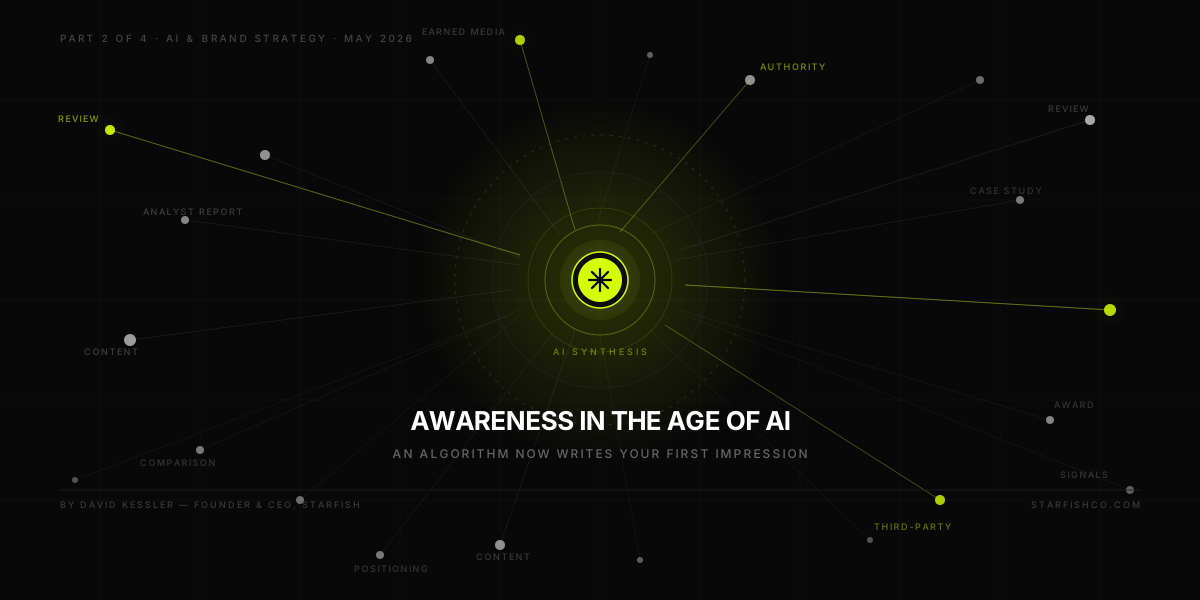
Picture a buyer opening ChatGPT or Perplexity and asking, “What is the best project management software for a 50-person creative team?” They are not waiting for your ad to show up. Instead, they get an instant answer that’s stitched together from every review, every analyst report, every comparison, every scrap of content the AI has ever seen about your brand and your competitors. That synthesis happens before the question is even asked. The AI’s opinion is set before your campaign launches, and the shortlist is built before your sales team even says hello.
This is not some distant risk on the horizon. It is the reality shaping buyer journeys right now, in both B2C and B2B. The real question is not if AI has changed brand awareness; it is whether your brand is showing up in the conversation, or being left out entirely.
THE DATA
Discovery Is Accelerating
By late 2025, Forrester found B2B buyers were embracing AI-powered search three times faster than consumers. Nine out of 10 organizations now use generative AI at some point in their buying process. AI-driven B2B traffic is exploding, growing over 40% every month. The pace is impossible to ignore and hard even to wrap your head around.
Data from Teradata and HigherVisibility show that the number of users who search in the US is rising from 14% in February 2025 to 29% in August 2025, a six-month doubling. The B2C discovery landscape is shifting at the same velocity as B2B, just through different tools. Kaare Wesnaes, Head of Innovation at Ogilvy North America, put it plainly: “AI Overviews and Google Zero pushed us into a world where the search result is now the answer itself. If a brand is not mentioned or cited in that instant, it effectively does not exist.”
This shift is rewriting the rules for brand awareness. Organic search traffic has dropped 15–25% in many categories as zero-click behavior takes over. Your campaigns might reach buyers, but those same buyers are turning to AI systems that could be telling a completely different story about your brand. Awareness is no longer a single moment; it is a mosaic pieced together from everything the AI has ever seen.
- 3x – rate B2B buyers adopt AI search vs. consumers (Forrester, 2025)
- 40%+ – monthly growth of AI-generated B2B traffic (Forrester, 2025)
- 29% – US daily AI search users doubled in 6 months (HigherVisibility/eMarketer 2025)
THREE NEW DISCIPLINES
GEO, AEO, and AI Visibility Work is Branding and Not Technical.
The marketing industry has rushed to coin new terms for the AI awareness era: Generative Engine Optimization, Answer Engine Optimization, and AI Visibility. These labels are helpful, but here is the trap: treating them like technical tweaks in the old SEO machine. They are not. At their core, these are brand disciplines. Every requirement for showing up in AI-driven discovery comes down to one thing: the strength of your brand.
Generative Engine Optimization (AEO)
GEO is about shaping your content, brand data, and authority signals so that large language models put your brand front and center when buyers ask questions. Bain found shopping queries on ChatGPT doubled in just six months. The brands that show up in those answers? They have made their content citation-worthy, evidence-backed, and tied to credible third-party sources.
GEO does not begin with a content audit. It starts with a brand clarity gut check: Do you have a point of view that stands out? Real expertise you can prove? A content trail that sends a clear signal, or just a pile of marketing noise?
Answer Engine Optimization (AEO)
AEO is about crafting content that answers the exact questions buyers ask AI tools, in the format those tools love to cite. Most brand content misses the mark because it was built for humans skimming web pages, not for machines parsing structured data. AI wants short, sharp, authoritative statements as well as questions paired with direct answers, claims backed by data, and sources named up front.
FAQ content, structured data markup, and concise expert statements are the raw material of AEO. Brands that have built a content library focused on demonstrating expertise in answering buyer questions will outperform those that have built a library focused on promoting themselves.
AI Visibility
Accenture’s Consumer Pulse Survey 2025 found that half of active Gen AI users have already made a purchase based on an AI recommendation. AI Visibility is the ongoing practice of ensuring your brand appears accurately and is associated with the right attributes in AI-generated summaries. It supports brand reputation management that’s conducted at the speed and scale of machine learning.
Unlike traditional reputation management, the signals AI systems use to describe your brand are not controlled by your communications team. They are the aggregate consequence of every brand decision, every customer interaction, and every piece of third-party content accumulated over the years.
“Google is the place you go when you already know what you want. Chat is the place you go when you do not. Moreover, if your brand is not in that conversation, the buyer forms their consideration set without you. — Mark Himmelsbach, CEO, RYA”
WHAT AI ACTUALLY MEASURES
Brand Quality, Not Campaign Volume
AI does not pick brands at random. It’s looking for quality signals, and every one of them is a measure of brand strength. Consistency across your content tells AI you are stable and reliable. Specific expertise proves you know your stuff, not just that you want to. Third-party validation spreads your authority through the network. And a clear, distinctive voice? That is what cuts through the noise of generic language.
Brands that struggle with AI visibility almost always have a brand problem, not a content problem. Vague positioning, inconsistent messaging, expertise that’s claimed rather than demonstrated; these are the failure modes that AI makes consequential. The solution is not a content sprint. It is a brand investment.
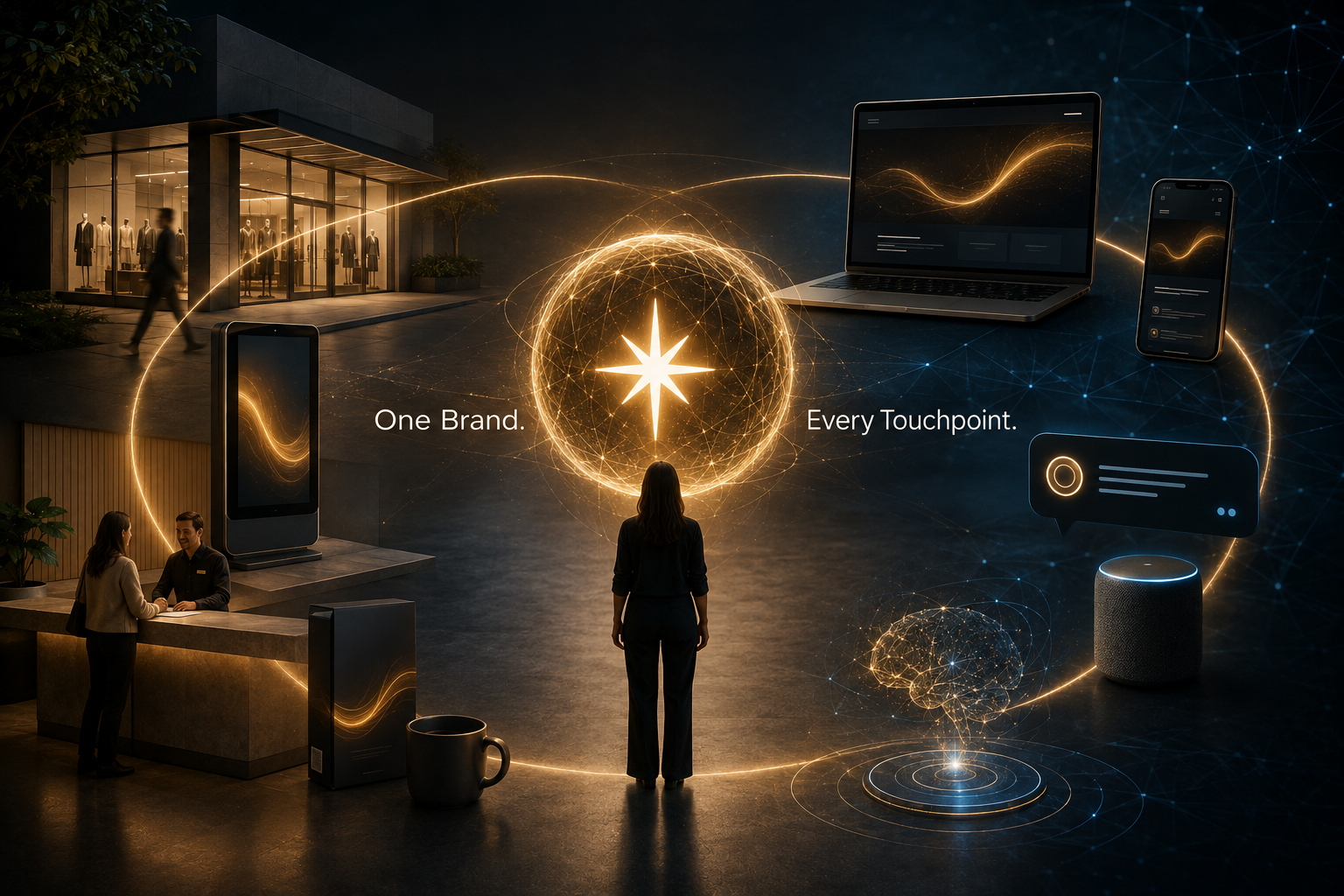
As we explore in From Logo to Operating System, if your brand is invisible to AI, chances are it is a brand problem, not a content one. Vague positioning, mixed messages, and expertise that’s all talk and no proof are the cracks AI exposes. The fix is not to churn out more content. It is to invest in your brand. As we explore in From Logo to Operating System, brand coherence is the engine that powers everything else: content, media, sales, customer service, customer-facing employees’ interactions with customers, etc. The ones you have deliberately built, or has the AI formed its own summary from fragmented signals you never coordinated?
Find the brand’s root cause before treating the content symptoms. If your AI audit turns up gaps, vagueness, or misrepresentation, the answer is not to crank out more content. It is to clarify your brand.
You need clarity on what you stand for, who you serve, and what sets you apart before any GEO or AEO work matters. Without that, more content just adds to the noise.
Rebuild your content strategy with AEO in mind. Audit what you have got by determining if you’re answering real questions, in the way AI wants. Find out exactly what your buyers are asking AI tools. Then create content that directly answers those questions, with specifics and sources. Make your expertise easy for machines to read, not just humans.
Invest in third-party authority signals on purpose. Analyst relationships, earned media, peer reviews, industry awards, case studies, etc., these are not just for show. They are the foundation on which AI decides which brands are credible enough to surface. As we discuss in Protecting Your Brand’s Soul in the Age of AI, brand soul, the conviction that makes you irreplaceable, is what earns that authority over time. There are no shortcuts.
SOURCES & FURTHER READING
Bain & Company: Goodbye Clicks, Hello AI — Zero-Click Search Redefines Marketing
Bain & Company: How Customers Are Using AI Search
Forrester: AI Search Is Reshaping B2B Marketing
Forrester: GenAI and Search Product Discovery
BCG: When Brands Meet AI Bots — CX in the Era of Agents
Accenture: Me, My Brand, and AI — Consumer Pulse Survey 2025
eMarketer / HigherVisibility: How Experts Say GEO and AI Will Change Discovery 2026
McKinsey: The State of AI in 2025