How to Make Your Brand Visible in AI Search Results

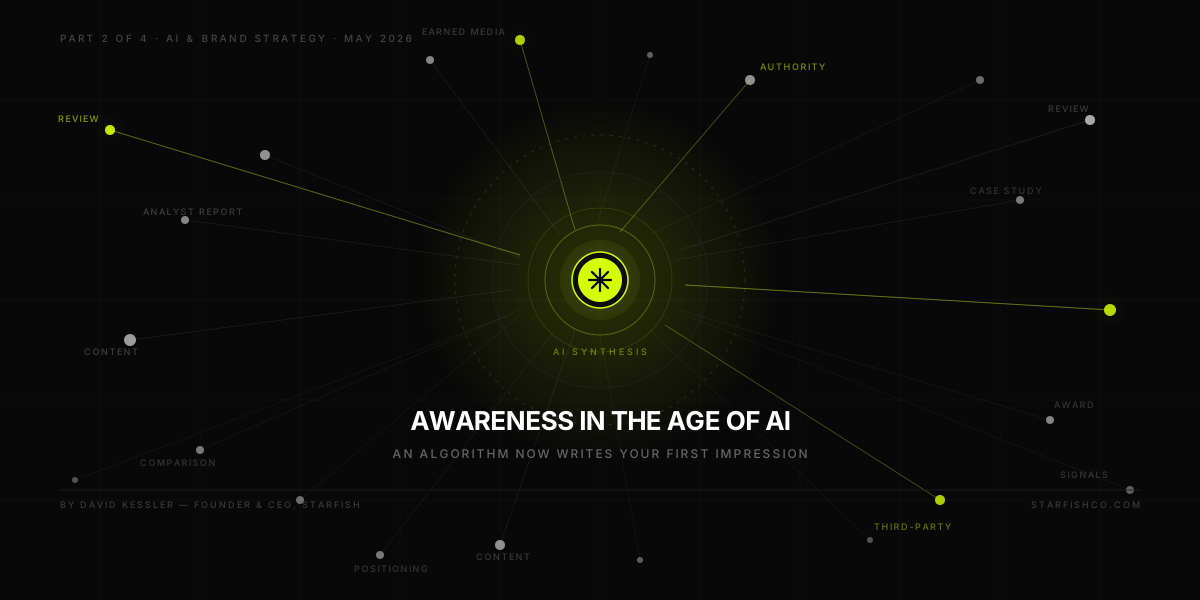
Brands have spent decades perfecting the art of speaking to humans. Every headline, every logo, every carefully chosen word was crafted to resonate with a person sitting on the other side of the screen. Now, something has shifted. For many queries, AI systems now play a major role in initial brand evaluation, and they think in entities, evidence, and structured relationships, not brand voice. They decide whether your brand gets cited, summarized, or ignored entirely. If you want to understand how to make your brand visible in AI search results, the starting point is recognizing that you are no longer optimizing for a human reader first.
This is not a routine SEO update. It is a genuinely new problem, one that differs from traditional SEO in three specific ways: AI systems use entity signals rather than keyword density, they extract concise structured answers rather than rank pages, and they weight cross-platform consistency over on-page optimization alone. At Starfish, our NYC-based independent branding agency, we built the Brand and Creative Intelligence™ framework in direct response to a pattern we kept seeing: brands with strong traditional search presence showing up absent or misrepresented in AI-generated answers. The challenge of AI brand visibility forced a new question onto every brand strategy conversation: what does it actually take to show up when an AI system synthesizes a response?
This article gives you a prioritized 60, 90 day plan to close that gap. By the end, you will know how to build the right entity signals, create answer-ready content formats, run digital PR to generate authoritative citations, and set up measurement that tracks real progress in AI-generated search results.
How to Make Your Brand Visible in AI Search Results: Entity and Content Foundations
AI-generated answers are not ranked pages. They are synthesized responses drawn from trusted, clearly structured sources, and the logic behind what gets selected is fundamentally different from keyword matching. Understanding this distinction is the first mental model shift required for any serious AI search optimization effort.
How AI overviews and generative search engines choose what to cite
Google’s AI Overviews use a process called query fan-out, running multiple related sub-searches before assembling a response. This pulls from a broader and more diverse source pool than a standard search results page. How to get cited in Google AI Overviews is a useful primer on the mechanics publishers and brands face when trying to earn those early citations. Ahrefs found in July 2025 that roughly 76% of AI Overview citations came from pages ranking in Google’s top 10 organically. Its updated study of 863,000 keywords and 4 million AI Overview URLs put that figure at 38%, though Ahrefs cautions the two datasets are not directly comparable because its detection method improved between them. A separate BrightEdge analysis using different methodology put the overlap nearer 17%. The direction is consistent even where the exact figure is not: traditional search prominence still matters, but it is no longer the whole picture. A page can rank at position three and never appear in an AI overview if it lacks structural clarity or coherent entity signals.
The shift from keywords to entities
AI systems recognize brands as named entities with attributes, relationships, and consistent signals across the web, not merely as domains with backlink profiles. This is the core of entity-based SEO: visibility in AI search requires brand identity coherence across every surface where your brand appears, not just on-page optimization. A brand that says one thing on its website, another on its LinkedIn profile, and something slightly different in third-party directories sends ambiguous entity signals. In the world of knowledge graph optimization, ambiguity functions as invisibility.
Build Your Brand’s Entity Foundation with Schema Markup
Schema markup for AI is not about earning gold stars in search results. It is about telling AI systems precisely who your brand is, without ambiguity, across every structured touchpoint. Think of it as writing your brand’s identity card in a language machines read fluently.
Organization schema: your brand’s digital identity card
The Organization schema, implemented in JSON-LD on your homepage, serves as the sitewide root entity. A minimal working example looks like this:
{
  "@context": "https://schema.org",
  "@type": "Organization",
  "@id": "https://www.yourbrand.com/#organization",
  "name": "Your Brand Legal Name",
  "url": "https://www.yourbrand.com",
  "logo": {
    "@type": "ImageObject",
    "url": "https://www.yourbrand.com/logo.png"
  },
  "sameAs": [
    "https://www.linkedin.com/company/yourbrand",
    "https://www.wikidata.org/wiki/QXXXXXXX",
    "https://www.crunchbase.com/organization/yourbrand"
  ]
}
Every property in that schema must match visible page content exactly. Mismatches between your structured data and what users actually see reduce trust signals and can decrease the likelihood of being cited by AI systems, Google’s own structured data guidance confirms that content parity between schema and visible page content is a core eligibility factor for rich results and structured features.
Connecting entity signals across the web
The sameAs network is only as strong as the consistency behind it. Your brand name, description, and category should read identically across Google Business Profile, LinkedIn, industry directories, and Wikipedia-adjacent sources. Beyond the Organization schema, FAQ Page and QAPage schema work as amplifiers, but only when the visible content on the page genuinely mirrors a question-and-answer structure. Schema does not substitute for content; it amplifies what is already there. A practical implementation sequence: Organization root first, then page-specific schema types, then FAQPage or QAPage only where the format genuinely qualifies, and finally validation through Google’s Rich Results Test.
Create Content That AI Systems Can Actually Use as an Answer
Answer engine optimization lives or dies at the content format level. The core insight is deceptively simple: AI systems favor content that is self-contained, direct, and structured so that a passage can be extracted and quoted without losing meaning. Narrative prose buried under long introductions works against AI snippet visibility.
The anatomy of answer-ready content
Generative search systems consistently extract content that follows one specific pattern: a question heading, a direct 40, 100 word answer, supporting bullets, and optional detail below. Practitioner guidance across multiple AI search analyses converges on this range as the sweet spot for extractable responses. The answer must lead; the supporting evidence follows. Building toward an answer over several paragraphs, which reads well as editorial content, is the structural opposite of what AI extraction systems need. Short declarative sentences work well here. So do brief bullets. The format signals extractability before the content even loads.
FAQ blocks and Q&A formats that get extracted
FAQ blocks are among the most AI-friendly content formats available and frequently appear as cited sources across AI search systems. A practical template: headline written as a full question, answer in two to three sentences under 100 words, followed by three to five concise bullets covering supporting detail. Each answer must stand alone without needing the surrounding page for context. This format also serves voice-adjacent AI tools and Speakable schema, though Speakable is a secondary signal compared to strong entity markup and clean answer copy. The priority is always the quality of the visible content itself.
Earn the Authoritative Citations That AI Systems Trust
Brand mentions and citations from trusted third-party sources are among the strongest signals AI systems use to confirm brand authority. No amount of schema markup replaces the weight of a named mention in a respected publication.
Digital PR and original research as citation engines
Editorial features, expert commentary, and named quotes in trusted publications place your brand inside the source pool AI systems pull from. This is digital PR framed not as a promotional exercise, but as an entity-building one. Original data and research assets are especially powerful citation engines because they give publishers a concrete, quotable reason to mention your brand by name, creating the cross-platform entity association that AI systems reward. Surveys, benchmarks, and proprietary studies generate citations that outlast any single news cycle and continue feeding AI systems long after publication.
A simple outreach approach that consistently produces placements: lead with the data angle, not the brand name. Subject line: “New [Industry] Data: [Surprising Finding], available for exclusive use.” Keep the pitch under 150 words. Offer the full dataset in exchange for attribution. Named brand mentions in the resulting coverage build the kind of authoritative citations AI search systems trust.
Third-party platforms and consistent brand mentions
The supporting layer of AI visibility comes from industry directories, B2B review platforms like G2 and Capterra, Reddit threads, Quora answers, and structured community platforms. These surfaces collectively build the repetition of your brand entity across non-affiliated sources, which strengthens AI recognition. Expert pitching through HARO-style platforms and media outreach produces named quotes in relevant articles, creating contextual brand mentions that AI systems can extract and associate with specific query topics. No single channel is sufficient. The goal is a web of consistent, authoritative brand mentions across multiple trusted surfaces, because cross-platform coherence is what transforms a brand from a domain into a recognized entity.
Measuring How to Make Your Brand Visible in AI Search Results
Measurement needs to be in place before implementation begins, not after. Setting a baseline before any optimization work makes it possible to isolate what is actually driving improvement, and which prompts are gaining traction versus stalling.
Tools built specifically for AI visibility tracking
Several platforms now monitor brand presence specifically within AI-generated answers. Scrunch covers eight AI platforms including ChatGPT, Gemini, Perplexity, and Google AI Overviews, with dedicated citation views and competitor share of voice data. Semrush’s AI Visibility Toolkit, Ahrefs Brand Radar, Riff Analytics, and Spotlight each offer cross-platform tracking with varying depths of citation analysis and historical trend data. Before choosing a tool, build a fixed set of target prompts that represent how your ideal customers would ask about your category. That prompt set becomes your measurement baseline. A starting prompt set might include: category-level queries (“best [your service category] for [your audience]”), problem-led queries (“how do I solve [pain point your brand addresses]”), and brand comparison queries (“[your brand] vs [competitor]”). Track these consistently, not just when results look promising.
The metrics that actually tell you if it’s working
The core metrics to track are brand presence per prompt set, citation rate, share of voice against competitors, average position in AI responses, sentiment of brand descriptions, and knowledge accuracy. These direct AI metrics should be paired with downstream signals: branded search lift and UTM-tracked referral traffic from AI touchpoints confirm that AI visibility is translating into real business interest, not just abstract citations. Tracking ChatGPT referrals specifically via UTM parameters has become a practical way to quantify AI-driven traffic, and industry tracking indicates that LLM-sourced referral traffic has grown meaningfully as a share of overall organic traffic through the first half of 2026. When you review performance, make sure to compare your AI visibility metrics against a documented baseline and adjust tactics accordingly, learn more about practical measurement approaches in our What Is AI Brand Visibility and Why It Matters in 2026 resource.
Your Prioritized 60, 90 Day AI Visibility Action Plan
AI visibility is not a one-time project. It is an ongoing identity discipline, and the 60, 90 day window below is a starting point for building the foundation, not a finish line.
Days 1, 30: Entity foundation and content audit
Spend weeks one and two auditing your existing schema for completeness and consistency. Implement or repair your Organization schema using the JSON-LD structure above, and build out the sameAs entity network across all authoritative profiles. In weeks three and four, audit your top 15, 20 pages for answer-ready structure. Reformat key service and FAQ pages using the question-heading plus direct-answer plus bullets pattern. Set your baseline AI visibility measurements using at least one dedicated tracking tool before any new content goes live. The baseline is everything: without it, you are optimizing blind.
Days 31, 90: Citations, PR, and measurement review
In month two, launch digital PR outreach. Identify two to three original data assets or research angles your brand can publish, and begin expert pitching for relevant industry topics. In month three, expand to industry directories and third-party platforms, then review AI visibility metrics against your baseline. Adjust schema, content, and PR targeting based on which prompts are showing traction and which are not moving. Making your brand visible in AI search results ultimately requires the same discipline as making a brand coherent to any audience: a clear identity, a consistent message, and credibility backed by evidence. These are not new ideas. They are the oldest ideas in brand strategy, now carrying measurable consequences in the AI layer of search.
The Brands AI Systems Cite Most Confidently
The brands that AI systems cite most confidently are not the ones that reverse-engineered an algorithm. They are the ones that built a coherent, well-documented, authoritatively validated identity and made it easy for any system, human or machine, to understand exactly what they stand for. That has always been the job of brand strategy.
Following this 60, 90 day plan is a realistic way to learn how to make your brand visible in AI search results and start measuring genuine progress. The signals that drive AI visibility, entity coherence, answer-ready content, authoritative citations, are the same signals that have always made strong brands recognizable. The difference now is that clarity has trackable, measurable consequences at every layer of search.
Agencies and brand teams that treat AI visibility as a brand coherence challenge rather than a technical SEO exercise will be the ones whose brands show up when it counts. At Starfish, that framing is exactly what Brand and Creative Intelligence™ was built to address: the belief that a brand clear enough for a human to trust is a brand clear enough for an AI to cite. The two are not as different as they might seem.
Frequently Asked Questions
Read MoreRead Less
How do you make a brand legible to AI?
Making a brand legible to AI is an entity problem, not a content-volume problem. AI systems recognize brands as named entities with attributes, relationships and consistent signals across the web, rather than as domains with backlink profiles. That requires brand identity coherence everywhere the brand appears. A brand that describes itself one way on its website, another on LinkedIn and differently again in directories sends ambiguous signals, and ambiguity functions as invisibility.
Why does brand consistency across the web affect AI visibility?
AI systems assemble their understanding of a brand from many sources at once. When the brand name, description and category read identically across your website, Google Business Profile, LinkedIn and industry directories, a model can build a confident picture. When they diverge, it cannot, and it will either misrepresent the brand or omit it entirely. Consistency is the signal and inconsistency is the noise.
What schema markup helps AI systems understand a brand?
Organization schema in JSON-LD on the homepage is the sitewide root entity, carrying the brand name, URL, logo and a sameAs list linking to authoritative profiles. Page-specific types follow, and FAQPage or QAPage only where the visible content genuinely takes a question-and-answer form. Every property in the schema must match visible page content exactly, because mismatches reduce trust signals.
What does answer-ready content look like?
Generative systems consistently extract one pattern: a question as the heading, a direct answer of roughly 40 to 100 words immediately below, then supporting bullets and optional detail. The answer has to lead. Building toward a conclusion over several paragraphs reads well editorially and is the structural opposite of what extraction systems need. Each answer should stand alone without the surrounding page for context.
In what order should you implement schema markup for AI visibility?
Organization schema as the root entity first, then page-specific schema types, then FAQPage or QAPage only where the format genuinely qualifies, and finally validation through Google’s Rich Results Test. Schema does not substitute for content, it amplifies what is already there. Adding question-and-answer markup to a page that is not structured as questions and answers will not help.