What a Brand Experience Agency Actually Does

Most organizations do not hire a brand experience agency because they want better campaigns. They do it when the brand has become a business problem.
That problem takes familiar forms. A company acquires three firms and now presents four different identities to the market. A category leader enters the U.S. and realizes recognition does not transfer across geographies. A leadership team senses that sales, marketing, product, and customer experience are all telling adjacent but incompatible stories. Or AI-mediated discovery starts shaping perception before a buyer ever speaks to the company, and no one has defined what those systems should consistently understand about the brand.
In each case, the issue is not simply communications. It is experience. A brand experience agency exists to make that experience intentional.
What a brand experience agency is responsible for
A brand is not the claim an organization makes. It is the cumulative impression created across every touchpoint, every message, and every interaction. That includes visual identity, verbal expression, digital environments, sales materials, onboarding, service interactions, internal alignment, and increasingly, the structured signals that train AI systems to interpret the company.
A brand experience agency works at that operating level. Its responsibility is to define what the brand means, determine how that meaning should be expressed, and ensure those expressions hold together across the places where customers, employees, investors, partners, and algorithms encounter the organization.
That is a broader and more consequential mandate than campaign development. It reaches into strategy, architecture, messaging, behavior, and governance. Done well, it reduces friction inside the business as much as confusion outside it.
Why organizations bring in a brand experience agency
The need usually appears when complexity outruns the current brand system. A mid-market company may have grown beyond what the marketing department can coordinate on its own. An enterprise brand may have accumulated layers of legacy language, overlapping portfolios, and inconsistent regional execution. A newly merged organization may know it needs one market-facing story but lack a disciplined path to get there.
These are not cosmetic issues. They affect growth, reputation, recruiting, pricing power, and speed to market. When a brand means different things in different contexts, the business pays for that ambiguity. Sales cycles lengthen. Internal teams duplicate effort. Customers struggle to understand what is distinct. Leadership loses confidence that brand investments are compounding.
A serious agency is brought in to restore coherence. Not by imposing style for its own sake, but by creating a system that can support decision-making across the enterprise.
The work goes deeper than expression
Executives often encounter the term through visible outputs – naming, identity, messaging, websites, campaigns, launch materials. Those matter. But they are downstream of the real work.
The first question is strategic: what is the source of truth for this brand? That requires understanding the company’s ambition, category dynamics, audience expectations, competitive context, internal culture, and the signals already present in the market. It also requires clarity about what should change and what should remain stable.
From there, a brand experience agency should establish the core logic of the brand. Positioning. narrative. architecture. value proposition. proof. voice. decision principles. Without that foundation, execution becomes improvisation.
Only then should expression take shape. Visual and verbal systems are not decorative layers. They are mechanisms for making strategy legible and memorable. If the strategy is vague, the expression will be inconsistent. If the expression is disconnected from how the business actually operates, it will not hold.
What strong agencies do differently
The difference is not taste. It is method.
Organizations facing rebrands, M&A integration, or market expansion do not need more opinions. They need a structured way to diagnose brand equity, identify fault lines, and build a coherent future state. That is why proprietary methodology matters, provided it is used to sharpen decisions rather than obscure them.
A disciplined process should reveal where perception is already working in the company’s favor, where it is fragmenting, and where the organization is making claims its experience does not support. It should also translate findings into practical systems that teams can apply, not just admire.
At Starfish, that discipline has been shaped over more than 30 years through methodologies including ALBERT.ai discovery, the Brand Equity Evaluation Model™, and the Conceptual Compass™. The point is not methodology as theater. The point is rigor. Complex brand decisions require a repeatable way to connect insight, strategy, and execution, especially now that AI systems are part of the brand environment rather than a separate technical concern.
Brand experience in an AI-mediated market
This is where many leadership teams are underestimating the shift.
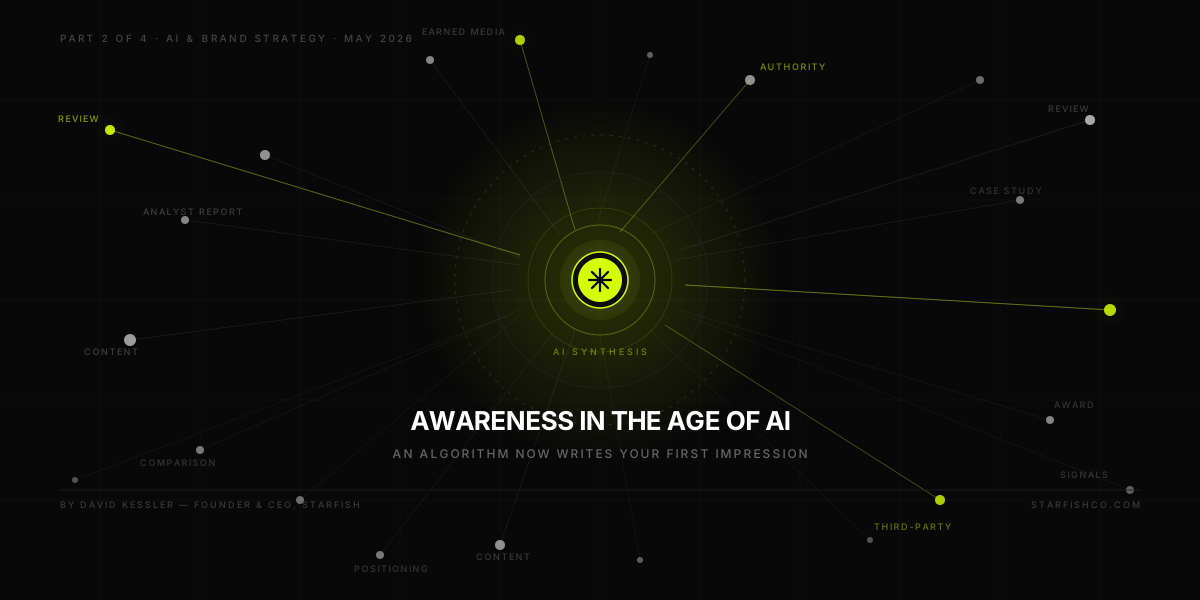
Brand experience no longer begins when a prospect lands on a homepage or enters a sales conversation. It often begins when an AI system assembles a view of the company from dispersed signals – website language, structured data, press coverage, thought leadership, product descriptions, social proof, executive visibility, and third-party references. Those systems do not merely retrieve information. They interpret it.
That changes the job of a brand experience agency. The agency must still shape human-facing experiences, but it must now also help organizations create coherent machine-readable signals. If the company’s positioning is inconsistent, if the portfolio is poorly organized, or if proof points are scattered and imprecise, AI systems will reproduce that confusion at scale.
This is not a future-state issue. It is already affecting discoverability, evaluation, and trust. Brand strategy now has to account for how meaning is formed across both human and machine intermediaries.
When the work is transformative – and when it is not
There is a tendency to treat brand engagement as inherently high impact. It is not.
The work is transformative when leadership is prepared to make decisions the brand can carry. If the executive team wants clarity but will not resolve strategic contradictions, the result will be polished ambiguity. If the business wants one market story but preserves every internal exception, coherence will remain out of reach.
This is why the strongest client relationships are collaborative and senior-led. The value does not come from outsourcing taste. It comes from creating alignment on the business truth the brand should express, then building a system that makes that truth visible and consistent.
There are also trade-offs. A tightly unified global brand can create efficiency and memorability, but may need flexibility for regional relevance. A post-acquisition consolidation can reduce confusion, but may require the retirement of equity built in legacy names. A sharper positioning can increase distinction, but it may also narrow who the company is speaking to. These are strategic choices, not creative preferences.
How to assess a brand experience agency
For senior leaders, the right question is not whether the work looks contemporary. It is whether the firm can help the organization make consequential decisions and implement them with discipline.
Look for depth in three areas. First, strategic diagnosis. Can the team identify what is actually broken, what is merely outdated, and what already holds equity? Second, system building. Can they translate strategy into architecture, messaging, identity, experience principles, and governance that work across a real organization? Third, executional continuity. Will the senior team you meet remain involved when the work moves from framing to rollout?
Proof matters here. So does pattern recognition. An agency that has worked across sectors, stakeholder environments, and moments of organizational change will usually bring stronger judgment to the table. Not because every problem is the same, but because they know where misalignment tends to hide.
The real outcome
The real outcome is not a launch. It is a brand that can carry the business forward.
That means customers understand what the company is, why it matters, and why it is distinct. Internal teams have a shared framework for making decisions. New products and acquired entities can be integrated without starting over. Leadership can scale communications without diluting meaning. And AI systems encounter a clearer, more consistent set of signals about the organization.
A memorable brand experience is not built by adding spectacle to the surface. It is built by aligning meaning, expression, and delivery so the market meets the same company every time.
That is the standard worth holding. If the brand is going to shape perception across every interaction, it should be managed with the same precision as any other enterprise asset.