PART 3 OF 4 · AI & BRAND STRATEGY · MAY 2026
Consideration & Conversion: Performance Media Built Its Empire Here, And AI Just Demolished It.

AI has wrung the life out of the funnel’s middle. What fills that vacuum isn’t just another channel; it’s the unmistakable signal of a brand that knows itself and can be found by AI when it matters most.
By David Kessler — Founder & CEO, Starfish · May 2026
PREVIOUSLY IN THIS SERIES
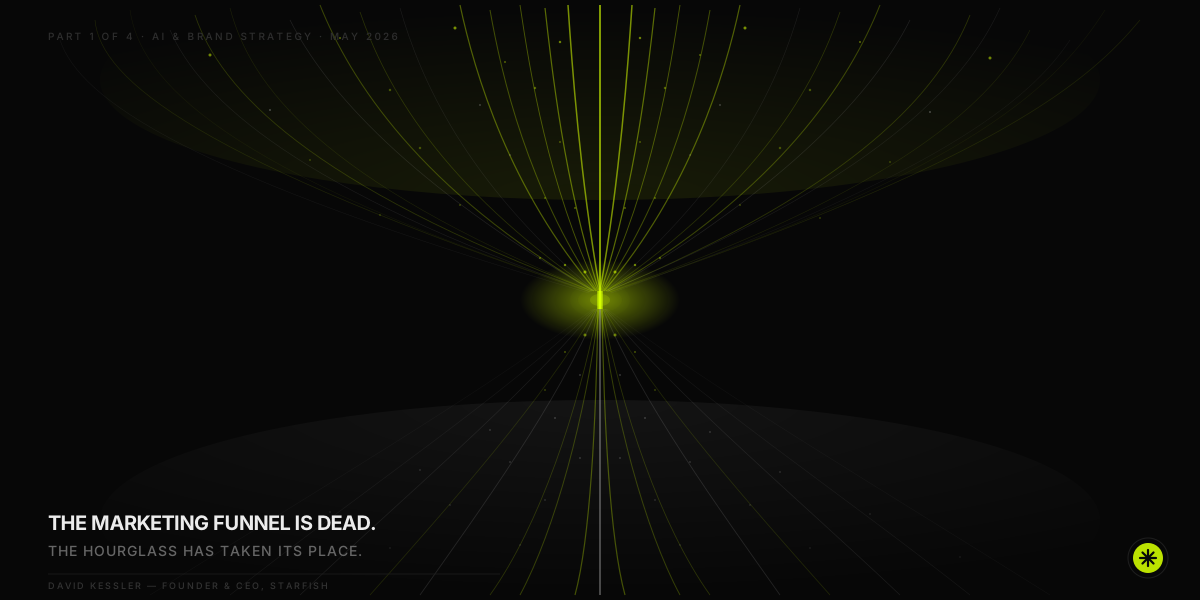
AI replaced the funnel with an hourglass; the neck is the AI-mediated consideration phase, the most consequential moment in the journey, and the one brands have the least control over. Awareness: 80% of consumers rely on AI results for 40%+ of searches. GEO, AEO, and AI Visibility reward brand authority, not campaign volume.
What enters the neck is determined entirely by brand substance. Undifferentiated brands are filtered out before a human ever sees them.
INTRODUCTION
The Middle That Performance Media Built and AI Destroyed
Let’s start in the middle, the old heart of digital marketing. This was the golden age of consideration. Paid search pounced on intent the moment it flickered. Programmatic display shadowed buyers across the web, whispering reminders that felt almost telepathic. Retargeting revived abandoned sessions. Lead scoring sifted through digital breadcrumbs to deliver the hottest prospects to sales. Nurture sequences landed with uncanny timing, all choreographed with surgical precision. Account-based marketing orchestrated entire buying committees. For years, it was a symphony of sophistication and results.
That whole machine ran on two big assumptions: first, that brands could actually shape the consideration phase; second, that buyers would bump into brand-crafted content as they explored, each touchpoint stacking up until a decision tipped.
AI has swept those assumptions off the table for a bigger share of buyer journeys. The B2C shopper who once wandered the funnel now just asks an AI. The B2B buyer who used to wade through white papers and nurture emails? Now, they do 70% of their homework before you even know they exist. AI tools synthesize and shortlist in a single breath.
The middle of the funnel has collapsed.
The space performance media built its empire, and it is now largely invisible to the brands that want to occupy it. Spending more on the systems designed for that middle is not a response to the structural shift. As we argued in Part 1, for all intents and purposes, it is denial with a media plan attached.
THE EVIDENCE
How Consideration Has Changed
- 70% of B2B purchase research is completed before the buyer engages any vendor – Gartner, 2025
- 90% of organizations now use GenAI in some aspect of purchasing – Forrester, 2025
- 25% higher conversion rates for AI-powered personalization leaders – Accenture, 2025
BCG’s report on brands in the AI era documented the mechanism directly. As buyers rely on AI tools to shortlist brands, the ones that do not appear accurately and favorably in those AI-generated summaries risk losing influence entirely. More specifically, they are not losing a battle for preference, but being absent from the consideration set before the buying process formally begins. The B2B buying committee that converges on a shared AI-generated shortlist before engaging any vendor has already made the most consequential filtering decision.
This is not a marginal shift affecting a subset of buyer journeys. Forrester’s research
on B2B AI adoption shows that the organizations whose buyers are most deeply embedded in AI-assisted research are typically the largest, most sophisticated purchasing organizations. These are exactly the accounts that represent the highest contract values and longest relationships. The segment most exposed to AI-mediated consideration is the segment most worth winning.
THE MECHANISM
How AI Filtration Works at the Neck of the Hourglass
Understanding why some brands pass through the neck of the hourglass, and others are filtered out, requires understanding what AI systems actually measure when evaluating which brands to surface. The signals are coherent and consistent, and they map directly onto brand quality.
AI weighs brand consistency because consistency across indexed content signals a stable, reliable identity; a brand that knows what it is and has not contradicted itself across channels and over time.
- It rewards specific expertise because brands that answer precise buyer questions in depth demonstrate genuine knowledge rather than the broad, undifferentiated claims that characterize generic marketing
- It surfaces brands with third-party validation because external citations like analyst reports, media coverage, review platforms, and case study references are how authority propagates through an information network
- It deprioritizes undifferentiated content because generic marketing language produces no signal that meaningfully distinguishes one brand from another
The brands being filtered out at the neck are, almost universally, brands with brand problems. Vague positioning. Inconsistent messaging. Claimed expertise that is not demonstrated in actual content. A brand voice that changes by channel. These are not new failure modes; they have always weakened brands. AI makes them consequential in a new and more immediate way, because the penalty for brand incoherence is no longer just lower preference. It is exclusion from the shortlist.
CONVERSION
The Decision Was Already Made. You’re Just Being Asked to Confirm It.
The conversion moment has fundamentally changed character. Buyers no longer arrive at a brand’s website or in a first sales conversation in an exploratory state. They arrive with a strong prior, formed by AI-assisted research that may have already placed your
brand in a ranked consideration set, surfaced specific differentiation claims, and identified potential objections. The conversion moment is not persuasion. It is confirmation. The brand experience the buyer encounters must confirm what the AI told them, or the deal is at risk before it has started.
McKinsey’s research on personalization shows brands that deliver genuine AI-powered personalization see 15–20% gains in customer satisfaction and 5–8% in revenue growth.
Accenture’s consumer experience research found that brands using AI-powered personalization see up to 25% higher conversion rates and a 35% rise in satisfaction scores.
However, there is a critical precondition embedded in those numbers: the brand must be coherent enough that personalizing its delivery actually creates value. A personalization engine built on a vague or fragmented brand proposition is not a conversion advantage. It is a faster way to confirm that nothing is compelling at the core.
“If a buyer arrives at your website already convinced by their AI-assisted research, your conversion rate goes up. If your brand is unclear or incoherent in the places AI indexes, no A/B test closes that gap.”
B2B SPECIFICALLY
What the Collapse Means for Enterprise Sales and Marketing
In enterprise B2B, the consequences of AI-mediated consideration are especially acute. Being excluded from a procurement process in a complex B2B sale means losing a deal that took months of pipeline development, involved multiple stakeholders across a buying committee, and represented revenue that the business had counted on. Moreover, the exclusion occurred before your SDR team made contact, on the AI-generated shortlist that the buying committee had already informally converged on.
BCG’s research on closing the AI impact gap found that leading B2B organizations are reallocating AI investment toward reshaping the end-to-end buyer experience, with a specific focus on how their brands appear in AI-mediated research environments.
Winning or losing the consideration phase in high-stakes B2B isn’t about your sales playbook or nurture tactics anymore. It comes down to one thing: how strong and coherent your brand looks in the places AI is scanning and synthesizing.
Proceed with Strategic Clarity and Decisive Intent
The Consideration and Conversion Agenda for 2026
Accept the structural reality without hedging it. The consideration middle is gone as a brand-controlled space for a significant and growing share of buyer segments. Continuing to invest in the infrastructure of that middle (i.e., programmatic retargeting, nurture sequences, mid-funnel content designed for a buyer moving through a brand-designed journey, etc.) without addressing the upstream brand quality that determines AI visibility is an allocation decision that will produce diminishing returns.
Build the brand authority that wins AI shortlisting. Brand clarity, knowing specifically what you stand for, who you serve, what you do differently, and why it matters, is the raw material that AI systems need to surface a brand accurately and favorably.
No content sprint compensates for a vague brand position. The investment is in the brand work itself: the positioning, the proof points, the demonstration of genuine expertise.
Redesign the conversion experience for a pre-conditioned buyer. Buyers who arrive at a brand’s website or first sales conversation having already been shaped by AI-mediated research need speed and confirmation, not education and persuasion.
The brand they encounter in the AI summary must match the one they encounter in the direct brand experience. Incoherence between those two impressions is the conversion risk that no A/B test addresses. As Accenture’s personalization research makes clear, personalization that is built on a strong brand foundation produces compounding returns. Personalization built on a weak one produces customized versions of something forgettable.
SOURCES & FURTHER READING
1. BCG: When Brands Meet AI Bots: CX in the Era of Agents — bcg.com
2. BCG: From Potential to Profit: Closing the AI Impact Gap — bcg.com
3. Forrester: AI Search Is Reshaping B2B Marketing — digitalcommerce360.com
4. Gartner: B2B Buyer Enablement Research
5. McKinsey: The Value of Getting Personalization Right — mckinsey.com
6. Accenture: Reinventing Consumer Experiences — accenture.com
7. Accenture: Me, My Brand, and AI: Consumer Pulse Survey 2025 — accenture.com
8. Bain & Company: Understanding the Five Types of AI Consumers — bain.com